







Leadership
We are obsessed with the customer





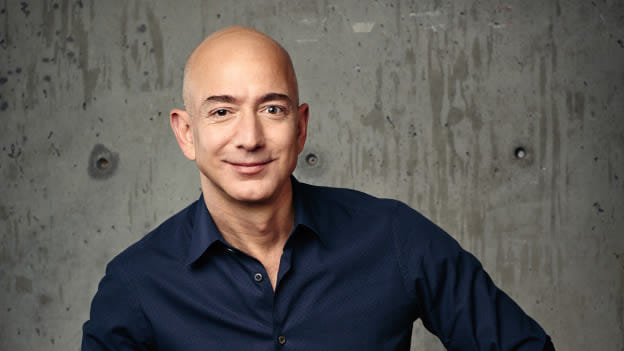
Jeff Bezos, Founder and CEO at Amazon.com, talks about how Amazon India came into being, his leadership style and more
Q. Most people think Amazon came to India a year ago. Tell us about the beginning of Amazon in India.
A. We started a software development office in India 10 years ago at Bangalore. Over the years, we have expanded our offices to Chennai and Hyderabad. We have had great success with those operations because we can find such talented people here in India. Thanks to our local team, the business is going shockingly well. We have been open for a year and have great expectations. We have a unique approach in India as the number of small and medium businesses is huge. Our local team has innovated a bunch of things, which makes it easy for small and medium scale enterprises to connect to the digital economy and this trend is now growing very fast.
Q. How did your company Blue Origin come about?
A. I have always been fascinated by space though I don’t know where the passion comes from. I think I got imprinted when I saw Neil Armstrong walk on the moon and then I got addicted to science fiction and read every book I could find. I fell in love with Star Trek and then the rest is history (laughs). At this point, I would like to congratulate India on the Mars Mission as well. It is a great achievement and the frugality of the budget is even more astounding.
Q. Tell us about your leadership style.
A. My leadership style has had to change over the last 20 years or so. When I started, I was just a one-member team. Very soon, we were four people and then 10 people. In the beginning, I was an SME myself. I drove all the packages myself to the post office every night; squeaking in at 10:29pm when it is supposed to close at 10:30 pm and begging them to still take the packages (laughs). As a leader for a dozen people, I was keeping track and doing everything. Now the company has really grown and my role has changed to that of a custodian and a steward of the values and principles of the company and to ensure that we live by them.
The big value at Amazon is customer obsession. A number of companies say that they are customer centric but I am not sure that they are; a number of them are actually competition focused. I think that both are rather good models but I think I like ours better. The second principle that I lead is the passion for invention. It is something that is so deeply ingrained in the culture of the company that we practice it all the time. We like to do things that nobody has ever done before. It also means that a lot of things that we do are not successful but the willingness to make bold bets and take risks is what makes Amazon, Amazon. Failures are part and parcel of this process. One of the important things at Amazon is that executives running those failures move on to bigger and greater things. They are not sidelined or asked to leave. If you want really good people to take on bold initiatives, they can’t be worried about all this. We also do a number of incremental inventions, which are more sure shot things.
The third thing is the willingness to be patient and think long term. I think that is really important. If you are going to be an inventive and pioneering company, then you have to be willing to think long term. If you look at your profits for just this quarter, then that will put you at odds with your customer. If you do the right thing for your customer today, it will be beneficial to the stakeholders down the line. That is the case here in India. The team here in India has been unbelievably inventive and is showing great promise with their programs. That is the reason that we are really looking forward to so much investment in India.
Q. What drove you to acquire Washington Post?
A. The internet has been extremely disruptive to newspapers all over the world. It has taken a lot of things away on which newspapers earlier use to make money on, like classifieds and advertising. It is very easy to give news online at a very low cost without subscription to any print newspaper. Washington Post is no exception to that. Their business has been difficult for the last several years. I had been friends with the owner of Washington Post for the last 15 years. This sale would not have happened if we had not known each other. He called me one day and said that he was looking to sell the Post and wanted a good home for it. I considered the Post as an important institution, but I told him I had no experience in newspapers or their business. He convinced me that the Post needed someone who knew about internet and technology. They already had a very strong execution team who knew the newspaper business. With the Washington Post, it has been a great learning experience and a ton of fun. However, I am not seeking any more media companies in the near future.
Q. You started with books as the main business at Amazon. If you had to start now, what would you start with?
A. I don’t know. Books worked really well; may be it will be books again. The internet is so much bigger and more developed now. So to answer that question today, we will have to start from scratch and do a new market’s study. I will tell you why we started with books. There are more items in the books category than any other category. Back in 1994, there were three million different books in print in different languages across the world. The vision was to build a store online where people could find any book ever printed. This was not possible for any physical store in a shop space. When we launched on day one, we had over a million titles. We wanted to create something so unique that could not exist in a physical world. Over the next couple of years, we added music and videos. And then we sent out an email to 1,000 customers as a survey asking what they would like us to be selling in addition to what we were selling then. The answers were like a window into their minds. It was like they wanted us to sell everything that they had on their mind at that instant. So, we realized at that point that the opportunity was much bigger than we had ever anticipated and we started adding categories.
Q. How are you enabling and connecting SMEs to the digital economy here in India?
A. There are a number of reporters I have spoken to here and they all ask about the difficulty we face in doing business in India. The point is that all places have their own unique challenges. The big thing is what the customer wants, which is a good selection of products and fast & reliable delivery. However, the details are always different. One can look at those as problems or as opportunities for invention. There are two basic ways in which SMEs can access the Amazon platform. One is through ‘Fulfillment by Amazon’ centers, where the SMEs take a portion of their inventory and put it in our fulfillment center. The advantage there is that Amazon takes on the responsibility of the packaging, shipping and all other logistic responsibilities. So when you see ‘Fulfillment by Amazon’, we have helped SMEs overcome the problem of transportation and infrastructure by taking on that task. We have another feature called ‘Easy Ship’ where SMEs can keep the inventory at their own stores and directly fulfill to their customers. We help make the connection with the end customer and bring about fulfillment. We pick up and ship the products so that the businesses do not have to keep a dual inventory of their products. We still take on the fulfillment and that is the invention of our local India team. So far this business model is only operable in India. This invention has been so successful here in India that we are looking forward to exporting that to the world as well. The vision is to give these SMEs not just the reach across India, but also globally.
Topics
Author
Loading...