







Strategic HR
Dear HR, Putting yourself before others can save your company






For most people, being experimental, taking risks, re-imagining work, focusing on innovation etc. happen everywhere but in HR. So what can organizations do to build HR capabilities and maximize functions impact on business?
A group of individuals was once given a tour of a mental hospital. One of the visitors in the group made some very insensitive remarks about the patients. After the tour was completed, the visitors were introduced and met with various members of the mental hospital staff in the cafeteria. The unkind visitor chatted with one of the security staff, Rita, a kind and wise ex-policewoman.
“Are they all sick and crazy loonies in here then?” the visitor asked.
“Only the ones who fail the test,” replied Rita.
“What is the test?” asked the man.
Rita replied, “Well, we show them a bathtub filled with water, a large bucket, a large cup and a spoon. We then ask them what the quickest way to empty the water in the bath would be.”
The man said, “Oh, I see… that is pretty simple – the ‘normal one’ knows it’s the bucket, right?”
“No actually,” replied Rita. “The normal ones say pull out the plug. Should I see if there is a bed free for you?”
Looking to change the world, we seldom take the time to change ourselves. As someone once commented, we are our best lawyers and worst critics. So, what can organizations do to build their HR capabilities and maximize function’s impact on business?
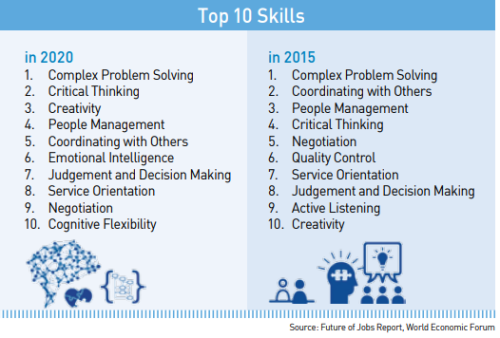
Build awareness
First things first – Knowing what skills and capabilities will be valuable in the future is a good place to start. Emotional Intelligence and Cognitive Flexibility, defined as the ability to generate or use different sets of rules for combining or grouping things in different ways, made its entry to the top 10 skills in 2020 according to Future of Jobs report by World Economic Forum. There is enough and more commentary on the pace of change, and as Jack Welch once commented, “If the rate of change on the outside exceeds the rate of change on the inside, the end is near.” While many of you may not be surprised to see the mention of Critical Thinking or Creativity or Service Orientation on the list, my personal favorite is Judgment and Decision-making, for this is where the rubber meets the road. All the knowledge and awareness of know-how is inadequate if one fails to act.
Take action
In the words of Jeff Bezos, most decisions should probably be made with somewhere around 70 percent of the information you wish you had. If you wait for 90 percent, in most cases, you’re probably being slow. Well said, unless you work in a Risk or Compliance department, most of the functions can do with this advice. Knowing “what to focus on” is the first step, but then knowing is not the same as doing. While I am a great fan of models (70-20-10 or 80-20 or the new one you read about yesterday), I am a bigger fan of acting and improvising if they don’t play out as expected.
Here are 2 principles that I practice and recommend at every opportunity:
Think in terms of work in progress vs. finished goods: For most people, being experimental, taking risks, re-imagining work, focusing on innovation etc. happen everywhere but in HR. And we have ourselves to blame for it. I believe HR at most times plays “to not lose” and the focus is to minimize the fallout from the event. Controls, expectations, rules are manifestations of this mindset. Contrast this to VUCA world where business and competition have a new meaning —the average lifespan of a firm on S&P 500 shrank from 61 years in 1958 to 18 years in 2011; or the probability that the market share leader is also the profitability leader declined from 34 percent in 1950 to just 7 percent in 2007. Instead of waiting to get it right and having all the ducks lined up, take the lead and play to win.
Design best systems not best practice: Best practices are useful reference points and are necessary but not sufficient conditions for advancement. There are several HR awards that celebrate best practice with not enough attention to the underlying system. Take the case of doing away with performance rankings. Ask your peers at companies who have done away with it and they can share slide after slide on why that is the right thing to do. One can easily fall into the trap of building a business case for implementation without recognizing the role organization culture will play in enabling that. For example, if your culture promotes top-down sharing of information and knowledge, this change is likely to be resisted including those by supervisors. In reality, best practices don’t work, best systems do.
So, what actions can one take? Here is a sampling
- To strengthen Critical Thinking: Do a post-mortem to visualize the project/initiative having failed and listing all criteria that may have led to it. Do this before starting the project, not after (thus pre-mortem).
- To strengthen Judgment and Decision-Making: Ray Dalio, the founder and CEO of Bridgewater Associates, Times 100 most influential person in the world, talks in his book Principles that rather than thinking, “I’m right”, he started to ask himself, “How do I know I’m right?” He talks about the practice of writing down the criteria to make the decision so that it can be compared to the outcome. Spend as much time hair splitting a good decision as we do for a bad one.
- To strengthen Cognitive flexibility: Work on a project with individuals outside of your industry and be surprised at discovering patterns that seemed improbable at first.
Best practices are useful reference points and are necessary, but not sufficient conditions for advancement
Measure and repeat
Peter Drucker is credited with the quote “If you can't measure it, you can't improve it.” Think about the “what” and “how” of measurement before acting, for the lag between action and impact will make it difficult, if not impossible, to attribute credit. This is perhaps the biggest challenge (and hence an opportunity) with development programs that we are reminded of, particularly when budgets are being set. Begin by measuring the application of the knowledge/behavior rather than its acquisition, and create conditions for that knowledge to be applied before it becomes a habit and is often repeated. Likewise, pay enough attention to the “how” of measuring the application of knowledge — feedback by the manager, development of a new product/service or resolution of an old problem. Even the best-laid plans may not yield desired results and there is no shame in going back to starting afresh. Accelerating capability development is the name of the game and before we proffer this to others, it is time we tasted a bit of our own medicine.
A giant ship’s engine had failed, and the owners tried one expert after another only in vain. Just when they were thinking of giving up, an old man who heard about it, walked in with a bag of tools. He offered to inspect and fix it for a fee to be paid only if it was fixed. The owners felt they had nothing to lose and readily agreed for him to take a look. He went to work and began inspecting the engine top to bottom. Two of the ship’s owners were there, watching this man, hoping he would know what to do. After looking things over, the old man reached into his bag and pulled out a small hammer. He gently tapped something. Instantly, the engine lurched into life. He carefully put his hammer away. The engine was fixed!
A week later, the owners received a bill from the old man for INR 1 million.
“What?!” the owners exclaimed. “He hardly did anything!”
So, they wrote the old man a note saying, “Please send us an itemized bill.”
The man sent a bill that read:
Tapping with a hammer…. ….… ….… INR 100
Knowing where to tap……. ….… .…. INR 999,900
Effort is important but knowing where to try makes all the difference!
Topics
Author

Loading...