







Talent Management
Bridging the gap: Why the NGO sector needs its 'missing middle'





Authored by: Heena Chougle, CHRO, EdelGive Foundation
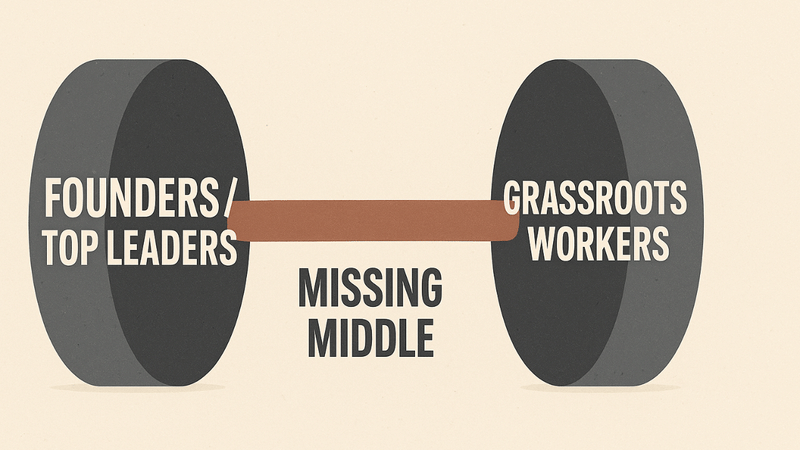
In the corporate world, no company dreams of operating with only entry-level executives and C-suite leaders. Robust middle management is the bridge between vision and execution that is making strategies operational, coaching young talent, and driving long-term continuity. Yet, in India's social sector, this middle layer is conspicuously absent. Most NGOs are built like dumbbells: strong at the top with passionate founders and at the grassroots with committed field teams, but worryingly hollow in between.
This absence – often called the “missing middle”, has become one of the most critical yet overlooked challenges in India’s development ecosystem.
Why This Gap Exists
For many NGOs, the problem begins with inception. Organisations often start with a handful of founders managing everything themselves. As they grow, they add program officers and field staff to deliver on expanding mandates. However, critical support systems are project managers, strategic leads, and operations heads who often don't grow alongside. This results in organisational structures where strategic direction and ground execution are disconnected, lacking the crucial middle layer that ensures cohesion.
This is not merely an oversight; it is structural. Donors and funding institutions have historically prioritised programmatic impact over organisational development. Staff salaries, leadership training, and talent development are frequently categorised as “overheads” rather than mission-critical investments. Resource constraints further amplify this challenge. With finite funding, NGOs are often forced to make trade-offs, choosing immediate service delivery at the cost of long-term organisational capacity.
A Bridgespan study found that while 97% of social-sector leaders believe leadership development is important, only 18% of NGOs invest in it. As a result, promising employees often find themselves with limited growth opportunities, leading to attrition toward international NGOs, philanthropic institutions, or corporate roles that offer more structured career paths.
The effect is a top-heavy leadership structure with a junior field team underneath, but very few people can provide continuity, institutional memory, or operational leadership.
Globally, the same problem persists. Also, according to the Bridgespan study, it was found that only 30% of nonprofit CEO and director roles were filled through internal promotions, compared to nearly double that incorporates. Without intentional investment in the leadership pipeline, mid-level professionals hit a glass ceiling, leading to burnout or exits from the sector altogether.
The result is a sector that cultivates leaders inconsistently and responds to leadership gaps only during crises, often defaulting to external hires who may not be grounded in the NGO's mission, context, or culture.
Why the Middle Matters
The leadership gap isn't just a staffing issue, but it has direct consequences on an NGO's ability to deliver impact. Without a capable middle tier, field operations often lack consistent guidance and support, leading to fragmented execution. Strategic plans may look solid on paper but crumble without managers translating them into practice. Teams become overloaded, responsibilities fall through the cracks, and collaboration across functions weakens. The absence of this connective tissue often results in duplication of effort and programmes not meeting intended goals.
The gap also becomes a ceiling on growth. Middle managers are the engines that keep complex social impact programmes running and turn strategy into grounded action, allocate resources effectively, and ensure frontline teams are supported. Many NGOs cite the lack of leadership capacity as one of the major barriers to scaling. Without a strong middle, senior leaders are quickly overwhelmed by operational complexity, while grassroots teams struggle without guidance.
Institutional memory is another hidden casualty. Mid-level leaders often carry deep knowledge of relationships, processes, and context from the ground. When they leave without successors, NGOs lose not just personnel but wisdom — creating cycles of “reset syndrome” where hard-earned lessons vanish, slowing adaptability and eroding donor confidence.
Importantly, strengthening the middle also requires robust HR systems. Talent planning, structured leadership development programmes, and clear career pathways ensure that promising staff see a future in the organisation. These systems are common in corporates but underutilised in NGOs, as they can foster retention, reduce burnout, and make the social sector a more sustainable career choice. They provide the infrastructure for continuity, resilience, and smarter scaling of impact.
Bridging the Gap: Organisational Insights and Examples
Solving the missing middle in NGOs demands more than intent, as it requires structural clarity and investment in people. Experts highlight three levers: building a defined mid-leadership tier, setting distinct performance metrics, and clarifying decision-making between central and local teams.
Some NGOs have already taken steps such as identifying a mid-level leadership gap and creating a cross-regional role to unify programme direction, improving alignment across countries. Others are introducing competency frameworks, leadership rotations, mentoring and adapting corporate tools to strengthen nonprofit leadership pipelines.
In India, there are several such examples, which can be a strong example. As the NGOs grew, they proactively built a second line of leadership and promoted them from within. Structured development plans and internal frameworks enabled smoother decentralisation and stronger mission alignment.
And the lesson learnt is when NGOs support the missing middle, they aren’t only fixing a structural gap, as they are enabling smarter growth, resilient leadership, and stronger programme outcomes.
Conclusion: From Overhead to Investment
It’s time to change the narrative. Middle management is not overhead. It is impact. It is an investment. NGOs, donors, and ecosystem actors alike must recognise that without investing in this critical leadership tier, ambitious visions will remain unrealised. But with it, the social sector can build organisations that are not only mission-driven but also resilient, scalable, and equipped to sustain impact over the long term.
Topics
Loading...