







AI & Emerging Tech
How should the unconventional future ready workplace be built?






This article is an excerpt from the author's book Demystifying HR available on Kindle. It is an attempt to explain HR concepts based on authors experience as an HR practitioner across industries like manufacturing, IT and pharma. The approaches, suggested by the author, are industry agnostic and can be readily implemented or customized depending on the context.
Visioning the Future (Year 2040)
Adira, aged 35, is a new-age entrepreneur, creative artist who follows an unconventional working pattern where she is free to choose where and how she wants to work. She works from the comfort of her home environment and when needed, reaches out to the local community for sharing workplace either provided by the customer or co-working hubs paid by the hour. Being a fitness freak, she mixes leisure activities into her unconventional working schedule. She leverages her networks of experts to obtain interesting and yet flexible consulting projects.
Let us understand how Adira blends technology and healthy living together to remain productive and relevant. The AI-based system suggests task list for 2 weeks highlighting priorities and maximizing her performance-based out of her bio-health indicators. The enhanced telepresence helps her connect with multiple stakeholders from the comfort of her home. Adira’s working environment is spread across geographies from home to eco-campus sharing office space on need basis. The collaboration will range from face to face (real-time or virtual) or in collaboration hubs as commuting is no longer necessary. In majority cases, she connects virtually for discussions with clients or other stakeholders. Project member selection is influenced by skillsets and subject matter expertise. The flexi-work contract has no limit to how long or how little Adira can work.
Insights into Future Work Skills
Most of what has been mentioned above might seem like a science fiction movie. However, it is based on research articles and expert talks on Future of Work. Our article attempts to provide insights into Future Work Skills and provides suggestions for organizations to develop them.
“Future Work Skills” written by Anna Davies, Devin Fidler, and Marina Gorbis and published by the Institute for the Future, University of Phoenix Research Institute in 2011, describes the top 10 capabilities required to succeed in future. For understanding which of these capabilities are likely to impact the most from an Indian scenario, we conducted a survey with select leadership team across Indian organizations, who were asked to rate each parameter on its importance.
(Sample Size N = 37)
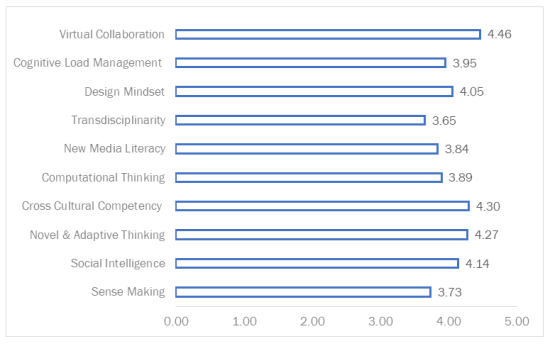
The top 4 capabilities identified for future workforce in our survey:
Our article attempts to deep-dive into each of these 4 capabilities and suggest development interventions for the same.
Devising a Development Journey
Workforce development will require a paradigm shift in its approach and methodology. As HR professional, there is need to understand the context which will affect devising any learning & development program.
Given the context on how future capability building will operate, let’s look at how each capability can be developed –
Skill #1 - Developing virtual collaboration
Skill #2 - Developing cross-cultural competency
Skill #3 - Developing novel & adaptive thinking
Skill #4 - Developing social intelligence
However, we realize that mere investment into developing capabilities will not be an entire solution itself. Organizations will have to transform themselves to adapt to new age workforce.
How organizations will adapt
The organization structures will undergo radical changes by adopting agile team working dispersed across wide geographies and incorporating digital transformation in their business model. Flexi-contracts supporting gig-economy workforce will come in play dismantling the “fixed office hours” model. More entrepreneurial and unconventional working patterns will emerge for supporting employee mobility and work-life integration.
Though concerns about privacy and intrusion will rise, tracking user activities and experience without using intrusive technologies will be developed. The workplace environment will get redesigned to enhance collaboration and enhance user experience.
Conclusion
Though technology will be all-pervasive, the paradox lies in the fact that the value of human relationships and need for authenticity and human values will be regarded in highest worth. The community will be our ecosystem displaying more collaborative and participative mindset in dealing with them. Social ties will be used as driving engine with our reliance on our community and network for survival.
References
Topics


Loading...