







AI & Emerging Tech
HR Cyborgs





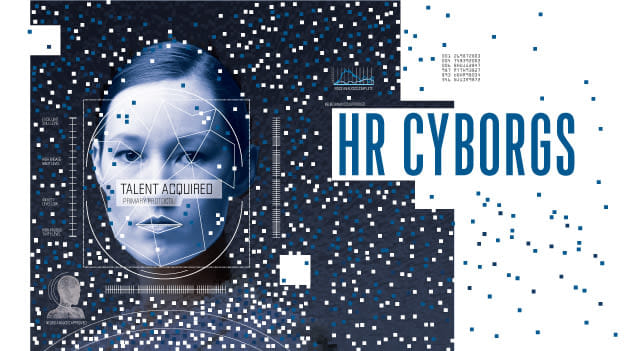
While technology helps talent managers do their job effectively, they should at all costs avoid the humanoid trap
Very recently, Virgin Airways successfully completed a two-week field trial of Google Glass. If you are a first-class passenger in Virgin, you’d be warmly received by a “glass-ed” hostess who’d literally know all about you, even pre-empt and address those considerations, which make your travel experience truly memorable. Business analysts tout this as the next big thing in customer relationship management. Futuristic technologies are rapidly making inroads into the way business processes are managed and executed, promising to improve them over time. These promises are grounded on validations, which unmistakably and unequivocally serve as proofs-of-concept. These are validations to the idea that data and efficiency are the only true measures of success in the future.
Last September, we carried a story on the tectonic shifts in the discipline of human resource management by Big Data and argued about the possibilities that it was likely to bring. The Google Glass example seeds the thought that there is no end in sight on the overlay of analytical strata that one can introduce to improve transactions. At present, an HR manager already has several tools at her/his disposal to make deep analytical conclusions about individuals and the workforce. Data on an employee’s web behaviour can provide invaluable insights about several talent metrics such as engagement, productivity and integrity. Imagine pivoting this information with organizational events or stages of employment to arrive at conclusions about the employee’s time of quitting. Adding another layer, if this information could be mapped to the internal and external talent database of the organization to find the best replacement. An HR manager of the future could be talking about metrics on the lines of “potential replacements for probable departures”.
One cannot help but draw parallels of the future talent manager with the “T 800” cyborg played by Arnold Schwarzenegger in the Terminator movies. At several points, the movies provide glimpses of the cyborg’s view of ambient human presence—a piercing peek into a cold alternate reality. The image of a “glass-ed” HR manager looking at an employee as a set of data points suddenly appears like a distinct possibility. Many sceptics predict that the disciple of HR management will face an imminent but slow death in the future. The foundations of HR are not rooted as much in the execution of processes as they are in the fundamentals of good relationships. For good or for the worse, HR technologies are looking to shake this very foundation of HR. While this may mean efficient administration, robust business preparedness and precision execution, it does raise questions on what it means for the deeper and often unpredictable fundamentals of human behaviour—a layer that any analytical model cannot possibly hope to penetrate—of unpredictability, intuition, and impulse of emotion. Until human emotion continues to hold the embargo rights in business decisions, organizations and employees can take comfort in the fact that HR and talent management systems will continue to have the enviable capability to self-correct. When man and machine cohabitate, the possibilities of the future not only sound aspirational— they sound exciting. It is important to know and prepare for these exciting opportunities that the future of HR technology presents.
A peek into the future
The future of HR technology indicates that with the changing conditions of the enterprise, a talent manager will have several tools at his disposal. Wearable devices and real-time analysis will no longer be possibilities of sci-fi literature but will become part of the mainstream enterprise. What will be interesting to consider is the possibility that all these developments will be driven by the demand from the consumer or the employee and not by the mandate of senior leaders. Rudy Karsan, GM, Kenexa and Smarter Workforce at IBM, believes that these technologies will automatically trickle from the consumer market into the enterprise. Karsan says, “The trajectory of the smartphone use in the enterprise is perhaps a great indicator of how end-users drive the introduction of technologies within the enterprise.”
It is important to note that organizational management should not only be aware of key developments in the technology world, but be fully aware of its impact on the enterprise. Some of the key indicators of future workforce conditions include changing nature of employment contracts, diverse range of expectations and nature of work execution. Such developments will mean more complex methods of talent management and more sophisticated means of meeting requirements.
A technology-led talent management function will be capable of migrating most of the talent manager’s administrative tasks towards simple interfaces or body gestures. This will leave the talent manager to perform complex talent management tasks such as engagement and performance. Some of the experts we interviewed during this investigation are already talking about word cloud engagement analysis, social media mood analysis and predictive sentiment analysis. While these technologies are still in early stages, they indicate that there is a clear and present need for talent management functions to start thinking about these predictive analytics platforms. Through these engagement and performance technologies, a talent manager will always be able to keep her/his ears on the ground.
A key area where companies have already started experimenting is in the field of wearable technology. Talent managers can soon expect apps and devices specifically aimed at providing real-time view of workforce measures such as individual vs. overall engagement, attendance, output and productivity etc. Information about an individual’s or a group’s talent indicators will be accessible through the wave of a hand or the blink of an eye. Experiments with implant technologies are already underway in the consumer market and it is no longer impossible to imagine talent managers with a chip in their wrist or an optical analytical device in an eye. In 2002, an Academy Award winning movie called the ‘Minority Report’ rocked the imagination of viewers through the concept of ‘precognition’ or the awareness about a happening before its occurrence. Fast forward to 2014, that incomprehensible concept suddenly appears frighteningly close. As one of the law enforcers in the movie puts it, “Science has stolen most of our miracles.”
Opportunities of the present
Progressive HR organizations are utilising technologies to gain deeper and richer insights into the talent management conditions in their organizations and making better decisions based on them. Technology’s biggest influence is the way it can mine large volumes of data to facilitate decisions that traditionally rely on judgement and intuition. As a consequence, the decisions that a talent manager needs to make based on the hunch-and-gut feeling are fast getting replaced with data-enabled insights. Several futuristic technologies are already underway or in “beta” phases and are providing a peek into the power that they hold for the future of talent management.
Engagement is an area where new technologies and innovations have made it possible to predict and correlate engagement metrics more accurately. Progressive talent leaders are tracking sentiments of the talent market, both internal and external, to accurately assess perceptions through platforms such as Glassdoor, Facebook and internal social networks. These platforms not only provide a talent leader insights about the general sentiment about organizational events, but also an indication of measures that can increase engagement to desired levels. Point-in-time surveys are fast becoming obsolete as more and more organizations are looking to capture engagement in real-time. Through social voice analysis and sentiment analysis tools, companies are able to find answers to their deepest engagement problems in a much more accurate and timely fashion. Pratik Kumar, CEO, Wipro Infrastructure Engineering and Member of the Board - Wipro Enterprise, says, “In our organization, we experimented with word cloud analysis to find out if we can use the results to improve our talent outcomes. The analysis provided us with indicative ideas about several aspects of talent management such as improvement of the employer brand, increasing engagement and improving the overall happiness of talent inside the organization. Such measures can potentially reduce the exit of critical talent.”
In the field of learning, pervasive and mobile have become buzzwords. An increasing number of technology companies are trying to build learning platforms which are not only immersive, but also interesting. Accordingly, gamified learning is replacing traditional learning methodologies rapidly. Manojit Sen, Group Head of Learning- Trading & Supply at Shell says, “A key area of gamification technology that enterprises are flirting with is gamified on-boarding. Gamified technologies are aiding onboarding processes by involving a new-joinee’s supervisors, his buddy, his mentor and his HR to collectively help him onboard through an interactive incentive-linked platform.”
Facial recognition and biometric technologies are already showing promise to become a regular part of a talent manager’s daily life. Karsan says, “It will not be too long before facial recognition software that can match pictures of individuals and conduct database operations. At the workplace, one obvious use of this technology will be tracking of absenteeism and attendance.”
In the face of all this available technology, data and metrics which sound inaccurate, unreliable, and even unconceivable in the current day will become a part of a talent manager’s bread and butter in the future. Many technologies that sound futuristic are actually getting developed and implemented in the market, and organizations that are leading these innovations will be better prepared for future talent market conditions. Many organizations are slow in adopting to these ideas because they are stuck in a time-warp, or are unwilling to invest in them owing lack of demonstrable RoI. Adoption is another key challenge that a traditional market like India faces. Historical evidence suggests that the pace of adoption has not kept pace with the pace of innovation in the Indian market. The organizational leadership needs to sit up and notice these trends, and provide the right amount of support for building a tech-enabled talent management function.
Maintaining the human face of HR
While it is possible for the future talent manager to have information and decisions at the tip of the finger, there is a very real risk. With a wearable device or a retinal implant, some argue that a talent manager would end up like a humanoid cyborg who is constantly assessing and analysing people based on system-generated data. The talent manager could be performing an in-depth assessment of an individual’s engagement, intent, and productivity- all while having a casual in-person conversation. Every interaction, every event, and every activity can be recorded as an input for assessing an individual’s productivity, engagement, or potential. Big data will likely become one of the biggest instruments of talent management decisions in the coming times. In such a scenario, an HR or talent manager will only need to look at people and talent as a set of congruent data sets. Taking all these developments into consideration, it is not impossible to perceive a future where a talent manager views employees only as resources and hires and fires only on the basis of data projections.
While the picture of a talent manager in the form of a cyborg may appear extreme at this point, the risk that a talent manager may become over-reliant on technology for every action is also very real. There is a limit to how much technology can predict the outcome of human effort and emotion. Sentiment analysis or emotional modelling can never accurately predict the exact human reaction to an event which is based on much more complex neurological triggers such as past experience, mood, and beliefs. As long as this inaccuracy of technology exists, what will continue to differentiate a great talent manager from an average one will be the ability to make sound decisions? Prithvi Shergill, CHRO at the technology services company HCL says, “One cannot disregard the risk that many future talent managers may shy away from taking responsibility for actions with the golden words, ‘the system told me.’ The leader of a truly future-ready talent management team should start thinking from now on about how to put together a foundational process that leaves no room for such incompetence.”
The talent management function will undergo several transitions such as migrations into automated processes, management of vast data volumes, and greater expectations of business outcomes. While all of this may indicate that technology will reduce human interactions, many believe that this proliferation will actually have the reverse outcome. Debjani Ghosh, Vice President, Sales and Marketing Group, Managing Director, South Asia, Intel says, “The chances that technology will increase human interactions is a more likely scenario. Social media will place the responsibility of human interaction into the hands of the employee. An indicator of a mature talent management organization will, thus, be the degree of seriousness it attributes to social voice.” An exceptional talent manager, will therefore, be one who is able to drive talent outcomes by influencing people. With the power of technology at his disposal, the future talent manager will need to work out ways to improve people interactions and motivate the workforce. Rajesh Padmanabhan, President and CHRO at the natural resources company Vedanta Group, says, “A talent manager’s biggest goal in the future will be to influence sentiment among the workforce. S/he should not look at technology as a way to gain greater control over people, but as a means to influence positive energy.”
As technology pushes the function toward greater efficiencies, there will be greater need for a talent manager to develop an analytical bent of mind. Aptitude in analytics, and the ability to arrive at better business decisions through insights will become a common expectation from a talent manager. Though this may mean that the future talent manager may need to become more analytically inclined, it will be all the more important for him to avoid the “humanoid trap”.
Topics
Author

Loading...