India and Artificial Intelligence are no longer just buzzwords but rather two peas in the same pod. In today’s talent economy, they are divergent lines drawn together by scale, speed, and ambition. From the boardrooms of global behemoths to the hallways of scrappy startups, the world’s largest talent marketplace and the most disruptive technology of our time are rewriting the rules of recruitment in real time.
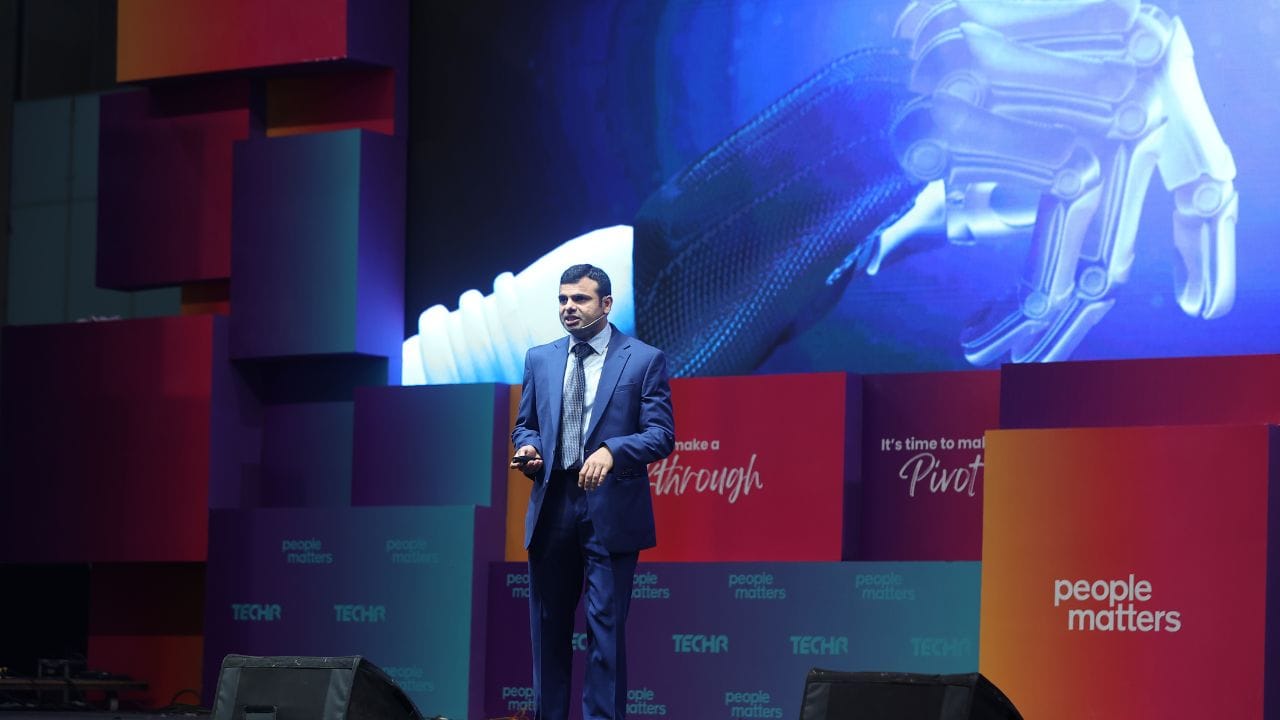
At People Matters TechHR 2025, where Jatin Thukral, EVP and AI Head at Naukri.com, gave a powerful keynote titled ‘AI in Recruitment: Revolutionary Times,’ this convergence was on full display. The session explored how artificial intelligence is changing recruiting practices and redefining how organisations approach speed, quality, and cost in hiring, not just in India but globally.
Jatin began by grounding the audience in perspective. “AI is not new,” he said. “It has been around for nearly 70 years. But what we are experiencing now is the third wave of AI, and it’s the biggest so far.”
No country for old playbooks
India’s hiring landscape shows why this revolution is inevitable. The country is home to 5.5 crore white-collar professionals, with 1–2 crore actively job-hunting every month. On Naukri.com alone, the platform processes 70 lakh job postings annually, over 100 crore applications, and 500 crore recruiter–job seeker interactions every year.
“Long before large language models became popular, Naukri had already built what we call a ‘talent language model’, our own AI-powered taxonomy,” Thukral explained. “India’s talent landscape is vast, with over 50 lakh skills. Even company names appear in countless variations. A single organisation like TCS shows up with more than 1,100 spellings in our system. AI captures and cleans this complexity in a way no human team ever could. That’s how AI has been creating magic all along.”
The combination of vast datasets, exponential computing power, and breakthroughs in model design has turned recruitment into a data-rich science. Automated shortlisting tools, recruiter co-pilots, and intelligent recommendation engines are integral components of India's talent economy and are no longer futuristic experiments.
Gone with the old
Jatin drew a clear line in the sand: “Before 2022, AI in recruitment was evolutionary. After 2022, it became revolutionary.” In its earlier phase, AI offered incremental upgrades:
Personalised matching funnelled curated roles to candidates and sharper shortlists to recruiters, powering 30–50 lakh applications a day.
AI co-pilots automatically expanded recruiter pipelines, improving conversion rates.
Skill and employer taxonomies cleaned up messy data, mapping over 50 lakh skills and thousands of company variations into structured lists.
However, after 2022, the emphasis switched from honing tools to developing true intelligence. One of the earliest AI factories in India was launched by Naukri, which has deep-tech infrastructure that can train domain-specific engines rather than a single general algorithm. “Instead of relying on a single model for all roles, we’ve built separate engines for hiring data scientists, cybersecurity experts, and medical coders, because each requires a different approach,” Thukral explained.
Hire hard, hire smart
Artificial Intelligence is being ingrained in the DNA of recruitment and no longer serves as just an accessory. The question is not whether AI should be used, but rather how to design it to complement human judgment rather than take its place.
For enterprises, the debate over buy versus build has sharpened. “Building an AI system sounds exciting, but it’s slow, costly, and requires huge amounts of live data to stay relevant,” Thukral said. “Without scale, your AI won’t learn. Buying from platforms like Naukri gives you the benefit of millions of recruiter–candidate interactions every single day.”
However, transformation is driven by people, not just tools. Recruiters must evolve from résumé processors to intelligence architects who guide AI systems rather than simply consume their output. “The recruiter of tomorrow won’t just use AI,” Thukral said. “They will think in AI, reading its signals, questioning its results, and refining its recommendations.”
The good, the bad, and the algorithm
With sharper engines comes a new responsibility. Fairness and transparency need to be coded into recruitment models from the ground up. “AI should be an equaliser, not an amplifier of old biases,” Thukral explained. “We build explainable AI so recruiters know why a candidate appears on a shortlist.”
And the next frontier is already visible: recruitment moving from matching to predicting. AI will soon anticipate skill gaps, flag emerging roles, and surface talent pipelines even before job requisitions are raised. “We’re entering a phase where AI won’t just help you find the right candidate,” Thukral said. “It will tell you when you’ll need them, and why.”
The final sequence
As AI seeps into every vein of business, recruitment has become both the litmus test and the launchpad. Today, it is evident that hiring should be accelerated, made more intelligent and equitable, and never sacrificed for the human element that fosters team success.
Don’t think of AI as a crystal ball,” Thukral concluded. “Think of it as an engine that learns every day. The winners will be those who adopt fast, scale responsibly, and remember that people, not algorithms, make the final call.”
And this was certainly no crystal-ball session. The keynote address at People Matters TechHR 2025 didn’t stop to gaze at the horizon. It crystallised the present and rewrote the rules of AI-powered talent acquisition. AI is no longer at the margins of recruitment; it is becoming its very foundation. The pulse of hiring is changing. Will your organisation weave AI into its DNA, or be left behind in the talent gene pool?