








Hiring has often been treated like an emergency response function. Hiring managers react when the crisis hits, scramble to find candidates, burn out recruiters, and hope the right talent sticks.
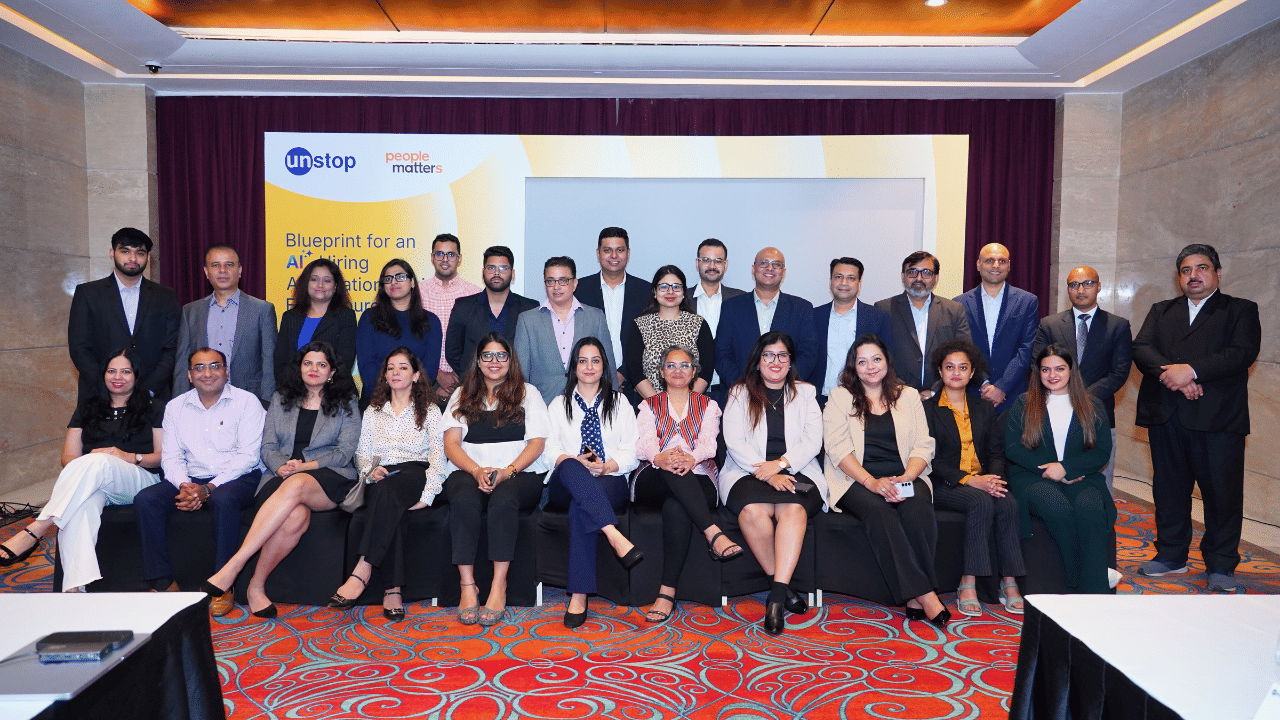
In a roundtable hosted by People Matters in collaboration with Unstop at the Leela Ambience, Gurugram, Ankit Aggarwal, CEO, Unstop, led a high-stakes conversation among CHROs, talent leaders, and business heads. The industry leaders agreed on one thing: Hiring can no longer be a firefighter’s job. It has to be an intelligent, forecast-led function. Hiring cannot remain reactive; it needs to become predictive and data-driven.
Organisations need connected systems that enhance decision-making and create meaningful experiences for both candidates and employers. An AI talent engine represents this vision. It integrates intelligence into every aspect of talent management to develop ecosystems that can adapt and scale with purpose.
Thus, the AI talent engine shifts talent acquisition from “filling roles” to “building engines”.
The hiring paradox: abundant applicants, insufficient clarity
Organisations don’t lack talent. They lack visibility into talent. Hiring managers struggle to match skills to expectations. This impacts not only speed but also the candidate experience. “The recruiter should not be a process administrator. They should be a talent problem-solver,” reflected a business head working closely with hiring managers in sourcing the right talent for their organisation.
Talent sourcing isn’t the issue; it's prioritisation, knowing which talent to spend the time on. “We get applicants, but we don’t know who to spend time on,” shared a CHRO from a tech company.
Here, AI helps reduce the noise. AI improves prioritisation, pushes aligned talent to requirements, and automates, freeing HR to focus on people and culture.
From talent pipelines to talent communities
One of the strongest insights came when leaders challenged a long-held assumption that hiring starts only when there’s a vacancy. Unstop’s approach flips that narrative.
“Talent that interacts with your brand can be activated at any point in time,” Unstop’s CEO Ankit Aggarwal, presented a clear vision, advocating talent communities that exist before the vacancy does. This shifts focus from creating a pipeline for a role to creating a talent community around the brand.
This community is nurtured through:
assessments,
challenges,
learning pathways,
career-focused engagements.
Instead of starting from zero for every requisition, organisations would have already warmed talent, engaged and mapped.
AI does not replace recruiters; it only removes the chaos
Recruiters are overwhelmed not because work is complex, but because much of it is repetitive. From scheduling interviews to chasing feedback and manual JD vs CV comparisons - AI can absorb this operational drag. “If we can automate matching through AI, we can save everybody’s time - the recruiter’s, the hiring manager’s, the candidate’s,” shared Ankit.
This enables HR to be strategic, adding value in evaluating the right talent, beyond administrative processes.
Another strong point raised by CHROs was that most organisations still evaluate hiring success based on speed and the number of closures. But leaders agreed that hiring must be linked to performance, retention, and contribution to culture. “Quality of hire is not just hiring fast. It is about whether they perform and stay,” shared a Hiring head of an automobile company.
AI enables stitching together the previously disconnected data - from assessment results, behaviour signals, onboarding engagement, and early performance indicators.
Current talent seeks clarity, not complexity
With an increasing percentage of talent now comprising Gen Z, today’s candidates do not want “two-hour-long interviews”, as a hiring head shared - “break the assessment into smaller steps. Don’t make it a two-hour monolithic test.”
The next-gen talent seeks speed, transparency, and visibility of progress.
Ankit thus mentions a 30-30-30 framework that Unstop advocates - “A reality where, within 30 minutes, you have 30 relevant candidates within a 30-kilometre radius.”
This ensures shorter assessments, faster feedback, and transparent journeys, keeping the “talent pool” active and engaged. If the process is slow, they drop off, not because of a lack of interest, but a lack of clarity.
The mindset shift: from filling vacancies to predicting business outcomes
Thus, as opposed to traditional hiring, an AI talent engine makes the process outcome-driven with maximum returns -
In AI Talent Engine, the community exists before the vacancy.
The process is pre-planned, orchestrated and dynamic as opposed to being linear.
Manual administrative processes are replaced by AI-powered prioritisation.
While traditional hiring was driven by urgency (firefighting), AI is about forecasting and visibility-driven.
As AI makes talent acquisition predictable, it helps hiring to play a strategic, impact-driven role. This helps leaders map the right talent for organisations, “planning talent the way CFOs plan revenue,” as a business leader from one of India’s leading tech companies put it.
This is the vision for the future that Unstop sees.
The future is not “faster hiring”. It is intelligent hiring.
An AI talent engine enables visibility, which in turn leads to preparedness. Preparedness enables a competitive advantage. In the next 18–24 months, AI-talent engines will separate companies that hire to fill from companies that hire to win.
Organisations that treat hiring as a transactional process will continue to firefight, whilst organisations that treat hiring as a strategic engine will unlock growth. With AI, the shift has already begun.