








Recruitment has always been a balancing act, part science, part intuition, and almost always a race against time. Despite decades of digital tools, the process remains fragmented: writing job descriptions, screening resumes, scheduling interviews, and managing candidate communication still demand hours of human effort.
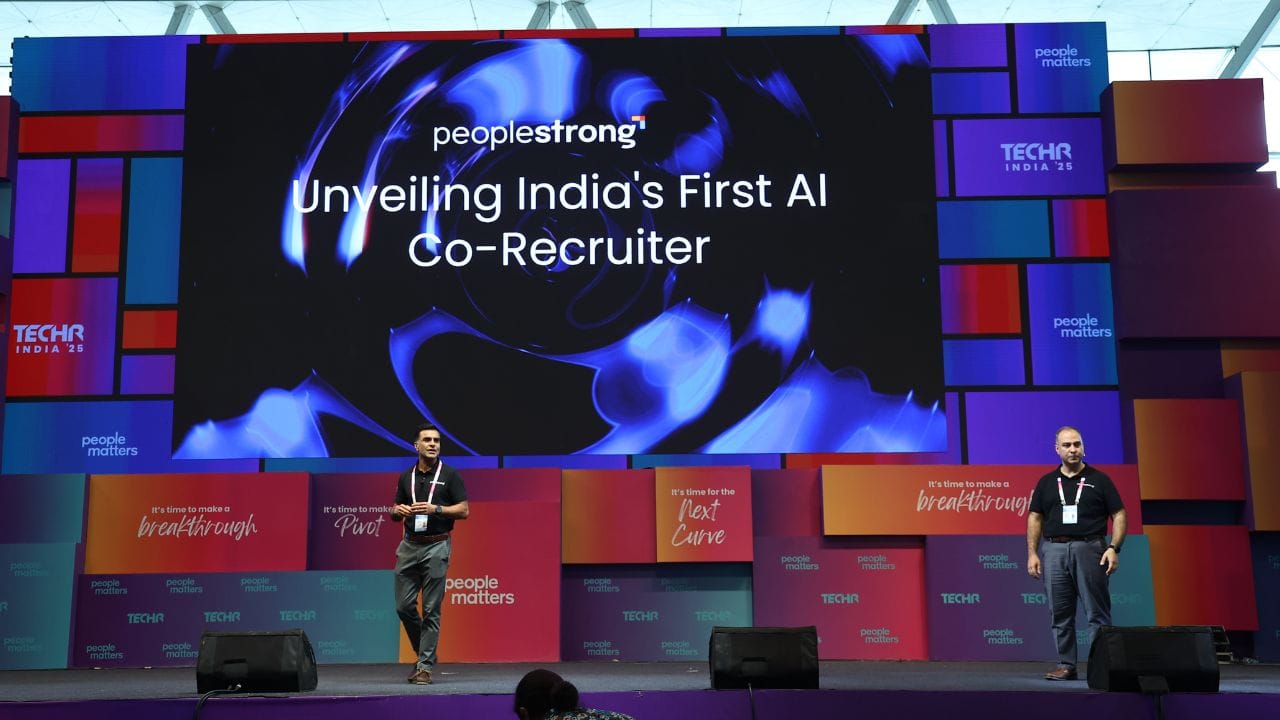
That equation is now being rewritten. At the recently concluded People Matters TechHR India 2025, Sandeep Chaudhary, CEO, PeopleStrong and Vineet Pandita, CTO, PeopleStrong, unveiled the company’s latest breakthrough: the AI Co-Recruiter. The keynote was a glimpse into a future where intelligent agents accelerate execution and elevate impact.
PeopleStrong’s AI Co-Recruiter steps into the hiring process not as another automation tool, but as a fully capable partner, able to draft, match, screen, schedule, and even conduct initial interviews with the nuance of a seasoned recruiter. It represents a shift from software as a passive assistant to AI as an autonomous co-owner of the hiring journey, compressing what once took days into hours and freeing HR teams to focus on what humans do best: building relationships and shaping culture.
The evolution of AI in HR: From agentic tools to autonomous co-owner
With a call to envision the state of recruitment in 2028, the session framed an interesting but inevitable question: what happens when traditional software approaches are overtaken by true AI-driven autonomy? With the rapidity of technological change, compressing years into months and months into days, how will the expectations and approaches within HR be fundamentally altered?
Sandeep traced the remarkable journey HR has undertaken in just the past twelve months, with artificial intelligence serving initially as an extended, but efficient, assistant. It operated much like any other tool, useful for routine tasks yet always requiring human direction. Now, the industry stands at the threshold of a new era where AI functions as an independent agent, capable of nuanced decision-making and active problem-solving.
The progress we have made in AI has heralded a major shift in how HR Tech organizations are approaching their product suites. Vineet Pandita added that at the start of 2025, AI tools were able to complete 20 minutes of human work with 80% accuracy and confidence, which has probably surged beyond 40 minutes of work by now. The switch from automation to agency is what marks this era as fundamentally different, signalling the dawn of true AI ‘agents’ in the workplace. With task length that AI can handle doubling every seven months, current trajectories suggest that by 2031, AI agents could autonomously handle projects that typically take humans an entire month to complete.
Pandita said that as the commoditisation of information transformed industries through the internet and data, AI is now commoditising the application of knowledge itself by changing not just how work gets done, but what work means in the HR context. He also addressed concerns about AI replacing HR professionals, saying that the data and studies so far suggest otherwise. Quoting a PwC study that showed roles with AI integration leading to a 38% year-on-year growth in jobs. “I think the role of HR is safe in that sense because the same is applicable for people functions like performance management and interviews, as HR professionals will be at the centre of it all to elevate the experience.”
AI in Talent Acquisition: Demonstrating the AI co-recruiter
The session also gave a practical demonstration of the AI Co-Recruiter from PeopleStrong. This new solution embeds intelligence directly atop the recruitment systems, creating a seamless, end-to-end experience for recruiters.
Key features of the AI Co-Recruiter include:
Instant job description generation and customisation:The AI Co-Recruiter doesn’t just draft JDs, it springs into action the moment an exit is raised or when a recruiter requests a new role. It then quickly prepares, reviews, edits, and publishes the job opening, ensuring no time is lost in starting the hiring process.
Role-specific candidate matching:The agent can thoroughly analyse candidates to assess role fitment. With the full context of the profiles currently in the organisation and the skill profile of the role, it gives profile recommendations to the recruiter.
Integrated AI screening interviews:Conduct initial video screenings that assess candidates on technical capabilities and soft skills that are typically gleaned only through live conversations.
Automated scheduling and candidate engagement:The Co-Recruiter manages interview windows, sends reminders and coordinates with candidates and the interview panel for availability, presenting options and finalising slots in minutes.
Comprehensive context and summarisation:Interview questions, candidate summaries and holistic views are generated for hiring managers before the scheduled interview; all interviews are transcribed and feedback is consolidated, ready for immediate review for the hiring manager.
Seamless closure and communication:Feedback and outcome emails are dispatched automatically to candidates, allowing recruiters to focus on follow-up strategy rather than routine correspondence.
PeopleStrong's AI Co-Recruiter fundamentally changes how recruiters interact with the HR Tech system. From filling long forms and sifting through resumes, the recruiter's role will shift to ensuring great candidate experience, getting to know the candidates more, and getting the right person on board.
The technology behind: Orchestration and service agent layers
At the heart of PeopleStrong’s innovation lies a sophisticated architecture built on orchestration and service agent layers. Unlike rigid, manually configured HR tech systems of the past, the new approach delegates the complexities of workflow management to AI.
The orchestration layer breaks complex processes into smaller, manageable sub-tasks, which are then fulfilled by specialised sub-agents. This architecture allows the recruiter to simply state a desired outcome, leaving the system to figure out all operational steps, such as connecting tools, drawing in data, managing schedules and synthesising insights. This differentiation allows the AI Co-Recruiter to deliver truly autonomous results across the entire recruitment value chain.
The Co-Recruiter functions as a super-agent, interacting with the user and triggering the right sub-agents at the right places to ensure that the process moves along. It can loop in the human recruiter when needed, and also ensures complete auditability of the process, with the ability to iterate through each steps and ensuring nothing gets missed.
The road ahead: AI empowerment and the future of HR
The AI Co-Recruiter marks a significant milestone. AI Agents are going to revolutionize how HR functions in organizations. The aim is not to replace human professionals but to elevate their work and free them to focus on people-centric, strategic initiatives that foster culture, engagement and innovation.
HR’s role will evolve as AI assumes responsibility for repetitive and administrative tasks, placing HR leaders at the centre of talent strategy, business alignment and employee experience. As the capabilities of these systems grow, the industry can expect further expansion, with AI-powered talent partners, payroll assistants and more.
Beyond recruitment, AI agents show immense potential across HR. A learning agent could act as an always-available coach, recommending new skills, certifications, and courses tailored to employees’ aspirations. Similarly, a payroll agent could help employees interpret pay statements, resolve queries instantly, and address grievances with clarity, improving both efficiency and employee trust.
In the end, the message was clear, while the promise of AI in HR is substantial, its greatest value lies in how it enables HR teams to do what only they can, which is to connect, coach and create the conditions for human potential to flourish. The AI transformational journey is just beginning, and those prepared to embrace it will shape the future of work.