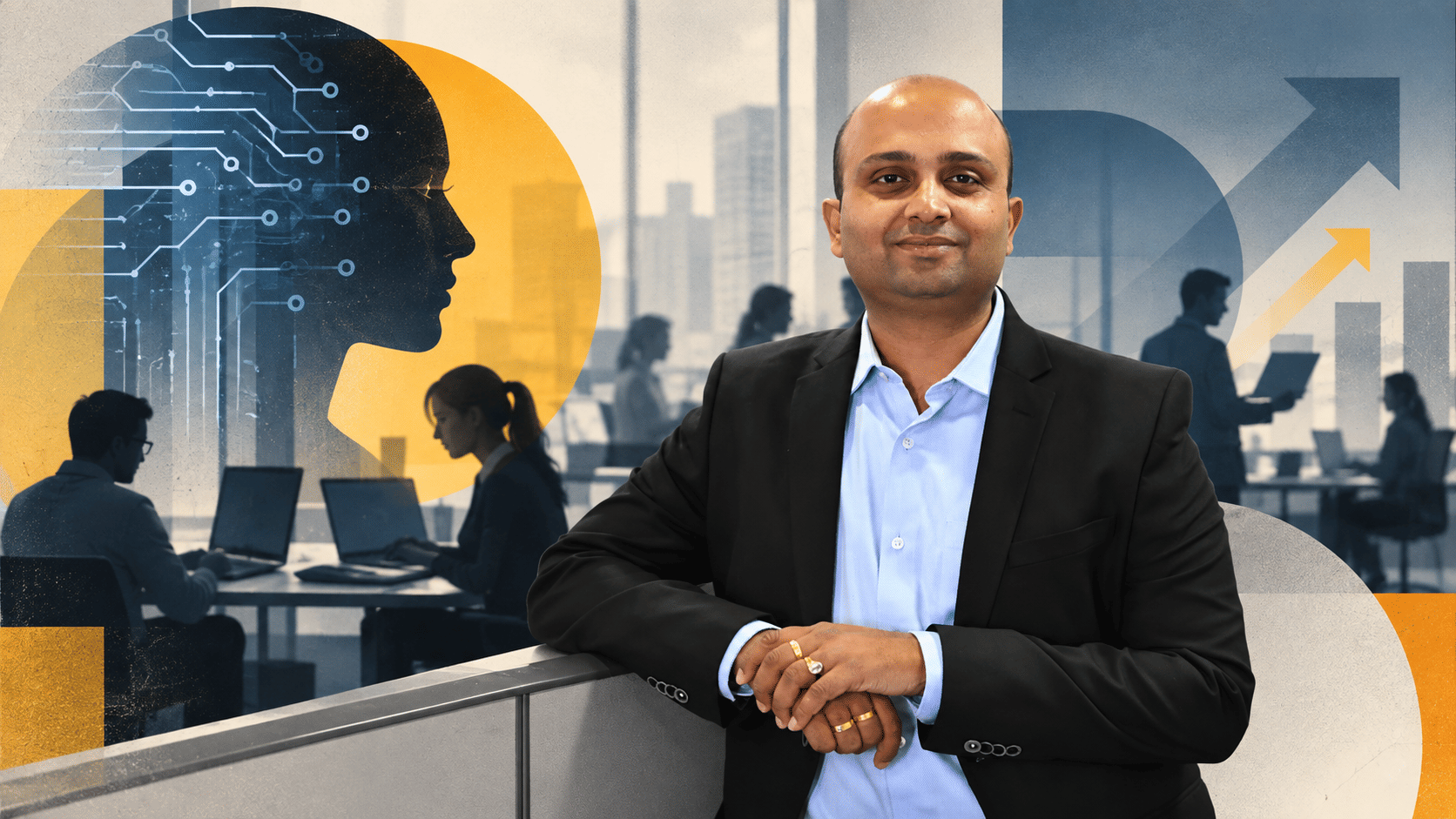
Piyush Mehta leads Genpact’s global Human Resources (HR) function and in this capacity has played an integral role in the organization's journey to becoming an Employer of Choice. With more than 25 years of experience in HR, he has contributed to various aspects of people management in both business and corporate roles, including employee relations, organization capability building, M&A integration and managing the HR function for P&Ls and geographies. He is also a Genpact executive Officer.
Piyush joined Genpact in 2001, where he first led HR engagements across various businesses and was then appointed to his current position of Senior Vice President of HR in 2005. He began his career with Hindustan Lever, served as HR director for AT&T in India, and has been the organization capability director for Frito-Lay, Asia Pacific. Piyush holds a post-graduate degree in personnel management from XLRI, Jamshedpur and an honors bachelor’s degree in Economics from Delhi University.
How do you think the professional services industry has evolved over the years?
Technology has changed the world, and our industry, in a way that most are still grappling to fully understand and embrace. From tackling climate control through the Internet of Things to preventing suicides via AI algorithms – technology is changing the way problems have been approached for decades. And with this, our ability to respond to those changes with speed has become really important.
To take an example from the professional services business, until quite recently, it was common to send an army of resources to the client’s site to understand their work in order to “transition” business processes to the provider’s side. This was a laborious, physically-intensive, and expensive exercise that could take up to 3 months. Today, we’re able to virtually transfer the process over a weekend that results in saving millions of dollars and a ton of time. The other big change is that clients no longer want to tell us their business challenges and wait for us to create solutions; today, they expect us to be completely in synch with how they and their industry works, and also want us to anticipate unforeseen business problems and solve for them proactively with customized solutions. This trend has provided us a huge opportunity to combine our domain expertise gathered through decades of understanding processes of various clients with our digital and analytics capabilities to curate composite solutions for our clients to win in the marketplace.
What do you think “work” will look like in the next 5 years?
Defining how work will look 5 years from now is not a risk I am willing to take because honestly, I am not sure about it. Will it be dramatically different from today? Absolutely! Will it leverage technology, analytics, and data in a different way? Absolutely! Will a different set of skills be required to function than those that exist today? Absolutely!
The impact of technology is understated in the long-term and overstated in the short-term.
In my view, the concept of work will be dramatically different than what it is today and along with it, the nature of jobs will also change. As to how it will be, it is very hard to predict. But clearly, facilitators like technology, analytics, data, automation, Machine Learning and Artificial Intelligent and related fields will augment this change and will become clearly more and more important.
How do you think organizations can prepare for this unknown future?
The first thing is to be able to look around corners, having a reasonably good idea as to what skill-sets will be critical in the future while keeping the ear close to the ground so that one can understand how businesses and client expectations are changing. One also needs to leverage technology, data, talent, and domain to create solutions. It is not a one-time approach; it is something that needs to be continuously churned and wheeled.
But this also links to behavior, which the HR people love to call as ‘competencies’. So, how curious are we to learn, how willing are we to learn, and how agile are we to learn are the questions we need to ask. These questions, along with the ability to look ahead and understand the pulse of the business will make for a formidable combination that will prepare organizations for the future.
What role do you see technology playing in equipping leaders and organizations to prepare the organization for the future?
Technology will play a huge role, and that’s a given. In fact, how we leverage technology will determine the difference between success and failure. But at times we make the mistake of looking at technology in isolation and believing that it is the only thing that will enable us to deliver to business challenges. Believing in “technology for technology’s sake” is just plain wrong. It is really important to understand the context and the business challenge while attempting to create a business solution by leveraging technology. Even though change is impossible without technology, a nuanced and important understanding of technology is critical.
Genpact has been fairly progressive when it comes to leveraging technology. What has worked for Genpact so far in the way it has approached and leveraged technology for higher business performance and productivity?
I think, first of all, it is crucial to understand that this is a journey. We have not arrived at all, but we are on the path to get to a destination, which is changing all the time, and that necessitates learning.
From a technology perspective, we have always been ahead of the curve. Case in point being, we had a web-based rewards portal in 2004, and in 2009, we were among the first implementers of SuccessFactors in India, as we moved our performance management tool to the Cloud in 2009.
We are stepping into an era that revels in riding the wave of cutting-edge technologies, and for us, embracing this inevitably led to the birth of an empowering approach: Increasingly becoming more digitized and self-service oriented as an organization. From standard ERP platforms to leveraging the integrated power of SMAC (Social, Mobile, Analytics, Cloud), technology is changing the way we deliver HR services.
Which brings me to our chatbot. With AI and automation now taking center stage, we want to drive conversational AI within the system. We are using it to augment our shared services for employees, as we move to self-service by integrating a bot to reach out for transactional queries around HR policies. If we are able to leverage the chatbot well, we are solving for ‘scale’, because we have upward of 70,000 employees with queries coming to their shared services.
This reinstates our approach and belief in the need to reinvent systems and processes. If you do not have that (and Genpact is an organization of 75,000+ people in 25+ countries), managing such a large organization is tough. Plus, we have grown really fast in the last 20 years to just under $3 billion of revenue. We have always looked at ways in which we keep our systems and processes up to speed with the growth of the company. It is very important to be focused on the need one is solving or attempting to solve through technology. Taking the chatbot into perspective, the volume and quality of which is a far superior manifestation and implementation of technology than perhaps some niche tool which would only address the needs of some 400-500 employees as opposed to a larger group. Thus, it becomes imperative to see where a new tool or technology is going to take us, how it is going to give us a competitive advantage either on scale or insight.
Has there been any recent technology that you felt ticked all the boxes you just mentioned – scale and insight?
It happens all the time. For example, one of the tools we have put in place leverages technology and data for recruitment purposes – video interviews. The tool provides an analysis using Machine Learning and AI and provides insights on candidates based on their responses to a few standardized questions. If you take a step back and ask how powerful this can be when it is deployed across the business — the answer is that it will be immensely robust and compelling because the reliability and validity of this tool will be better than human intervention. However, that being said, the objective is not to replace human intervention because there is a value and benefit we get out of human judgment; yet, the opportunity for improving quality and productivity with such tools is immense if used across the organization.
Next, we have worked with MIT on an experiment where we have looked at Meta-data of emails that a focused group in the company sent out. Through an analysis of the sender, recipient, and subject line of the emails, we are now able to predict whether a person will be a high performer or not. In an environment where predicting performance is critical, if technology can be used to predict performance, the power and benefit that organizations can derive from them is huge.
If you were to design an HR technology that will solve some of the biggest HR or people challenges, what would that technology/tool look like?
I don’t think there is an over-the-counter solution. I go back to the fact that the needs of every business are unique — they are influenced by what the clients want, the culture of the organization, and also the competitive advantage a tool/technology grants. If we make the mistake of looking at ready-made, pre-packaged solutions or taking a cookie-cutter approach, then it is a problem. One needs to see if a tool can understand what the business is about, understand the business challenges, and the challenges going forward. So a solution needs to integrate talent, technology, data, insights and the understanding of the process to be able to deliver on the business needs.
For us to be able to think about a one-stop-shop tool that solves all challenges is a dream.
I think it is not about a tool — it is less about singularity and more about the human and technology intervention coming together and working to be able to bridge to future. It is not going to be one or the other alone.
What is a downside of technology that you can foresee?
On the human side, you have manual interventions that lead to challenges with absenteeism or people making wrong decisions; but with technology or machine, the challenges pertain to how you get a set of tools to be able to talk to each other. You get in a best-class tool for performance management, compensation benefits, and on-boarding – but how do you get them to talk to each other? And by the time that bridge is constructed, the technology would have evolved further ahead. So staying up with the changes that are happening becomes really important. Making technology talk to other tools, data privacy, and other challenges are also something that one needs to be aware of.