








The race to adopt AI is entering a new phase.
For much of the past two years, enterprises measured progress through pilot programmes, proof-of-concepts and user adoption figures. Today, the conversation is shifting towards something more fundamental: whether AI is changing how organisations operate at scale.
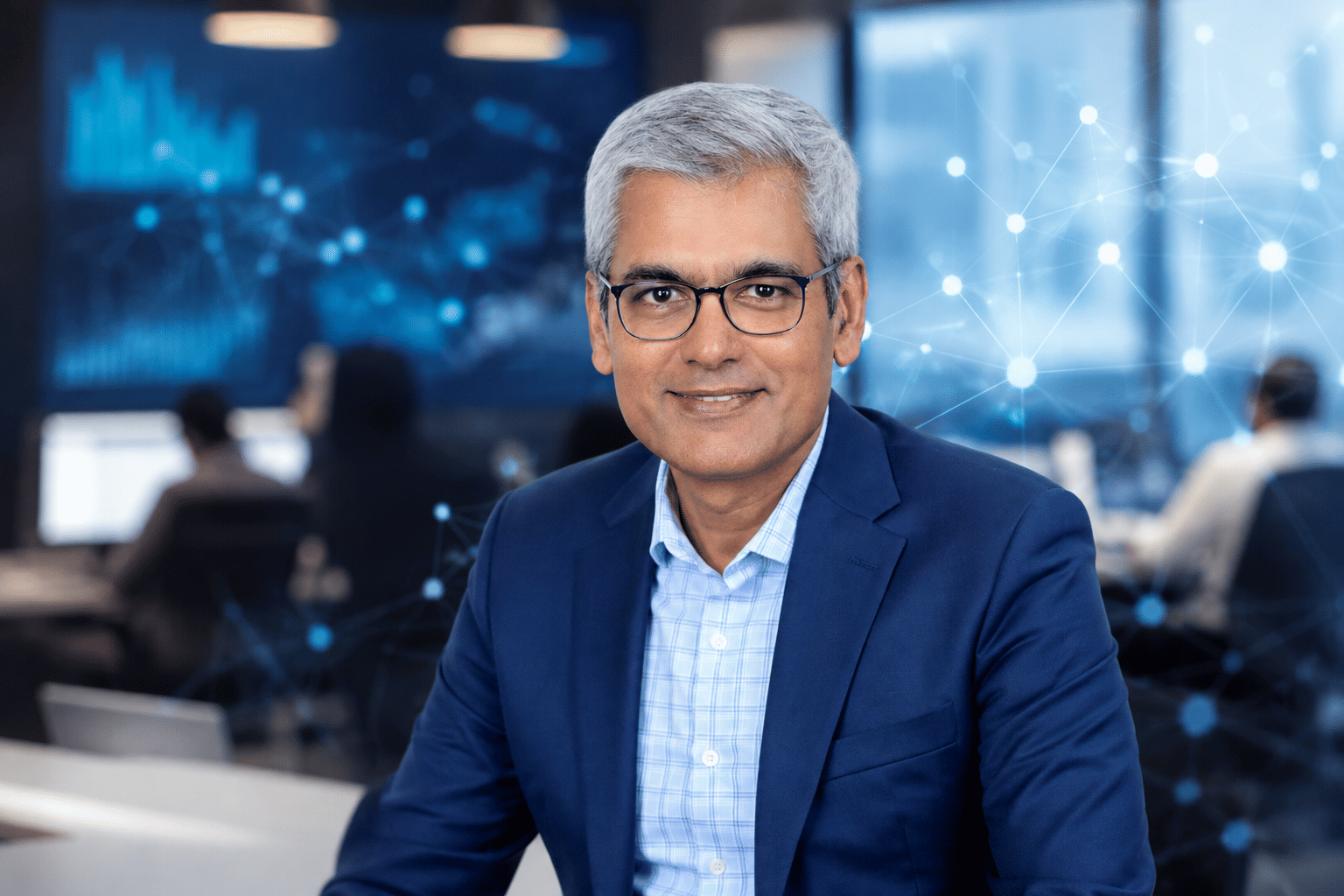
In an interview with People Matters, Joydeep Mukherjee, EVP and Head of Global Services at Infosys, outlined how the company is embedding AI across the enterprise, scaling adoption to more than 100,000 employees, and building the foundations required to move from experimentation to operational impact.
His message was clear. AI cannot remain a standalone technology initiative. It must become part of the enterprise operating model.
Beyond adoption metrics
The scale of AI usage inside Infosys is already significant.
According to Microsoft’s reporting on enterprise licensing, Infosys has expanded Microsoft 365 Copilot to more than 100,000 employees, with monthly active usage exceeding 91%.
Yet Mukherjee believes adoption figures alone no longer tell the full story.
“Our AI-first journey is about embedding AI into the fabric of the enterprise rather than running it as a standalone initiative.”
He says the company has spent the past year moving “from experimentation to operationalisation”, connecting AI to trusted data and governance frameworks instead of treating it as a separate capability.
Infosys has also expanded its AI ecosystem through collaborations with OpenAI and Anthropic, integrating frontier models into Infosys Topaz to support agentic AI solutions and AI agents for enterprise software development.
“The real shift the market needs to make is similar, from counting adoption to measuring whether employees are genuinely working differently because of AI.”
That distinction is becoming increasingly important as organisations seek evidence of productivity gains rather than usage statistics.
Why data foundations matter more than AI models
One of the strongest themes emerging from the discussion was the growing importance of enterprise data readiness.
Mukherjee says productivity gains from AI depend less on individual tools and more on the quality of the underlying data infrastructure.
“Productivity at scale starts with a strong data foundation.”
“AI delivers sustainable value only when it is built on trusted, governed, and reusable data rather than fragmented data silos created for individual use cases.”
To address this, Infosys is strengthening shared data and knowledge layers that support AI capabilities across multiple functions, including:
- HR
- Finance
- Marketing
- Procurement
- IT
According to Mukherjee, these shared layers enable AI capabilities, including agentic AI and AI agents, to be reused across the organisation rather than rebuilt for every department or project.
“This helps improve decision-making, streamline operations, reduce duplication, and accelerate execution.”
The broader lesson, he says, is that AI scales more effectively when organisations create common semantic and knowledge foundations that multiple teams can leverage.
The shift from pilots to enterprise transformation
The AI market has spent much of the last two years experimenting.
Many organisations launched isolated GenAI pilots with limited integration into core business processes. Mukherjee believes that phase is rapidly ending.
“AI has evolved from exploratory pilots into a core pillar of enterprise transformation.”
He says clients increasingly want AI embedded within processes, workflows and decision-making systems rather than operating as standalone applications.
That transition requires governance and data architecture alongside model capabilities.
As part of this approach, Infosys has developed frameworks through Infosys Topaz and Infosys Topaz Fabric, bringing together:
- Data engineering
- Analytics
- Data science
- Governance
into a single operating layer.
“What the market genuinely needs is that kind of unification, a single governed foundation AI use cases can plug into.”
Mukherjee believes this approach enables organisations to pursue larger outcomes such as revenue growth, efficiency gains and new business models instead of accumulating disconnected AI solutions.
Which industries are moving fastest?
AI adoption is accelerating across sectors, but not for the same reasons.
Mukherjee points to distinct priorities emerging across industries:
- Financial services: Risk intelligence and fraud detection
- Manufacturing: Operational resilience and asset performance
- Healthcare: Decision support
- Retail and CPG: Personalisation, revenue growth management and real-time insights
- Telecom: Customer experience, churn reduction and AI-led service automation
However, he argues that industry alone does not determine success.
“What separates the fastest movers isn't the industry, though whether the underlying data estate is AI-ready before AI gets layered on top.”
This thinking sits behind Infosys’ Data for AI approach, which focuses on preparing enterprise data environments before scaling AI initiatives.
“Getting enterprise data ready for AI first” remains a critical sequencing decision, he says.
What CEOs are asking now
Boardroom discussions around AI have also matured.
Mukherjee says executives are moving away from basic questions about AI capability and focusing instead on execution, governance and business outcomes.
“The boardroom conversation has shifted from 'what can AI do' to 'how do we scale it responsibly and prove business value.'”
According to him, CEOs are increasingly focused on:
- Governance
- Value realisation
- Data readiness
- Talent
- Risk management
- Productivity
The emergence of agentic AI is intensifying those discussions because AI agents operate with greater autonomy than earlier generations of AI tools.
“AI agents now act with more autonomy than earlier generative AI tools.”
As a result, trust, privacy, security, compliance and ethics are becoming board-level priorities.
Mukherjee also cited Infosys research showing that 86% of boards now receive AI updates on a regular schedule, although fewer remain deeply engaged in discussions around risk and explainability.
“The most forward-looking organizations are learning to balance AI strategy, governance and organisational literacy in roughly equal measure, rather than over-indexing on any one.”
Building reusable AI foundations
When asked about internal AI success stories, Mukherjee deliberately avoided highlighting a single use case.
Instead, he pointed to a broader architectural shift.
“Rather than one use case, the meaningful shift for us has been treating AI's knowledge layer as a shared, reusable asset rather than a one-off build.”
Infosys has developed internal platforms that structure data and context once before reusing them across multiple agentic AI and AI agent workflows.
The objective is to avoid rebuilding foundations for every new initiative.
“What makes this scalable, for us or any enterprise, is the discipline of building the reusable foundation before the use case.”
Mukherjee notes that many organisations only arrive at this lesson after early pilots fail to scale.
Rewriting software delivery with AI
Software engineering remains one of the most visible areas where AI is generating measurable change.
Mukherjee says AI is accelerating modernisation efforts while improving engineering productivity across the development lifecycle.
The impact is being seen in:
- Application assessment
- Legacy modernisation
- Software development
- Automated testing
- Migration
- Operational support
Through collaborations with OpenAI and Anthropic, Infosys is combining technologies such as Codex and Claude Code with Infosys Topaz Fabric.
According to Mukherjee, this supports automated code review, faster modernisation and improved engineering effectiveness.
“The larger shift is towards a governed, AI-native delivery model where AI agents handle repeatable engineering tasks including test generation and validation.”
Human oversight remains central to that model, with AI augmenting delivery speed, quality and predictability.
The rise of frontier teams
The workforce implications of AI are becoming increasingly visible.
Mukherjee says organisations are seeing a convergence of business, data, domain and technology skills.
“AI is accelerating the convergence of business, domain, data and technology skills.”
While technical expertise remains important, demand is expanding into areas such as governance, data fluency, business context and value realisation.
He also points to the emergence of what he describes as “Frontier Teams”.
These teams combine business understanding, industry knowledge and AI expertise to define agentic AI solutions aligned with business outcomes.
At the same time, demand is increasing for specialised AI engineering capabilities focused on operationalising and managing AI systems.
As AI agents assume more repeatable and multi-step work, entirely new oversight responsibilities are emerging.
“People who manage, validate and course-correct what AI agents do, rather than only building models.”
Mukherjee believes the most important capability organisations must now develop is human judgement.
“The capability every enterprise now needs to develop is this human-in-the-loop discipline at scale.”
“Judgment, critical thinking and change leadership matter more, not less, as more execution shifts to autonomous agents.”
The next chapter of enterprise AI
The interview highlights a broader shift taking place across the technology industry.
The debate is no longer centred on whether organisations should adopt AI. That question has largely been settled.
The challenge now is how to scale AI responsibly, connect it to trusted data, govern it effectively and generate measurable business outcomes.
For Infosys, that journey has already moved beyond experimentation. The focus is now on operationalising AI across the enterprise, building reusable foundations and preparing the workforce for a future where humans and AI agents increasingly work side by side.