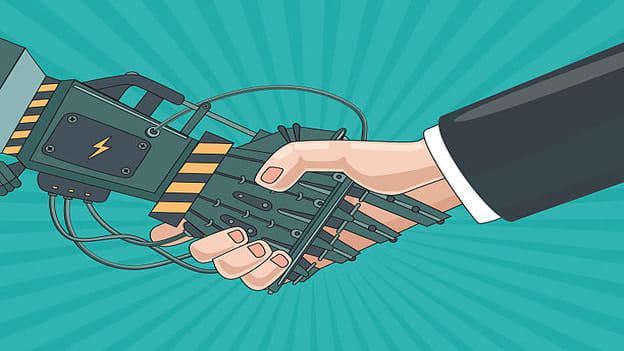
We are at an interesting crossroads but one that is definitely not new to the human history. It is about the large-scale interface between the humans and technology. A couple of such memorable ones are, the first industrial revolution when humans allowed machines to take on a part of the burden of their physical labor; and the other being the onset of personal computers, when humans allowed machines to take on a part of the burden of their mental labor. Today, we are at a similar juncture where humans are allowing technology to define (or redefine) experiences related to the way we work, travel, shop, or the way we entertain ourselves.
The HR function has not been and is still not immune to technology impacts. Today, there is a burgeoning of HR tech and app companies, and most ‘People’ seminars and conferences are literally taken over by offerings and promises of technologies that will make our workforce (and by extension our organizations) more productive, efficient, happy, engaged, and impactful. The paradox in question manifests itself in this context. How does a function that has traditionally prided itself on being the ‘heart’ of the organization, that has dealt with people’s emotions and engagement, deal with the onslaught of technology in the ‘human’ space?
In a recent discussion paper published by the McKinsey Global Institute, authors Jacques Bughin et al opined that the introduction of newer technologies will accompany significant shifts in skills. Now, that is not news. We have all read and experienced it. However, what is interesting is that with an accelerated adoption of technology such as automation and artificial intelligence, the need for social and emotional skills will rise. In some ways that sounds counter intuitive, but it is not.
In my view, it is less a paradox, and more of a partnership — a question of AND, not OR. There are three lenses with which I would like to see this — the work that HR does (the HR value chain); the world of end-user experience (in this context employees, managers, and leaders), and future strategic decision-making (related to talent). HR provides a range of services and has multiple touch-points with the organization — some extremely mundane, and others highly strategic. Technology will (and should) help in taking care of the mundane in a far more efficient and accurate manner, leaving HR professionals with the ability to spend more time, energy, and thought on areas that really matter to the organization. In the past, and in many organizations even now, a lot of so-called ‘touch’ is in areas that have no value addition, such as, in capturing the basic demographic and personal data of talent that we bring in through the doors. Technology will, at some point, completely replace humans in this space. HR will, therefore, have more time to spend with people where ‘touch’ is truly required — in recruiting, ensuring that individual human performance aligns to business performance, coaching, understanding business drivers, and managing change effectively. If we were to plot the value chain of HR activities from the mundane to the strategic, technology would help us become truly ‘high-touch’, where it is required.
In the future, technology and humans will partner to deliver an enhanced end-user experience that would be seamless (across tech hardware), customized (suitable to me), unified (same wherever I go), 24X7 (available ‘on the tap’), and predictable (I know how things operate). The workforce of today is used to such experiences in their day-to-day living; there is no reason why their expectations would be any different at the workplace. This is true across employees, managers, and leaders and while technology drives the real-time experience, humans (leaders, managers, and HR) will use their imagination, intuition, and lateral thinking to impact experiences such as career conversations, succession planning, creating a purpose and meaning for the organization, and in client interactions.
The last pillar is of insights and decisions. HR, just as any other business function, in early days did not have enough data. This was as much due to the lack of technology as it was because of the lack of belief in it. Today, there is data, but limited insights. Technology’s true win in the HR space will be to provide meaningful insights on aspects related to demographics, behaviors, performance, or engagement.
All said and done, technology and skill shifts are inevitable. HR needs to be on the skill-shift journey as much as any other function or business keeping in mind that no technology should be adopted because it is in fashion, or is the latest buzzword. Any organization just as any individual has its own unique journey. Therefore, the key question to ask at the point of decision on the adoption of any new technology would be ‘How does it contribute to our journey?’