








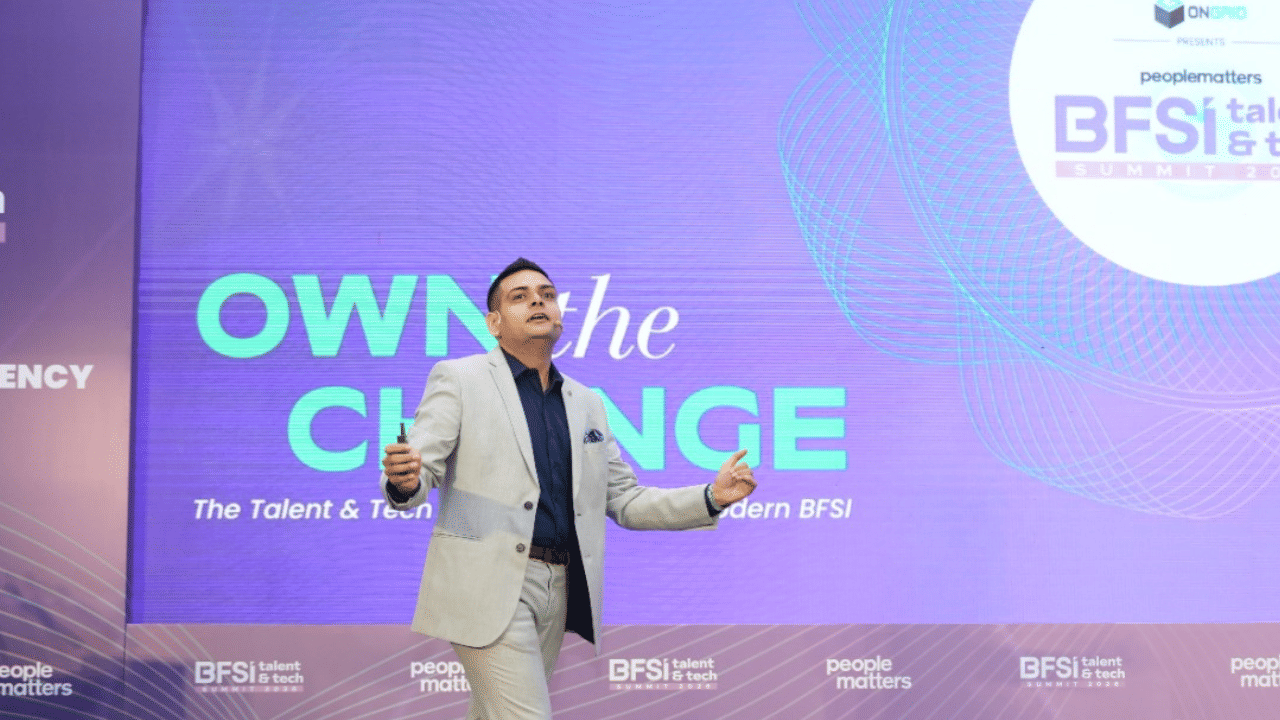
At the People Matters BFSI Talent & Tech Summit 2026 held at Taj Santacruz, Mumbai, the focus was simple: what’s actually working when it comes to talent, and what clearly isn’t.
Opening the summit with a keynote titled “Own The Change: The Talent & Tech Transformation Of Modern BFSI,” Pushkar Bidwai, CEO of People Matters, set the tone for a conversation that moved beyond AI hype and into the harder realities reshaping the banking, financial services, and insurance sector.
Bidwai explained how BFSI organisations are standing at the intersection of technological disruption, workforce instability, regulatory pressure, and rapidly shifting business models. And many are discovering that buying technology is easier than redesigning work itself.
“We’ve deployed AI,” Bidwai said. “I just don’t think we’ve designed it for humans.”
That distinction became the defining thread of the session.
The pressure is no longer theoretical
Drawing from findings of the latest People Matters SHRPA Research, one of Asia-Pacific’s largest HR and transformation studies spanning nearly 1,300 organisations, Bidwai mapped the macro-level forces reshaping work in India’s BFSI landscape.
Technology remains the biggest driver of change, he noted, but it is now deeply intertwined with geopolitics, regulatory shifts, and evolving workforce economics.
He pointed to two global data points that are increasingly difficult for organisations to ignore.
The first: nearly 48% of global tech layoffs in Q1 were linked, directly or indirectly, to AI-led restructuring and operating model shifts.
The second: from Oliver Wyman’s CEO survey that showed – the percentage of CEOs planning to reduce entry-level hiring rose sharply from 17% last year to 43% this year.
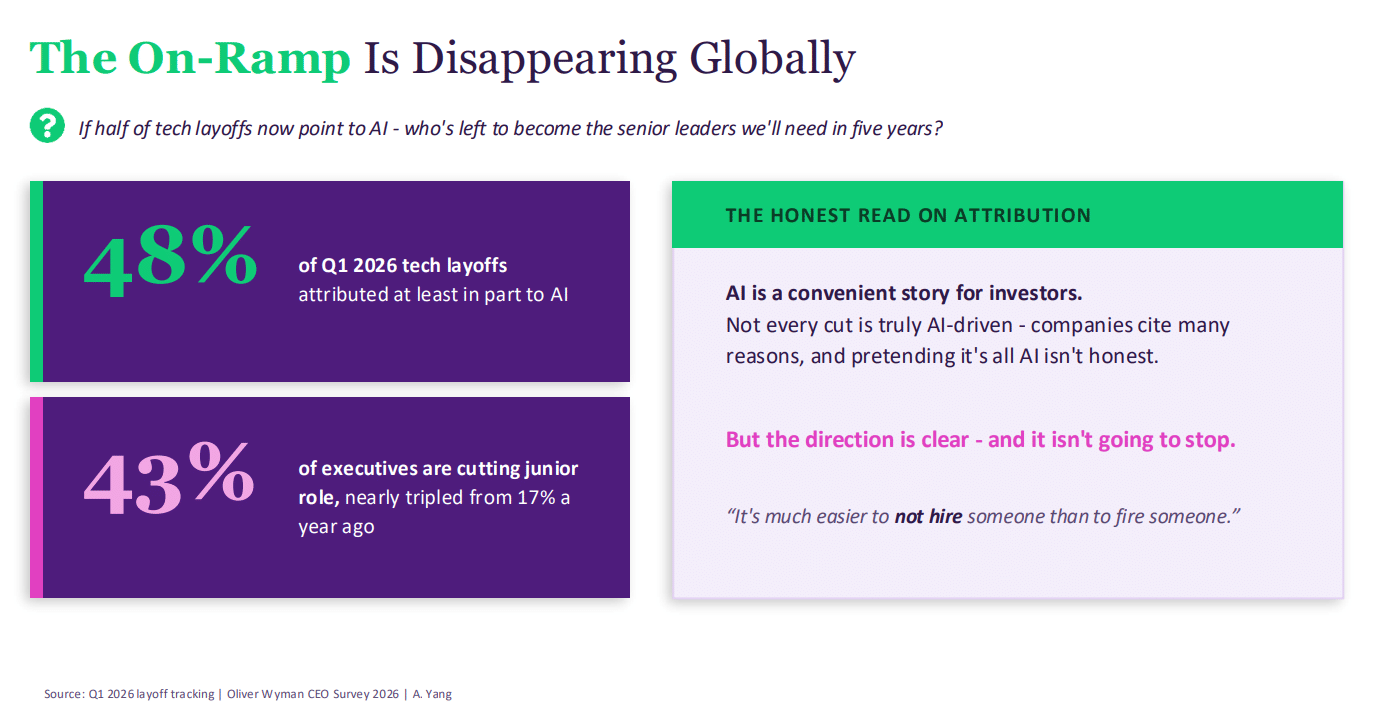
For an industry that traditionally depended on structured talent pipelines and early-career hiring, the implications are significant.
“We’re not going to buy ourselves out of this,” Bidwai warned, arguing that the race for AI-ready talent has already become unsustainable for many organisations.
“The skill is not there to the level which we want, and we can’t keep paying any price for it.”
The frontline attrition problem BFSI still hasn’t solved
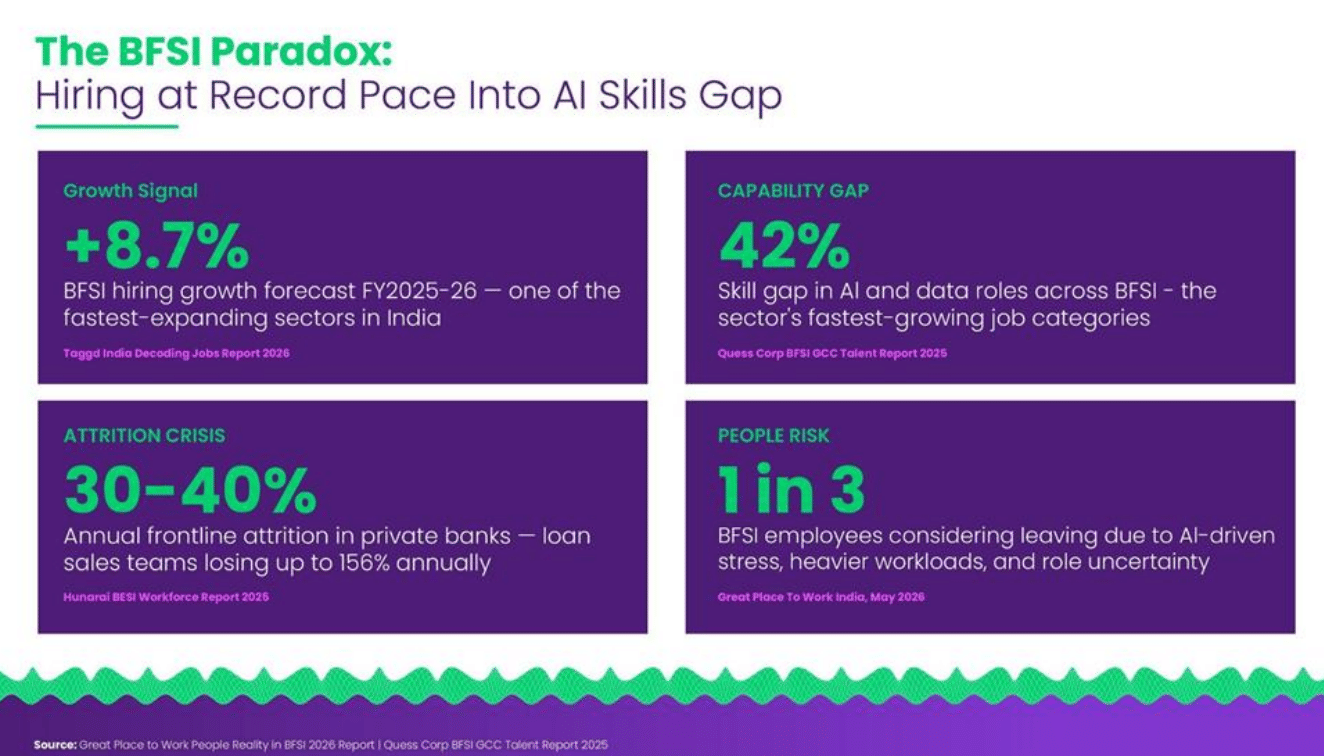
While much of the global AI conversation remains focused on automation and productivity, the summit repeatedly returned to a more immediate challenge for BFSI employers: workforce durability.
Several frontline roles across the sector are now witnessing attrition rates so high that ‘people don't even survive one year’ Bidwai noted.
That instability, leaders acknowledged, creates a dangerous cycle, rising hiring costs, weaker customer continuity, overwhelmed managers, and constant pressure on learning and development teams.
At the same time, organisations are layering AI tools, copilots, workflow systems, and automation platforms onto already fragmented work environments.
The result, Bidwai suggested, is not always higher efficiency. In some cases, it may be producing the opposite.
Referencing global workplace experiments involving AI-human workflows, he noted that organisations found employees increasingly relying on AI systems without sufficient accountability. In several cases, workers blamed AI systems for errors, while overdependence on automation weakened independent decision-making.
“The whole narrative around efficiency was actually acting in a different way,” he said.
That concern is now evolving into what many HR leaders are informally calling “AI brain fry”, the exhaustion employees experience while constantly switching between tools, prompts, platforms, and systems.
Why trust may become the biggest workforce issue
If there was one recurring theme throughout Bidwai’s session, it was trust. Not just trust in technology itself, but in the way organisations deploy it.
Bidwai argued that as AI systems become more embedded into hiring, evaluation, productivity, and decision-making processes, organisations will face growing scrutiny from employees, regulators, and boards alike.
Referring to a study by the Society of Corporate Governance and Nasdaq, he noted that boards are already asking sharper questions:
What exactly is the organisation’s AI risk?
Who owns decisions made through AI-assisted systems?
How is workforce impact being measured?
Where does accountability sit when systems fail?
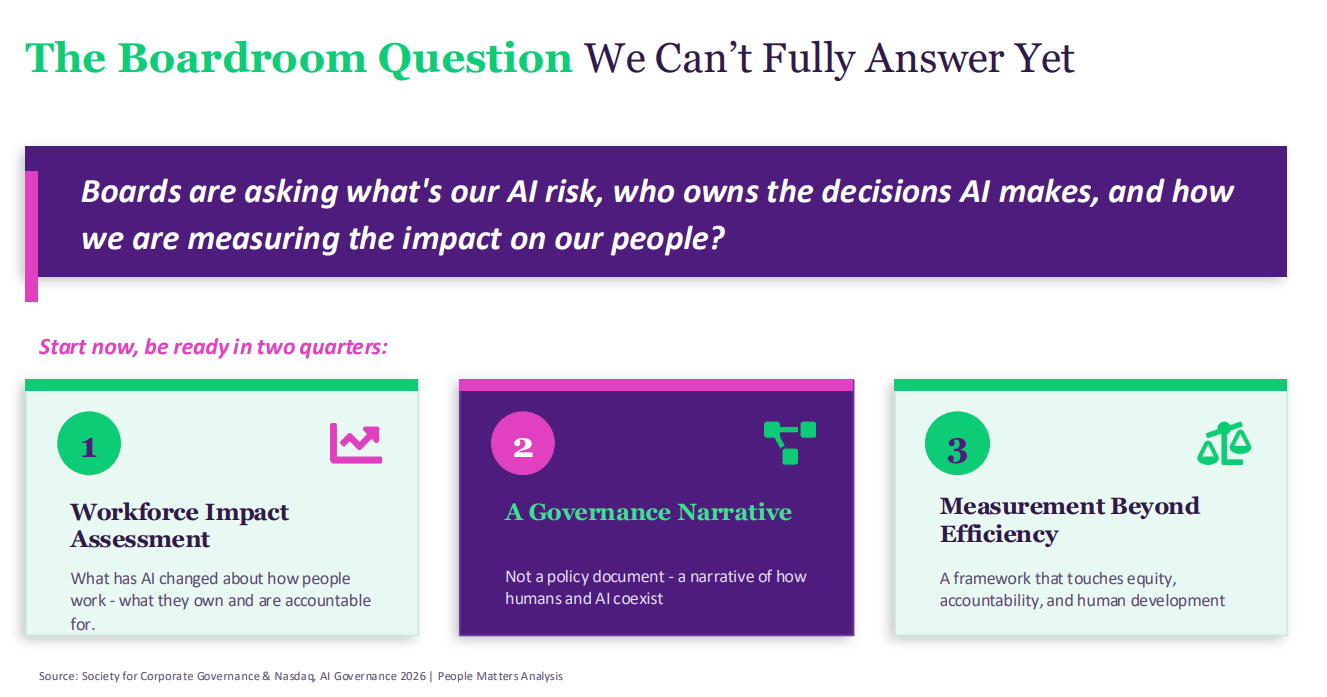
The conversation, therefore, is moving beyond adoption metrics.
“What’s happening now is that boards don’t just want to know whether you’ve implemented AI,” he said. “They want to know what it’s doing to your workforce.”
That shift is expected to place new pressure on CHROs and business leaders to develop workforce impact assessments, governance narratives, and clearer frameworks around human-AI collaboration.
Importantly, Bidwai cautioned against equating efficiency with effectiveness, a distinction he believes many organisations are only beginning to confront.
“I think there is enough data now bursting this whole efficiency myth,” he said. “Efficiency does not mean effectiveness.”
Work itself is being reconstructed
One of the most striking ideas emerging from the session was the notion that work itself is no longer stable. Bidwai traced the evolution of work from paper-based personnel management systems to HRMS platforms, then into knowledge work, digital work, gig work economy, and now augmented work environments powered by AI systems.
The challenge, he argued, is that many organisations are still applying ‘old workforce structures’ to entirely new models of work.
“Work is getting deconstructed and reconstructed,” he said.
That reconstruction is happening so quickly that traditional workforce planning models are struggling to keep pace. Skills relevance is shrinking faster, data cycles are shortening, and historical benchmarks are losing predictive value.
“The game is evolving so fast that data is changing every 16 days,” he noted.
In response, he urged leaders to stop relying on “rear-view mirror thinking” and instead build systems capable of adapting continuously.
The rise of AI experience design
Perhaps the boldest prediction from the session was Bidwai’s suggestion that HR may soon witness the emergence of an entirely new function: AI experience design.
The role, as he described it, would focus not simply on deploying AI systems, but on ensuring they are built around human behaviour, trust, usability, and organisational culture.
For years, organisations focused on driving “user adoption.” But Bidwai challenged even that terminology. “I hate the word ‘users’ because humans are the ones consuming it,” he said.
That shift in language may sound subtle, but it reflects a much larger mindset change underway in HR and enterprise technology.
The future of workforce transformation may not belong to the organisations with the most AI tools. It may belong to those capable of designing work systems where humans and technology can genuinely augment one another.
And for BFSI, an industry balancing regulation, customer trust, operational complexity, and relentless transformation pressure, that challenge may define the next decade.