Three decades ago, banking was a people-and-paper business driven by physical branches, manual processes, and personal relationships. Today, it is a digital, data-led industry powered by AI, automation, and real-time decision-making. Yet through all this change, one thing has remained constant: people and trust.
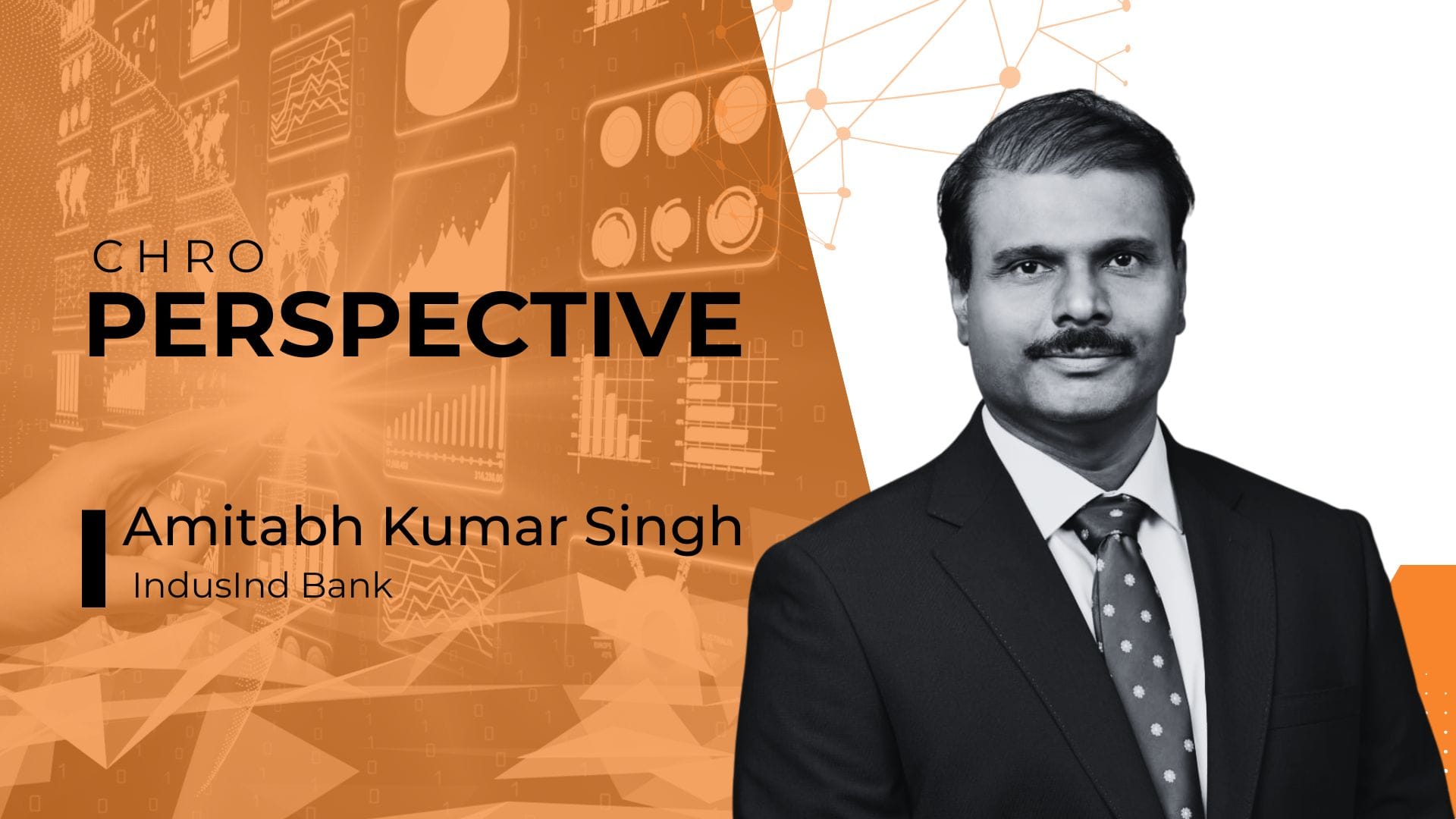
In this exclusive conversation on People Matters CHRO Perspective, IndusInd Bank CHRO Amitabh Kumar Singh reflects on banking's transformation through the lens of people, leadership, and culture.
Drawing from his experience across industries, Singh shares how organisations can balance trust with innovation, risk with agility, and legacy with fresh thinking. From building learning agility and intellectual humility to reimagining middle management, embracing AI, and fostering new ways of working, Singh offers a compelling perspective on how people and technology together are shaping the future of banking.
Edited excerpts:
Today, as BFSI effectively becomes a technology-driven industry, how does that early tech exposure influence how you look at IndusInd’s talent architecture? Is it an advantage to look at a bank not just as a financial ledger, but as a tech organisation powered by human capital?
Banking is fundamentally built on trust. So, when we talk about work from home, the real question isn't whether the technology exists, it's whether we trust people to stay committed and deliver on the bank's goals.
Having worked across manufacturing, technology, and now BFSI, I've seen how every industry shapes a different approach to managing people and complexity. When I started my career at in 1997, around 80 people shared just a handful of computers at the workplace. Today, we can't imagine working without laptops, smartphones, and AI. The workplace has transformed dramatically.
Through all this change, one capability has become indispensable: adaptability. That's why we value learning agility and intellectual humility, the willingness to say, "I don't know, but I'm ready to learn."
Given the pace of change today it's difficult to predict which skills will matter two years from now. So, we don't hire only for today's skills; we hire people who can learn, adapt, and grow.
Even when we onboard fresh graduates, we look for people who understand technology and AI. Banking business can be taught; the ability to learn is what matters most.
Banking has always been an early adopter of technology because of the scale of transactions it handles. So, the core philosophy behind our talent strategy is – keep it realistic, stay agile, and build future-ready people.

As you execute your vision for leadership pipelines and organisational effectiveness here, how do you balance honouring IndusInd's Bank’s deep institutional memory with the urgent need to inject agility, tech fluency, and innovation?
The phrase 'war for talent' was coined nearly 30-years ago, and I believe that war is far from over, only the definition of talent has evolved.
Two things are critical through any organisational change: trust, and risk & compliance, which together form the foundation of a real competitive advantage.
For us, innovation isn't just about launching new products; it's about process innovation. If an employee applies for leave, why shouldn't the entire process take just 30 seconds? That's where AI tools and automation can make a real difference.
We've already made progress. Some leave requests are now being auto approved, improving process efficiency while staying fully compliant with regulatory and internal requirements.
But I believe we're only scratching the surface. We are reducing account-opening timelines significantly, but the bigger question is, can we make them near-instant. AI, automation, and advanced analytics are helping us simplify processes and improve efficiency across the bank.
None of this is possible without a strong risk and compliance culture, and it's a shared commitment across all 45,000 employees, from the Managing Director to frontline relationship managers. That's how deeply it's embedded in the way we operate.
As AI begins to handle the heavy lifting of financial modelling and data synthesis, what happens to the 'apprenticeship model' that has defined banking for decades? How do you ensure that junior talent still develops the 'muscle memory' of financial intuition when the machine provides the answers instantly?
The apprentice model will remain relevant, especially in the AI era, because organisations need people who challenge established ways of working.
Younger talent is often more willing to question legacy practices instead of simply following them. That's why we're focused on creating more opportunities for young professionals and lowering the average age of the bank.
That said, "young" is really a mindset, not an age. You can be 50 and embrace new technologies with curiosity, or 25 and resist change. What matters is your willingness to learn, adapt, and evolve.
At the same time, institutional knowledge should live in systems and processes, not in individuals. With that foundation, you can continuously bring in fresh talent that challenges assumptions and drives innovation.
The industry will also continue to need a human touch. Customers may use AI to research products, but when it comes to key financial decisions, most still want to speak to a relationship manager.
The same is true for HR. Routine tasks can be automated, but empathy, judgement, and trusted relationships cannot. People still value the reassurance of a human conversation.
That's another reason the apprentice model will endure. Organisations need people who understand the business, build meaningful relationships, and learn from experience.
As for fears that AI will eliminate jobs, I feel every major technological shift has changed the nature of work, and at the same time, also created new opportunities. When computers entered banking, many predicted widespread job losses. Instead, it boosted the economy and employment.
Therefore, AI will disrupt but ultimately make organisations more productive and economies more prosperous, creating new roles and skills.

How is IndusInd Bank recalibrating its performance management and promotion criteria when traditional 'volume of output' metrics are rendered obsolete by automation? How do you measure and reward 'superior judgement' in a junior executive?
"Today's problems come from yesterday's solutions." - this quote from Peter Senge's The Fifth Discipline has always stayed with me.
That's what judgement in leadership is about. Every decision reflects the context of its time. It may look right or wrong in hindsight, but that's the nature of leadership.
The same philosophy shapes how we approach performance management at IndusInd. It all comes back to one word: trust.
We see performance management as a way to build trust, fairness, and transparency, not just to fit people into a bell curve or decide increments. Employees should feel they're being assessed fairly because a culture of trust inside the organisation ultimately reflects in the trust customers place in us.
The same applies to goal setting. It's not just about individual KPIs; it's about creating a culture of collaboration. No banking product is delivered by one person alone. Sales, operations, technology, data science, HR, everyone contributes. Therefore, performance is recognised as collective effort, not just individual outcomes.
Another leadership quality is decisiveness. Technology will evolve, from AI today to something else tomorrow, but leaders who can identify early signals, make informed decisions, and act with conviction will always stand out.
Not every decision will be right. Some will succeed, while others won’t. But the willingness to make a call, learn from it, and move forward is what leadership demands, something already part of our culture strategy.
AI tools can improve decision-making, data can strengthen judgement, but it can never replace humans.
Do you think in the world of uncertainty and frequent changes, there's more of a decision paralysis among leaders than ever?
Not really, in fact AI has improved decision-making. But decisiveness will always be a human quality.
One thing hasn't changed: some leaders are decisive, while others keep waiting for more information. Today, there's more information than ever.
Data doesn't tell you what matters most. Leaders have to identify the right signals, make sense of them, and take a call.
Take our work-from-home approach for non-customer-facing roles. But what works for a tech company won't necessarily work for a bank. Every organisation is different. Leaders have to make a decision, implement it, and learn from the results.
That's what leadership is about. If a decision works, build on it. If it doesn't, learn, adapt, and move forward.
And AI tools can shorten the feedback loop really well. They help us see results faster, course-correct quickly, and minimize losses. But deciding to change course still requires leadership. That's why I believe decisiveness remains one of the most important leadership qualities.
How are you redefining the mandate for middle management at IndusInd Bank so they become catalysts for this transformation rather than a bottleneck, while avoiding the fear of obsolescence?
Middle managers are critical to an organisation's success. They are the link between strategy and execution, translating leadership's vision into action while managing teams, customers, and day-to-day operations. They are also the organisation's future leaders.
That's why we're investing heavily in grooming our middle managers. Our branch managers play a key role in growing the business while mentoring the next generation of talent.
We also encourage role rotations and internal mobility because leadership is built through experience. Moving across functions helps managers develop broader perspectives and stronger capabilities.
At the same time, we challenge our managers to rethink their role in a technology-driven world. If their job is only to compile reports, technology can do that. Their real value lies in developing people, and helping teams succeed.
Our collective focus is to help managers use technology and data analytics to make better decisions, while leading and inspiring their teams.
We talk a lot about upskilling, but what is one 'old way' of working in HR in banking that you think we need to unlearn immediately to make space for AI?
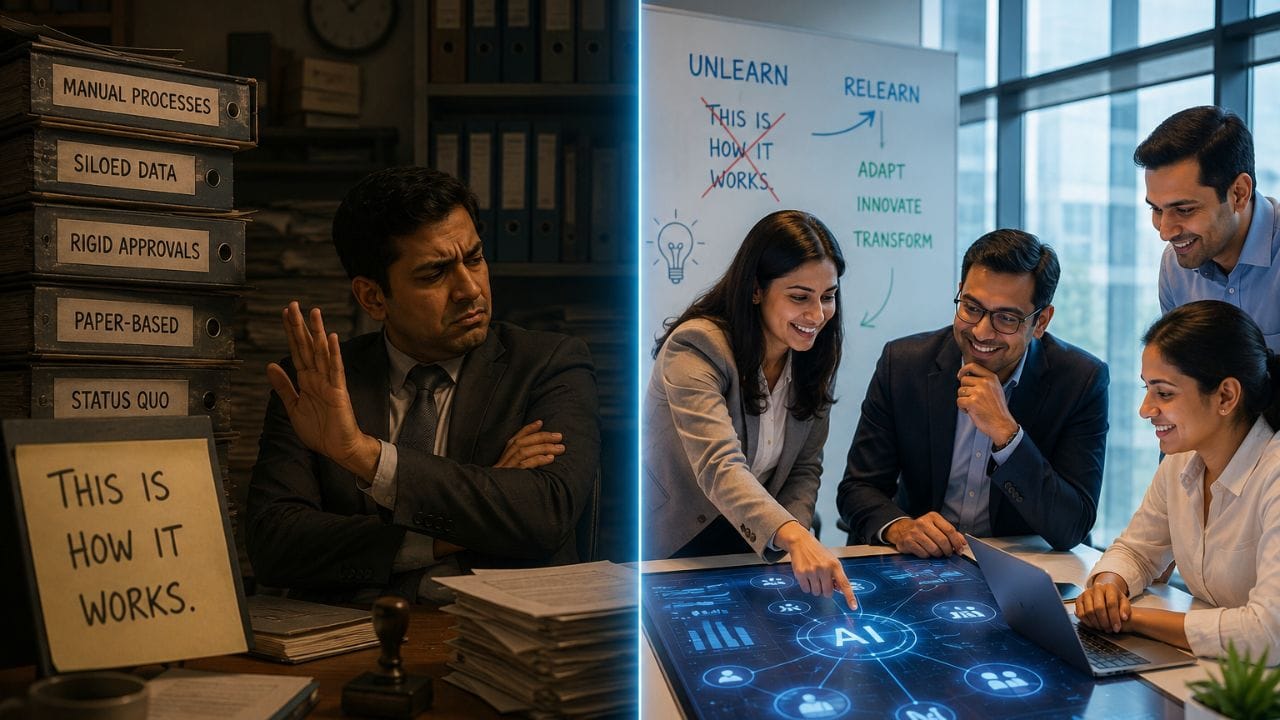
If I had to name one thing, it wouldn't be a skill, it would be a phrase: "This is how it works."
We're actively encouraging people to remove that phrase from their vocabulary because it stops people from questioning, unlearning, and adapting.
Today, growth is all about unlearning and then relearning. If we don't challenge the way we've always done things, we won't be able to embrace new ways of working.
As a leader, how has your own 'Inner Compass' shifted during this workforce transformation? What is the one thing about human nature that you have realised AI can never replicate, which you are now doubling down on in your leadership strategy for 2026?
One thing I consciously do is observe how young people work. There's a lot to learn from them. They're confident, clear about what they want, and articulate.
The way the younger generation learns, solves problems, and sees the world has influenced how I think about leadership.
If you want to engage young talent, you have to understand their language and mindset. The days of simply telling people what to do are over.
Leadership today is about influence, not authority. It's about helping people understand why something matters and inspiring them to embrace new challenges. That's the biggest shift I've seen, and it's how my own leadership has evolved.
This story is part of CHRO Perspective, a People Matters series featuring bold ideas and real-world insights from India’s top CHROs. Stay with us for more perspectives that power the future of work.