








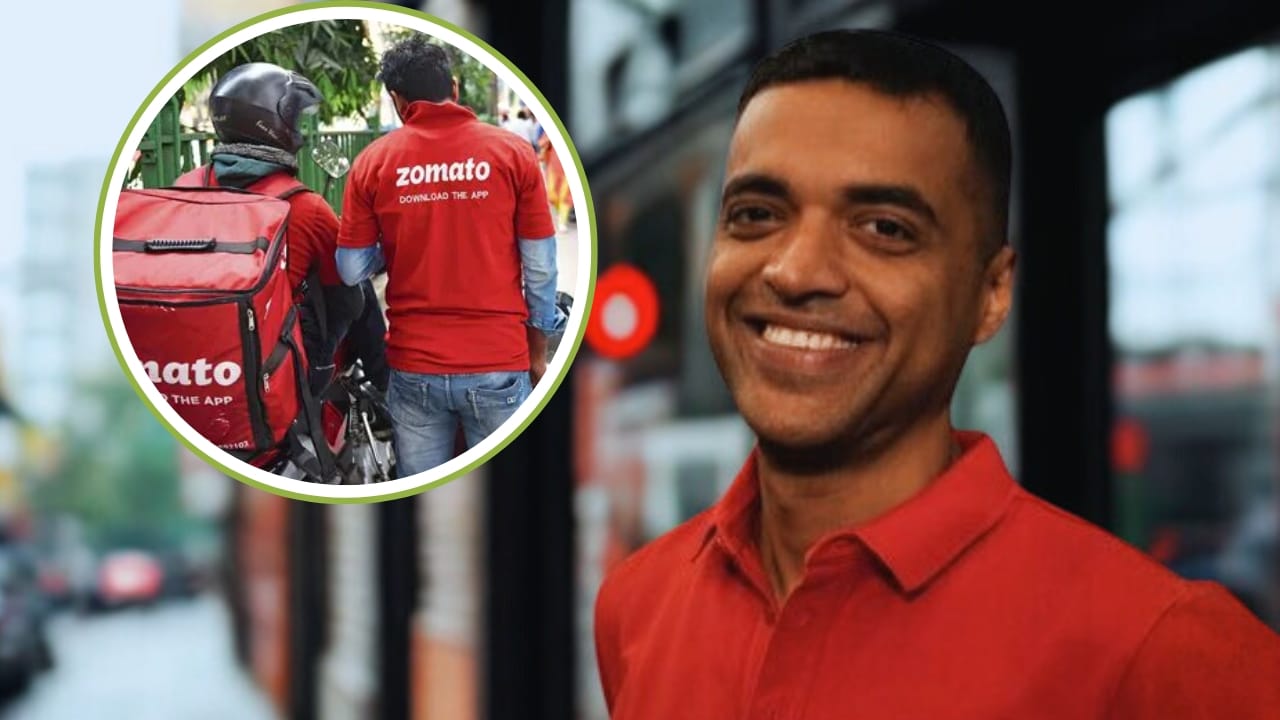
The debate over India’s gig economy has sharpened once again, with Zomato founder and CEO Deepinder Goyal stepping forward to publicly defend the company’s delivery model amid mounting criticism over earnings, safety and the pressure of ultra-fast deliveries.
In a five-point statement posted on X, Goyal sought to counter claims that quick commerce pushes delivery partners into unsafe conditions or exploits labour under the guise of flexibility. The intervention comes just days after holiday-period walkouts by delivery workers renewed attention on pay structures and welfare gaps in platform work.
A defence framed by data
At the core of Goyal’s argument is a clear line: gig work on Zomato is not designed to function like full-time employment. Calls for provident fund contributions, guaranteed salaries or fixed schedules, he said, misunderstand the model’s intent.
To support this, Goyal shared platform-level data:
-
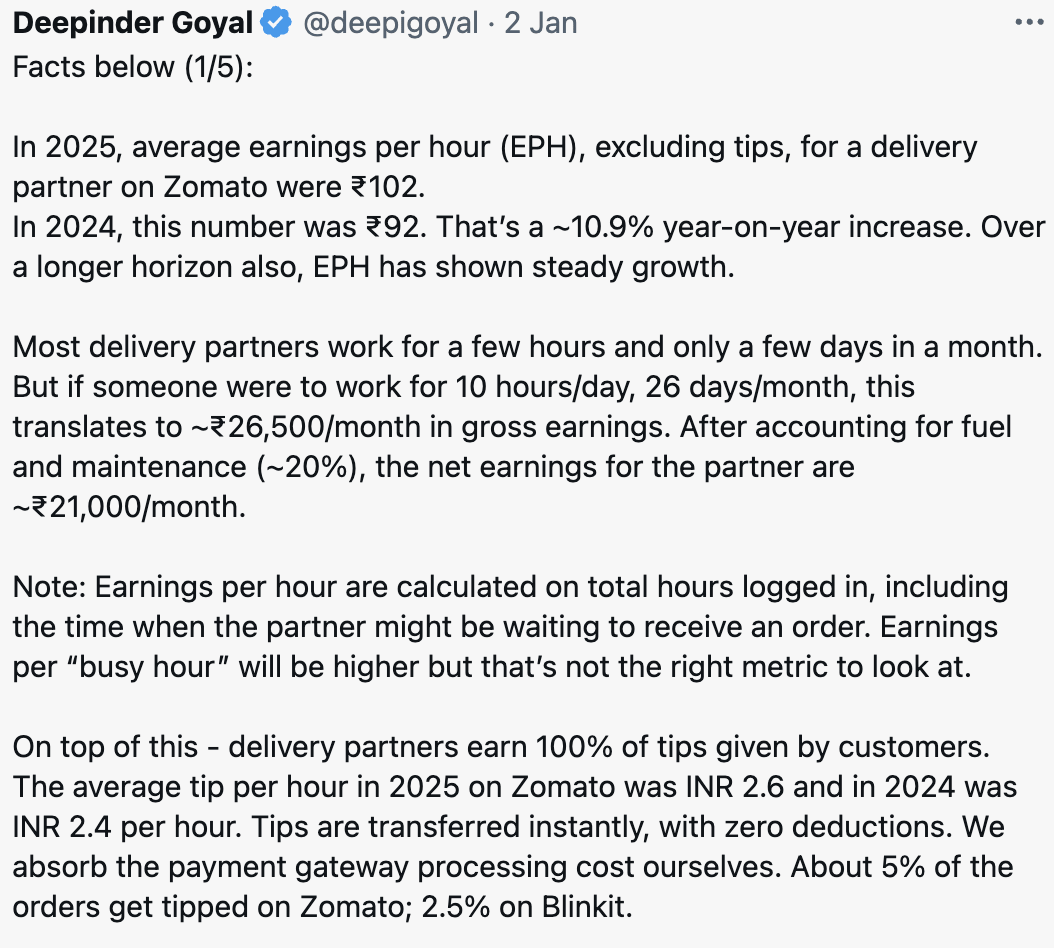
Average earnings per hour (EPH) for a Zomato delivery partner in 2025 stood at ₹102, excluding tips, up from ₹92 in 2024—a 10.9% year-on-year increase, he said.
-
Over a longer horizon, Goyal said, hourly earnings have shown steady growth.
On tips:
-
100% of customer tips go to delivery partners, instantly and without deductions, he said.
-
The average tip per hour was ₹2.6 in 2025, up slightly from ₹2.4 in 2024.
-
However, tipping remains limited: only around 5% of Zomato orders—and 2.5% on Blinkit—receive tips.
Work patterns and the ‘gig’ argument
Goyal also rejected the claim that delivery partners are overworked.
-
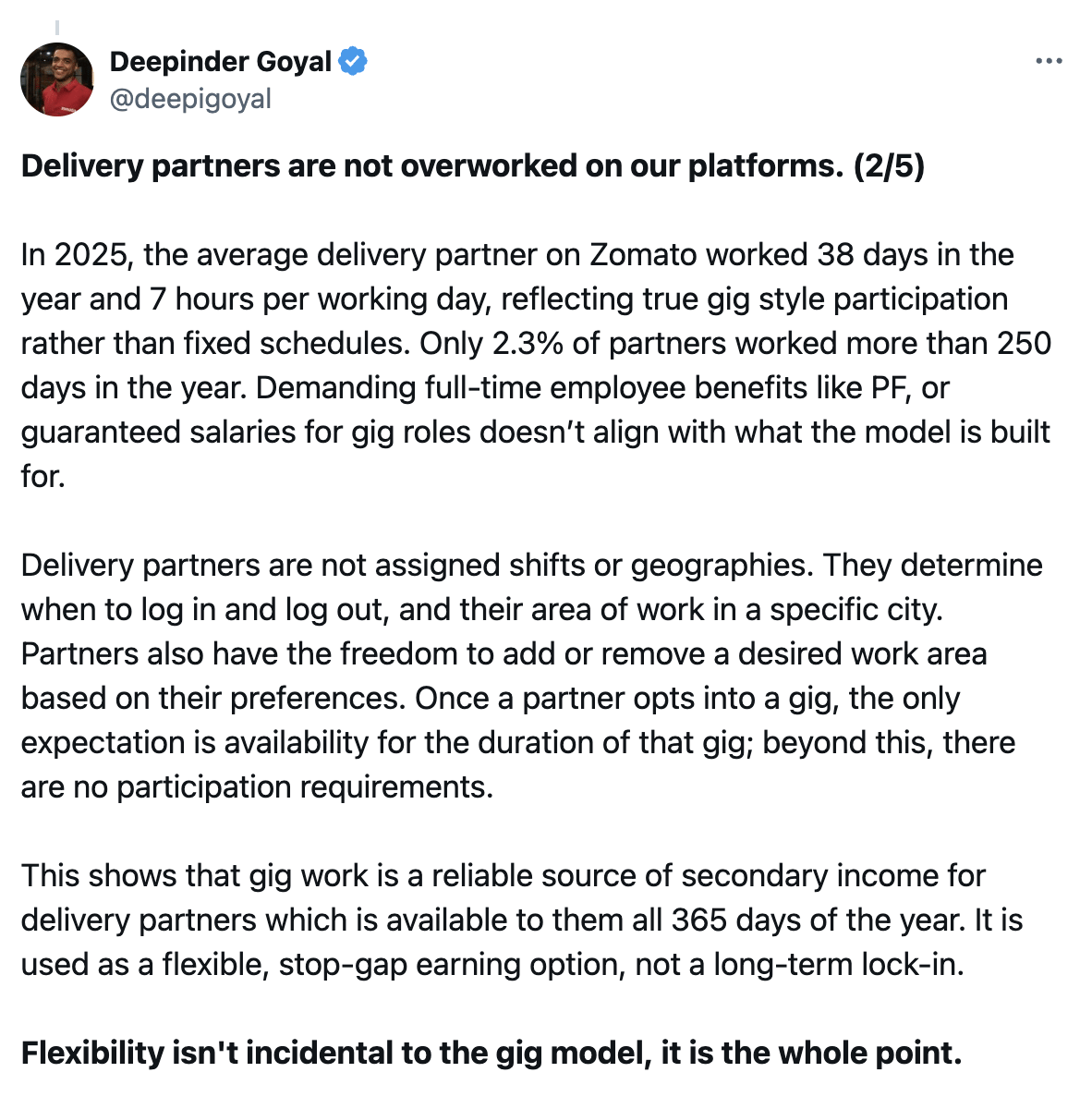
In 2025, the average delivery partner worked 38 days in the year, typically logging seven hours per working day.
-
Only 2.3% of partners worked more than 250 days annually.
These figures, he argued, reflect “true gig-style participation”—short-duration, opt-in work rather than continuous employment.
Crucially, he said:
-
Delivery partners are not assigned shifts or geographies.
-
They choose when to log in, when to log out, and where to operate within a city.
-
Partners can add or remove preferred work areas based on personal choice.
“Once a partner opts into a gig, the only expectation is availability for the duration of that gig,” Goyal wrote, describing platform delivery as a flexible, stop-gap income option, not a long-term lock-in.
The pressure of speed
The most contentious issue remains 10-minute delivery promises and whether they translate into unsafe behaviour on the road.
Goyal rejected that premise outright:
-
Delivery partners do not see customer-facing delivery timelines.
-
There is no countdown timer in the delivery app, he said.
-
Faster deliveries are driven primarily by store proximity, not higher speeds.
At the same time, he acknowledged the limits of platform control. Road safety, Goyal said, remains a systemic challenge across logistics and requires shared responsibility—from infrastructure and enforcement to customer expectations and individual behaviour.
Welfare without employee status
While resisting calls to classify delivery partners as employees, Goyal highlighted a growing layer of welfare support.
In 2025, Zomato and Blinkit spent over ₹100 crore on insurance coverage for delivery partners, with premiums fully borne by the companies.
The coverage includes:
-
Accident insurance of up to ₹10 lakh
-
Medical insurance of ₹1 lakh, plus ₹5,000 OPD cover
-
Loss-of-pay insurance of up to ₹50,000
-
Maternity benefits of up to ₹40,000
Additional support measures include:
-
Two rest days per month for women delivery partners
-
Income tax filing support, used by 95,000 partners
-
Access to a gig-specific National Pension Scheme, with 54,000 partners enrolled
-
An SOS service for emergencies such as accidents, theft or vehicle breakdowns
Goyal framed these initiatives as targeted interventions, not steps toward a traditional employer–employee relationship.
The statement lands amid intensifying scrutiny of platform work.
YouTuber Dhruv Rathee recently pressed Goyal to release earnings data to allow comparisons with entry-level formal jobs. Former Jet Airways CEO Sanjiv Kapoor questioned whether India truly needs 10-minute deliveries, suggesting longer timelines could better balance consumer convenience and worker safety.
At the policy level, the debate is unfolding alongside government efforts to extend social security coverage to gig and platform workers under the Code on Social Security. As the Times of India reported, draft rules propose thresholds for eligibility and aim to provide health, accident and old-age protection to a sector long defined by informality.
Goyal closed his post with a pointed question: “Now tell me, is this unfair?”
For policymakers, platforms and workers alike, the answer remains unresolved. As India’s gig economy scales, the tension between flexibility and security—now laid bare by strikes, draft regulations and a CEO’s public defence—appears set to define the next phase of platform work.