
Balance sheet approach sounds like a financial term and is well meant to reflect the principles of a financial balance sheet. Like in a Balance sheet, the sum of items on the left-hand side (LHS) will equal the sum of items on the right-hand side (RHS). Similarly, the Balance Sheet approach of compensation is aiming to balance the host vs. home costs for income taxes, social security, goods and services, and housing. Thus, the employee is no better or no worse off.
Trends:
According to Mercer’s 2017 WIAPP Survey, 79% of the companies globally and 49% of Indian companies follow the Balance Sheet approach.
Fundamentals of Balance sheet approach:
Balance Sheet approach starts with the understanding that an employee typically partitions their guaranteed cash compensation in four big buckets.
Balance sheet calculation is influenced by assignee income at home country and family size. It is also adjusted over a period of time, to take into account the influence of inflation and exchange rate fluctuation, in both, the home as well as the host country. This truly maintains assignee purchasing power parity.
There are tools available by consulting firms such as Mercer, AirInc, and ECA, which help in the calculation of balance-sheets for each assignee. These consulting companies update the values for inflation, currency, cost of living and quality of living, regulations on tax and social security on a regular basis, through thorough research. Thus, as an HR person, you do not need to collect all the external data but instead rely on tools and calculators, readily available.
Let’s understand balance-sheet calculation, with an illustration below:
Part A We start with the Gross Home Country Income, for India that would refer to annual guaranteed cash + PF (defined contribution social security)
- Example: INR 70 Lacs is Gross Home Country Income
Part B We net the same, post income tax and social security. This will be called Net Home Country Income. We park this value, for computation of Net Host Country Income
- Example: INR 50 Lacs is Net Home Country Income
Part C Calculation of allowances:
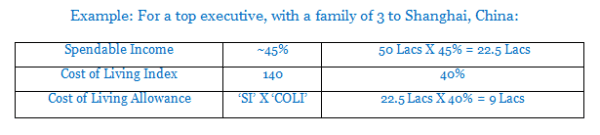
- Cost of Living Allowance: Cost of Living Index (COLI) X Spendable Income (SI)
- Cost of Living Index: It is calculated based on the cost differential of the basket of goods and services, between home city and host city. It is important to note that price fluctuation and currency fluctuation impact the volatility of this index and thus, it needs to be monitored on a regular basis. The basket of goods and services plays an important role as well
- Spendable Income: Based on the income level of the assignee and family size, the Spendable Income is calculated on Net Home Country Income. Spendable Income is an important factor since it will be used to calculate the cost of living allowance, along with the Cost of Living Index.
- Cost of Living Index: It is calculated based on the cost differential of the basket of goods and services, between home city and host city. It is important to note that price fluctuation and currency fluctuation impact the volatility of this index and thus, it needs to be monitored on a regular basis. The basket of goods and services plays an important role as well
It is important to note that two incumbents, going to the same location and having same net home country income, may get different cost of living allowance, if one is taking their family of 4 and the other is not taking their family. Since spendable income takes into account the family size.
- Hardship Allowance: Hardship Index X Gross Home Country Income
Hardship Index may also be called 'quality of living' index. All global mobility consulting organizations provide this index. This index could be based on only host city or a comparison of home city and host city. Evaluated factors include political stability, violence, and hostility, natural conditions and disasters, availability of schools of international standards, availability of medical services, public infrastructure such as roads, etc.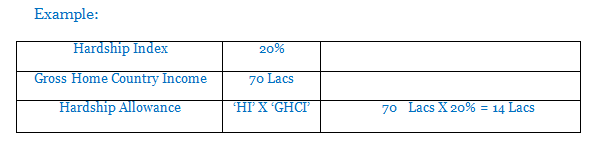
Part D Arriving at Net Host Country Income (guaranteed)
- Net Home Country + Cost of Living Allowance + Hardship Allowance + Mobility Premium (if any)
- Example: 50 Lacs + 9 Lacs + 14 Lacs + 10 Lacs = INR 83 Lacs = CNY 783,230
Part E Arriving at Net Host Country Income (with benefits):
- Net Host Country Income (guaranteed) + Benefits such as Car Allowance + Schooling + Housing Rent + Utilities
- Example: CNY 783,230 + CNY 287,000 (school 1 kid) + CNY 216,000 (house) + car on actuals = CNY 1,286,230
Part F Gross up Net Host Country Income (with benefits) with Income tax and social security to arrive at the total international assignee package
- EXAMPLE: Net Host Country Income (with benefits) – CNY 1,286,230 to be grossed up for tax and social security.
Part G Variable pay in the host currency is added to the Gross Host Country Income (with benefits) to arrive at the final assignee package.
When is balance sheet approach used:
- As illustrated in the example above, the Balance Sheet approach has a tight linkage with Home Country Income. Balance sheet maintains equity with home-country peers and facilitates easy repatriation. Additionally, the assignee is always aware of the home salary, that they would return to.
- It facilitates easy mobility to the future destination, irrespective of it being a high wage or lower wage country. Thus, if you need to move the assignee from Shanghai to Dhaka now, you merely need to run another Balance Sheet Calculation from Delhi to Dhaka.
- Balance sheet approach works well in case of movement from low wage to high wage country, as well as the reverse.
How are increments managed:
- Increments are typically awarded annually on the home country income and as per the home country merit matrix. Organisations usually maintain a shadow salary for increments and repatriation.
- The post-increment home country income structure is then run through the balance sheet approach, annually
Read the introduction to the series here