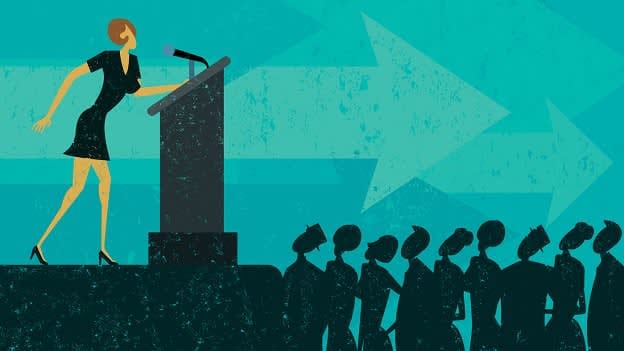
Much of the discussion about career women and woman leadership continues to focus on ceilings and barriers. Power, access and opportunities continue to be unequally distributed based on gender. In India, women comprise only one-fifth of the total labour force1, and the gap between men and women widens as the leadership ladder goes up, with only 7 percent of the board room seats are held by women2. Years have passed since the Center for Creative Leadership’s publication of Breaking the Glass Ceiling (Addison- Wesley, 1987) and the follow-up book, Standing at the Crossroads: Next Steps for High-Achieving Women (Wiley, 2002) but the basic issue still exists.
While research has consistently shown the value that women leaders bring to their companies3, women still remain scarce at the top of organizations. With 40 percent of the global labour force currently female, only 4.6 percent of Fortune500 CEOs are female4. This gap at the top also manifests itself throughout the workplace and workforce. There continues to be critical shortages of skilled labour and an expanding gap in the number of next generation mid managers and senior leaders. Wise organizations see the importance in identifying critical strategies that drive talent sustainability. Creating the conditions wherein all employees flourish includes having a culture of development for all. The Center has found that while organizations study how to adopt and expand leadership practices that identify, develop, accelerate and retain talented women and men, most are falling short in both categories. The gap is more significant when it comes to women.
Only a few organizations can be identified as establishing best and next practices in creating cultures wherein women flourish. Fewer still invest in next generation women leaders by reaching out, investing in and developing young women and girls in the areas they operate.
What are the barriers for women’s career advancement? What can individuals and organizations do?
Understand the barriers
These days, women at the workplace are intelligent, smart and ambitious. A McKinsey survey report states that 79 percent of entry-level women and 83 percent of middle-management women desire to move to the next level at work5. Additionally, 75 percent of women aspire to progress to top management roles, including C-suite – this number puts their ambition on par with their male counterparts5.
However, women still face barriers in their climb to the top. Many of these barriers result from a “second-generation gender bias”, i.e., unintentional actions and environments that appear neutral but reflect masculine values, and the life situations of men who have been dominant in the development of traditional work settings. These barriers include:
- Traditional perceptions of leadership are often associated with predominantly male qualities – a prototype of a leader is typically a masculine man.
- Many standard organizational practices reflect men’s lives and situations. For example, a career path to senior leadership position in multinational companies often includes some overseas rotation or assignments, which assume that spouses can easily move along – a situation that is much less likely for women than men.
- Women are expected to take up more family responsibilities than men. This may be especially so in Asia, where familial commitment and values are deeply entrenched in the culture.
- Women face a double bind of being either capable or liked—but not both.
- Women have limited access to network and sponsors, and have few female role models at high levels of leadership to look up to.
- Women are hesitant to advocate for themselves or ask for what they want.
Organizational support
It is a challenge for organizations to develop, retain and promote talented women. We believe that a strategic combination of individual development and a systemic shift in mind-set is the solution as well as a review and in some cases an audit of the organizational culture.
Individual development
The choice to and how individuals take up leadership roles is fundamentally a question of identity. When a woman leader internalizes a leadership identity, she is likely to demonstrate behaviours that assert leadership. An example would be her willingness to go in for challenging assignments, seek growth opportunities, and take risks. Such behaviors will, in turn, be affirmed by the people around her, who regard her as a leader and reinforce her leadership identity.
However, many women find it difficult to internalize such leadership identity. This is because in most cultures, leadership is associated with masculinity while women are expected to be soft-spoken, caring and friendly. The mismatch between traits attributed to women and that of leaders is the essential reason of the struggle that potential women leaders face.
Hence, the goal of individual development is to help women talent overcome the “second-generation gender bias” and discover their true identity so that they feel empowered to be both women and leaders. It is especially important to help women discover their purpose and passion in life, as a sense of higher purpose motivates leaders to overcome fear, move out of the comfort zone, and think of what is possible. We suggest a robust development process that provides talented women with opportunities to learn and grow in gender specific and gender neutral environments while encouraging the expansion and access to open networks for influence and development.
- Developing women leaders in an all-women setting
With the aim of developing individuals, a women-only leadership program provides participants with a novel context that contrasts the more familiar, male-dominated work environment. Such context allows the shared experience of gender to inform the content and support the conversation, thus fostering learning and provoking insight. Among fellow women leaders, participants feel more comfortable to discuss issues that are pertinent to them, without worrying about judgment.
- Developing women leaders in mixed gender settings
Leadership development should occur in a variety of venues, with different designs to achieve different objectives. Over the course of their careers, women talents can, and should attend not only women-only but also mixed-gender programs. A mix-gender program resembles the real life situation where women need to work with men and have cross-gender conversation. Introducing the discussion of gender issues in such setting provides additional value as women can hear men’s opinion and with the exchange of ideas, both sides will have a better understanding of each other.
- Mapping and managing network strategically
While formal learning experiences are important to growth, establishing strong and open networks are critical in navigating organizational structures with embedded (and often hidden) power and political infrastructure. Mentors, coaches and sponsors - inside or outside the organization - provide important resources and information and play important roles in women’s leadership journey. Mapping existing individual and organizational development networks help women create access to these development assets. Moreover, because people are more willing to follow leaders who can connect them to resource and information, women’s ability to build strategic network also make themselves more valuable, and powerful.
- “Long tail” approach of development
Leadership development is a journey; there is no one-off solution for it. For those who aim to enhance leadership skills by attending a leadership development program, a “long tail” approach is appropriate. Pre-work is important to prepare participants for the program and maximize the learning during the program. More importantly, learning should be extended beyond the classroom. After the residential program, structured follow-up helps participants to solidify and apply the learning in real life. The “long tail” can be carried out in various formats including mentoring circles, developmental conversations, and e-learning etc.
Systemic shift
A deep understanding of the unconscious bias that affects women in organizations is essential to promote more women leaders. With senior leaders’ support, HR leaders can look for ways that unconscious bias in the organization affects opportunities and motivation for women, rethink the talent management process and identify potential areas for improvement. Some practices that may help women talent include:
- Flexible working conditions
- Support for work and family life balance
- Gender-specific hiring
- Networking opportunities for women
- Coaching, mentoring and sponsorship for potential women talent
Women can also spearhead their own development by playing active roles in the process. For example, by getting involved in discussing gender biases, women are likely to realize how they have sometimes participated in reinforcing these biases in society and potentially within their respective organization. They may also arrive at possible factors that prevent women from advancing into senior leadership positions within their organizations. A deep appreciation for gender biases engenders a commitment to being a change agent in the workplace and community. Individual development programs also enable actions, like mentoring others and being a positive role model, to make significant impact on the lives they touch, and ultimately, reinforcing a positive cycle. Moreover, the world is not complete without strong and positive dynamics between men and women. As the HeForShe campaign states, change won’t happen if only half of the population is welcome to the discussion. This is true in society and is true in the workplace. In a world that may still be disproportionally influenced by men it is more critical that boundaries are spanned and bridges are built to create safe passages for the flow of skilled labour regardless of gender and increase the number and influence of half of the world’s population.
References
- McKinsey study
- Deloitte Women in the boardroom A global perspective.
- Catalyst, (2013). why diversity matters
- Catalyst, (2015). Women CEOs of the S&P 500.
- Barsh, J., & Yee, J. (2011). Changing companies’ minds about women. McKinsey Quarterly.
- Devillard, S., Sancier, S., Werner, C., Maller, I., & Kossoff, C. (2013). Gender diversity in top management: moving corporate culture, moving boundaries. Women Matter 2013. McKinsey & Company.