








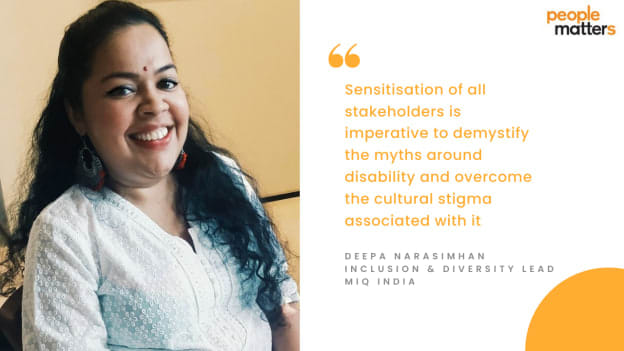
Deepa Narasimhan is the Inclusion and Diversity Leader at MiQ India, a leading market intelligence company.
Currently based in Bangalore, she comes with more than 12 years of experience in conceptualising and implementing the overall strategy for promoting diversity & inclusion initiatives. Prior to MiQ, Deepa spent more than a decade with Dell Technologies. She is a 'Diversity and Inclusion Champion', 'Startup Evangelist', 'Advisory member of Social Enterprise' and 'Thought leader in Inclusion'.
Deepa has been a passionate advocate for mainstreaming persons with disability and LGBTQ+ employees in the corporate sector. She spearheaded ERG initiatives, Disability Empowerment across APJ regions, including Redefine Abilities, Diversity Recruitment, Outreach programs, University connect, Social Impact Programs, Employee and Volunteering engagement & Inclusion training programs.
Deepa is a strong supporter of gender equity and diversity especially in the IT/ITES sector. She is a member of various government as well as private D&I forums including Advisory board for rural development, Trust member for Kickstart cabs (Wheels of change 2019), International Committee of the Red Cross (ICRC - 2017), Disability Technology Start-ups, Confederation of Indian Industry (CII) and a speaker at various international forum including TEDx – Bangalore and she is also a proactive technology evangelist.
In this exclusive interview with People Matters, Deepa talks about MiQ's top three DEI priorities, the myths that hinder employment and growth opportunities for differently-abled talent and advises how to overcome challenges prolonging sustainable DEI.
Here are excerpts of the interview.
What are your top three DEI priorities for 2022?
Inclusion & diversity is the foundation of our culture, and a source of pride for our company. We respect good ideas & aim to fully represent our people to create lasting equity. We love different personalities at MiQ and strive to build teams constructed with diverse backgrounds and inclusive points of view. We believe that higher the diversity representation, greater the performance. The three areas of emphasis for us are as follows:
Inclusion Everyday - Globally, we are constantly striving to be better supporters of one another and to invest in our own progress towards an inclusive culture. Taking similar action in India would entail identifying how we learn and grow in order to broaden our gender focus, implementing awareness and sensitisation programmes, and ensuring that one's workplace makes you feel secure when bringing your entire self to work. Where you'll learn and be challenged, where you'll be rewarded and recognised for your efforts, and where you can succeed regardless of who you are, where you're from, or what makes you unique. There ought to be Allyship for Neurodiverse People to empower everyone to be a better version of themselves.
Diversity Drives Innovation - We cultivate voices from all identities at all levels, particularly in decision-making environments, because we know that diversity fosters innovation. A key focus and continued goal will be the hiring of women into management and leadership positions.
Empowering our internal communities through Employee Resource Groups (ERG), helping and providing support, creates a better work environment and aims to foster a diverse workforce. One of the goals is to attract diverse talent, which can only be accomplished through an inclusive company culture.
Systemic Change - We unite to promote fair and equitable practices throughout the entire business.
Inclusion in a leadership programme empowers decision-makers.
- In order to create a welcoming environment for employees and new talent, the key factors that will drive change will be inclusive language and inclusive policies.
- We've organised Virtual Basic Indian Sign Language classes led by EnAble India to help foster a more inclusive culture. Participants learn sign language and gain knowledge about Deaf people and culture in order to contribute to the community. The Signlusion programme includes a mentorship component in which team members are paired with 30 Deaf students to interact with and learn together. This programme promotes deaf inclusion by raising awareness.
- Increasing the accessibility of our physical and technological platforms
- Ensuring each person has what they need to be successful at their jobs i.e benefits, reasonable accommodation, parental leave policy
What are some of the biggest challenges prolonging sustainable DEI? How can organisations overcome these?
There are a couple of reasons why organisations find instituting a sustainable DEI model challenging, such as lack of data available. The other challenge is that each generation: baby boomers, Gen Z, and Millennials, all have different issues prevalent, so it has to be continuously upgraded. The progress is not tracked, amongst other challenges.
The way organisations can overcome this is by undertaking a Risk and SWOT analysis which helps us arrive at the solutions.
- Challenge 1: What is the future model of work looking like, Hybrid or remote?
- Challenge 2: How do we ensure employee engagement and retention?
- Challenge 3: Will the talent team be able to find underrepresented communities?
- Challenge 4: Maintain open communication around vaccines and be inclusive in our communication, as the future is very uncertain and you can’t anticipate COVID.
- Challenge 5: Be mindful of employee burnouts
- Challenge 6: Polarity of voices - Creating a safe work environment
We can overcome these challenges by -
- Establishing a long-term vision for Inclusion & Diversity space
- Understand that employee recognition is very critical and incorporate the recognition process
- Make an impact on the community by showcasing real stories / voices so that the community can be heard and drive further engagement
- Making sure to have more Inclusion Ambassadors and I&D Committee to help us drive key initiatives
What does the corporate landscape look like for differently-abled talent? How is MiQ working towards enhancing inclusion for differently-abled talent?
A media report indicated that persons with disabilities (PWDs) constitute less than 0.5% of employees in India’s top companies. These figures indicate the low employment opportunities for this underrepresented segment in the corporate sector. This untapped talent pool with immense potential and skillset are waiting to be tapped.
Several reasons work as barriers for differently-abled talent to enter the workforce. It could range from lack of infrastructure, lack of financial support/ sourcing avenues, myths around additional expenditure in the recruitment of PWDs, lack of encouragement from family and society, negative perception of their work-related abilities, negative attitudes and insensitivity stemming from ignorance, stereotypes, and fear of backlash.
Driving innovation to solve some of these challenges internally, we introduced I&D topics in our Hackathon platforms recently. This was a great way to build awareness for the problem/ challenges and find innovative ways to integrate these into the business. Some of the initiatives MiQ has taken are:
- Underpinned accountability through data and workplace safety
- Neurodiversity ERG
- Hiring differently-abled talent in India
What are some myths and stereotypes that hinder employment and growth opportunities for differently-abled talent?
There are few roadblocks that interfere with the ability of differently-abled talent to have equality in employment, resulting from lack of experience and interaction with differently-abled talent.
The lack of familiarity nourishes negative attitudes concerning employment of differently-abled talent. It’s important to learn the facts to remove these roadblocks and to stop discrimination.
Some of these myths are:
- Employability and skill gaps are some of the myths that are very common for differently-abled talent. It's important to ensure that companies undertake proper training to ensure they create more awareness and reduce bias amongst peers.
- Accommodating workers with disabilities costs too much - Reasonable accommodation is usually far less expensive than many people think. In most cases, an appropriate reasonable accommodation can be made without difficulty and at little or no additional cost. A recent study commissioned by Sears indicates that of the 436 reasonable accommodations provided by the company between 1978 and 1992, 69% cost nothing, 28% cost less than $1,000, and only 3% cost more than $1,000.
- Opportunities to transfer into a new role - While it is important to do job analysis to find better matches that can enable differently-abled talent and the right fitment for them to excel/perform a particular job, enabling internship, training and hire model helps instil opportunities for beginners in this field.
- Setting up people for success - ensure platforms are accessible, peer sensitisation and enabling tools
- Enablement - Accessibility and Reasonable Accommodations–Organisations are ensuring that they provide differently-abled talent with disabled friendly infrastructure, accessible tools and technology and a formal accommodations program.
- Sensitisation -To ensure acceptability and smooth transition of PWDs in the workforce, sensitisation of all stakeholders, from the leadership to HR, recruitment leads and teams, facilities and operations teams and peers of the new recruits is important. This is imperative to demystify the myths around disability and overcome the cultural stigma associated with it. As part of the onboarding process, organisations like Lemon Tree make it mandatory for employees to go through sign language training to promote ease of communication with their colleagues with speech and hearing impairment.
- Accessibility audits- I&D committee last year did a local market audit, as part of the exercise the team came up with recommendations for both physical and policy inclusion checklist for each region.
What are some ways to weave inclusion and allyship in the flow of work, rather than occasional conversations?
We all have a role to play in creating a safe workplace.
At MiQ we have observed 84% active allyship to ensure inclusion at all levels. We conduct bystander intervention, neurodiversity celebration weeks, islamophobia awareness sessions, broaden inclusion and initiatives through immersive workshops and engagements (Pride challenge, Signlusion, IDPD week) . Over 96% employees at MiQ signed up for active allyship.
Particular to bystander intervention, the program is a mandatory training for Identity-Based Harassment. In this workshop, we practice specific actions to be better allies when we witness harassment or discrimination. We focus on the skills we need for effective bystander intervention when we witness people causing harm or being harmed in the workplace. This training is interactive and your colleagues benefit from your contributions.
At managerial level, we have implicit bias training where the managers are trained to manage inherent bias. Empower everyone with the StigmaZero Training - the online training dedicated to eliminating stigma around mental illness in the workplace.