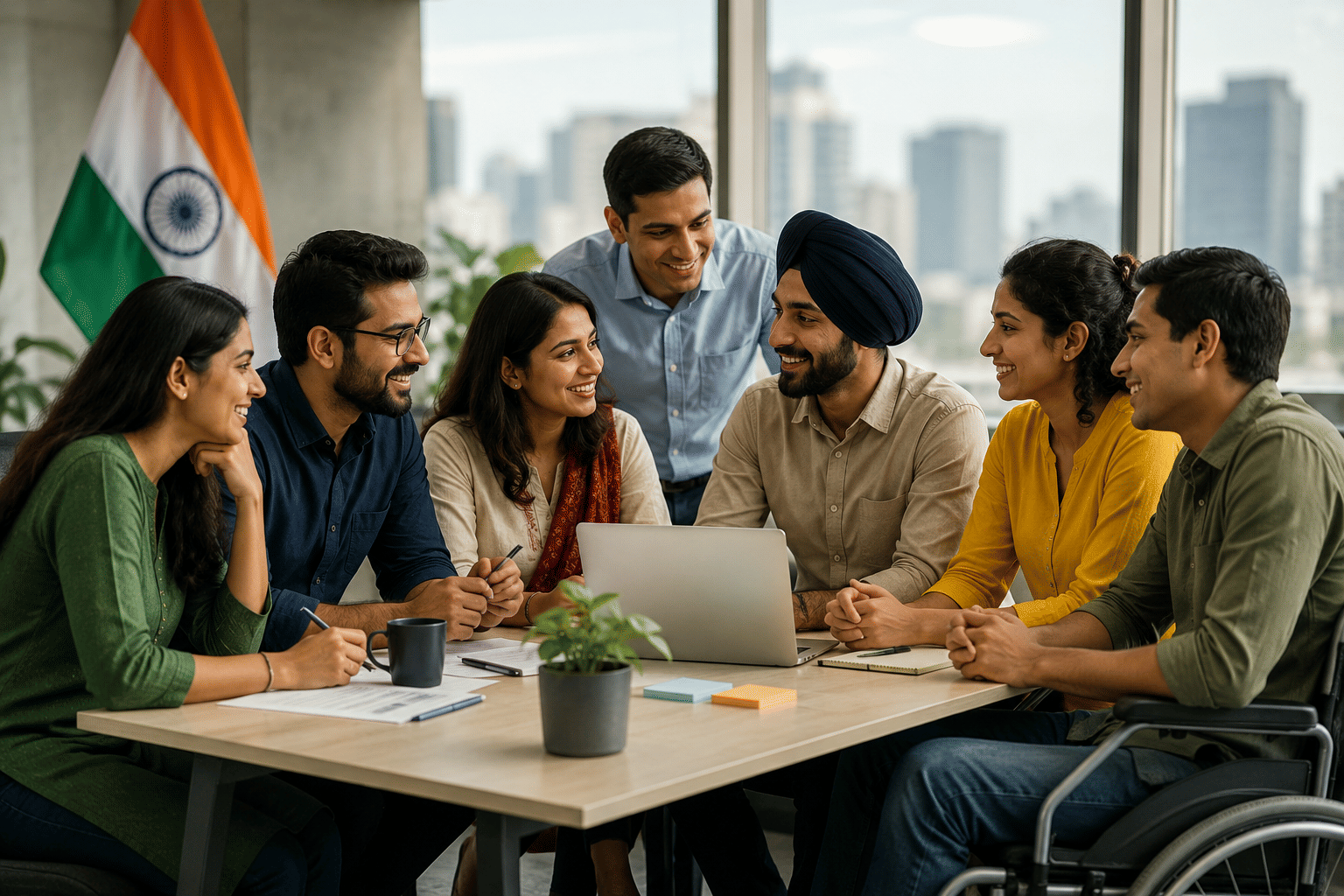
For years, workplaces were seen as places where people showed up, did their jobs and went home.
Now they are doing something else too.
They are teaching people how to work with someone who looks different, loves differently, thinks differently or comes from a completely different world.
That shift may sound subtle. It isn't.
According to Parmesh Shahani, Head of Godrej DEI Lab and author of Queeristan, it is one of the biggest reasons workplaces have become far more influential in shaping society than many people realise.
Think about it.
Most people spend more waking hours with colleagues than with family. They negotiate differences, build friendships, challenge assumptions and learn new ways of seeing the world, often without even noticing it.
"The workplace is where we form relationships, learn new behaviours, encounter people different from ourselves, and often challenge our assumptions," Shahani tells People Matters.
Unlike political debates, social media arguments or public campaigns, workplace interactions are personal. They happen every day. And that is often where change sticks.
The workplace is quietly becoming a social institution
For a long time, businesses were viewed largely as economic engines.
Make products. Create jobs. Generate profits.
But Shahani believes organisations are increasingly becoming cultural institutions too.
Not because they set out to be, but because of the influence they have on the lives of millions of people.
What's changed, he says, is that businesses increasingly recognise that inclusion is not separate from business performance. Diverse teams bring different perspectives, make better decisions and, according to some studies, are eight times more innovative than non-diverse teams.
That has transformed inclusion from a nice-to-have initiative into a business priority.
At the same time, workplaces have become places where people encounter difference in ways they may not elsewhere. Employees learn to appreciate the diverse abilities of colleagues and discover what it means to work towards a shared purpose.
Over time, those experiences travel beyond office walls.
"When organisations like ours create cultures of belonging, those values don't stay confined within our office or factory walls. Employees carry them back to their families, communities, and social networks. That's how workplace change gradually becomes societal change."
Workplaces don't just reflect society anymore. They influence it
Every organisation tells stories.
Not only through advertising campaigns, but through policies, leadership decisions, hiring choices and even the language it uses.
Shahani points to caregiving policies as an example.
At Godrej, the company uses terms such as primary caregiver and secondary caregiver instead of maternal and paternal leave.
The distinction may appear small. Yet it quietly challenges assumptions about who should care for children and whether caregiving roles must be tied to gender.
Similarly, when organisations hire transgender professionals in customer-facing roles or make accessibility a design priority, they shape public perceptions of who belongs.
These decisions rarely generate headlines.
But they help define what people see as normal.
And normal is powerful.
"Organisations shape society not only through what they sell, but through what they celebrate, support, and make visible."
The influence extends beyond the workplace too.
Shahani points to initiatives such as Queer Directions, a publishing imprint focused on queer voices, the Pride Fund supporting grassroots LGBTQIA+ organisations, and India Included on Campus, which encourages students at leading business schools to develop solutions around inclusion.
The objective, he says, is not simply to improve one organisation, but to help expand the wider ecosystem of ideas around inclusion.
Why Pride Month is the easy part
Every June, organisations launch campaigns, host events and celebrate Pride.
There is nothing wrong with that.
The problem, Shahani suggests, is when the celebration becomes the strategy.
His sharpest observation arrives when discussing what authentic inclusion actually looks like.
"The real question is what happens during the other eleven months."
That means asking less glamorous questions.
- Are LGBTQIA+ employees supported once Pride Month ends?
- Do inclusive benefits exist?
- Are there all-gender and accessible washrooms?
- Are leaders held accountable for creating belonging?
- Do people have pathways for growth and advancement?
Those questions rarely trend on social media. But they determine whether inclusion is real.
"The simplest test is whether the work continues when the spotlight disappears."
According to Shahani, authentic commitment shows up in policies, budgets, hiring decisions, leadership accountability and long-term investments. It is visible in the choices organisations make when nobody is watching.
People, he says, are remarkably good at spotting the difference between a campaign and a commitment.
When companies moved before society did
One of the more striking parts of the conversation is Shahani's argument that workplaces have often moved faster than broader society.
Long before legal and social frameworks evolved, many organisations were already extending benefits to same-sex partners, creating gender affirmation policies and building support systems for LGBTQIA+ employees.
"In many cases, workplaces became safer spaces than society itself."
The same pattern has appeared elsewhere.
Mental health support entered workplaces before it became a mainstream public conversation.
Discussions around fertility, menopause, elder care and caregiving responsibilities often gained traction inside organisations before they did outside them.
Accessibility followed a similar path.
Employers experimented with assistive technologies, accessible infrastructure and inclusive hiring programmes while many public institutions were still developing their own approaches.
That does not mean workplaces have solved inclusion.
Far from it.
But it does mean they have often acted as testing grounds for ideas that later spread more widely.
As Shahani puts it, workplaces can often move with greater agility than larger social systems, allowing them to imagine and experiment with more inclusive futures.
Why employees want more than a salary
The relationship between employees and employers has changed dramatically.
People still care about pay.
But increasingly, they care about values too.
"Younger generations, in particular, are asking deeper questions about purpose, ethics, and impact."
Employees want to know what their organisation stands for, not simply what it sells.
That expectation is rooted in lived reality.
Issues such as gender equality, accessibility, mental health, caregiving responsibilities, safety and LGBTQIA+ inclusion directly affect people's lives. They influence whether employees feel respected, supported and able to thrive.
As a result, employees increasingly expect organisations to create environments where everyone has an equal opportunity to succeed.
That does not mean companies should attempt to solve every societal problem.
Shahani is clear that businesses cannot replace governments, courts, NGOs or civil society institutions.
Their role is different.
"A company is part of a wider ecosystem in society."
What organisations can do is ensure fairness, dignity, safety and equal opportunity within their sphere of influence while amplifying those values more broadly.
The next decade will be about belonging
If the last decade focused on representation, Shahani believes the next one will focus on belonging.
Representation still matters.
But representation alone is no longer enough.
"The most successful companies will move beyond representation alone and focus on belonging."
That distinction matters.
Representation asks whether someone has a seat at the table.
Belonging asks whether they feel welcome once they get there.
As artificial intelligence reshapes jobs, demographics shift, family structures evolve and employee expectations continue changing, organisations will be forced to rethink what inclusion means.
The companies that thrive, Shahani suggests, will stop treating inclusion as a programme run by HR and start seeing it as a leadership capability, a cultural practice and a business priority.