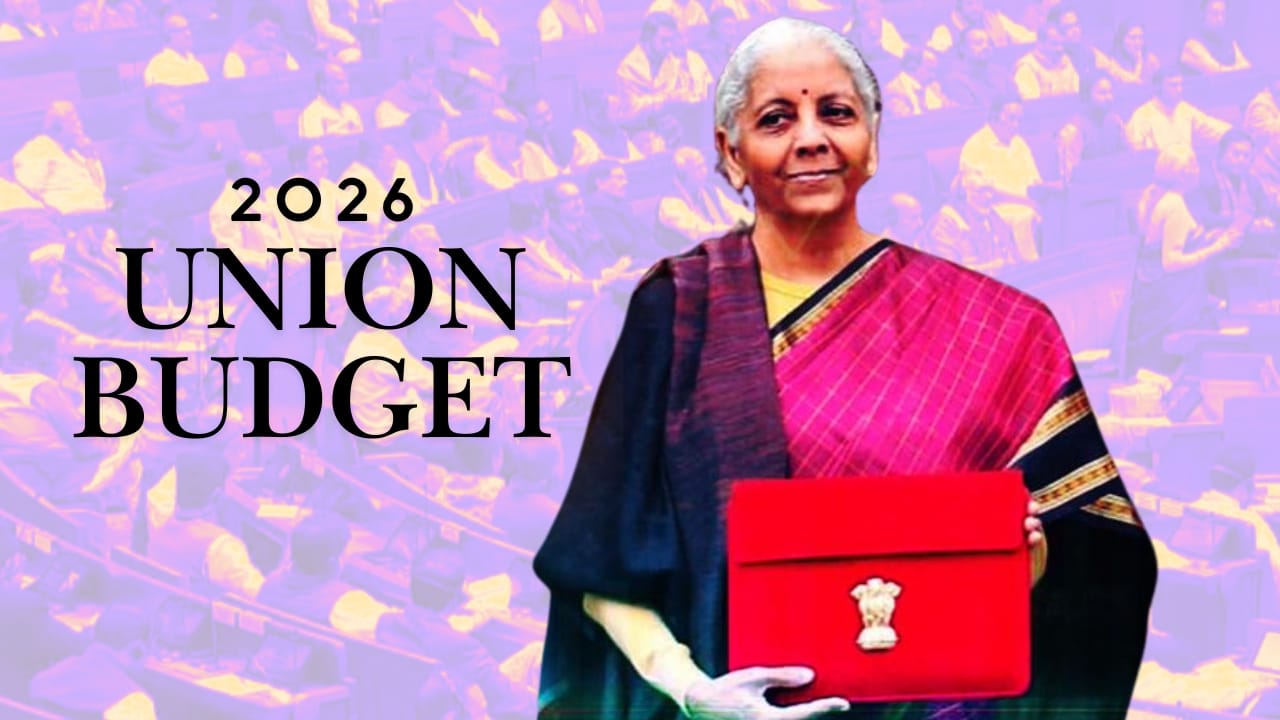
The Union Budget 2026 has landed with a clear signal to India Inc: the next phase of growth will be slower to headline, harder to execute, and far more structural in intent. From capital markets and infrastructure to skills, services, and workforce formalisation, the government has placed long-term capability over short-term stimulus.
What stands out is not a single flagship announcement, but a coherent thread running through the budget—a deliberate pivot towards services-led growth, deep capital formation, and job creation anchored in skills rather than scale alone.
Capital, infrastructure, and the geography of growth
At the macro level, the government has doubled down on capital expenditure, earmarking ₹12.2 lakh crore for capex, alongside ₹7.5 lakh crore for defence, while introducing an Infrastructure Risk Guarantee Fund to crowd in private investment by de-risking large projects.
For real estate and infrastructure-linked businesses, the budget redraws the growth map beyond traditional urban centres. Mr. Ramesh Nair, Managing Director & CEO, Mindspace Business Parks REIT, sees a structural shift taking shape:
“Budget 2026 signals that India’s next phase of growth will be powered by deeper capital markets and faster infrastructure creation. Easing foreign individual participation in Indian equities, alongside dedicated REIT structures for CPSE asset monetisation, strengthens the pipeline for long-term institutional capital across real estate and infrastructure. The push to develop City Economic Regions, supported by high-speed connectivity corridors linking Mumbai, Pune Hyderabad and Chennai expands the addressable opportunity for organised commercial real estate by enabling the formation of new business districts.”
He adds that the focus on strategic sectors and digital infrastructure could create sustained occupier demand:
“Critically, measures that support the digital economy — including safe-harbour clarity for IT services and a long-tenor tax holiday till 2047 for foreign cloud service providers setting up data centres in India — improve policy certainty, attract long-duration global capital, and create durable tailwinds for REITs through stronger occupier demand and deeper liquidity.”
Services move from support act to centre stage
If infrastructure provides the skeleton, services provide the muscle of Budget 2026. Multiple industry leaders point to a decisive shift in how the government views employment creation—away from volume hiring and towards productivity, skills, and formalisation.
Mr. Neelabh Shukla, Chief Business Officer, Careernet, calls it a turning point for the services economy:
“Budget 2026 clearly makes the services sector the next driver of job creation and ambition-based growth, particularly in a technology-based economy. The renewed emphasis on emerging technologies, including AI and missions in quantum or research-based innovation, recognises that the future of job creation will be increasingly skill-based rather than volume-based.”
He also highlights long-sought regulatory clarity for employment services:
“Regarding recruitment and manpower services, the Budget also offers a welcome breath of relief with much-needed regulatory clarity, as it explicitly addresses manpower supply under contractor TDS, eliminating uncertainties and compliance burdens.”
This clarity is echoed by Neeti Sharma, CEO, TeamLease Digital:
“Lower TCS on manpower services and clear TDS treatment finally address long-standing ambiguity for the staffing industry. This will directly improve cash flows and make large-scale formal employment easier to sustain.”
Education to employment: a policy bridge, not a slogan
The most widely referenced announcement across sectors is the proposed High-Powered ‘Education to Employment and Enterprise’ Standing Committee. Industry views it as an attempt to close a gap that has long plagued India’s labour market.
Naveen Tiwari, Co-Founder, Scrabble, frames it as a shift in philosophy:
“The Budget’s strong focus on skilling, employment, and structural reforms underscores a fundamental shift from job creation alone to workforce readiness and productivity.”
Sonal Arora, Country Manager, GI Group Holding, underscores the employability challenge:
“With the decision to form a high powered Education to Employment and Enterprise' Standing Committee, the government is recognizing the critical need to focus on employability by linking education to employment and entrepreneurship.”
For services exporters and GCCs, this linkage could determine India’s global competitiveness. Srinivas Nandigam, Managing Director – Global Capability Centre, Advance Auto Parts India, notes:
“Policy clarity around taxation for skilled global professionals can encourage longer term participation, enabling deeper expertise, leadership continuity and knowledge exchange within the workforce.”
Manufacturing, but with skills at the core
While services dominate the narrative, manufacturing has not been sidelined. The ₹40,000 crore push for Semiconductor Mission 2.0 and the acceleration of PM MITRA textile parks aim to convert trade agreements into domestic jobs.
Balasubramanian A, Senior Vice President, TeamLease Services, says:
“By scaling up the high-tech chip ecosystem and rejuvenating the labor-intensive textile sector—where job creation density is at its highest, these investments ensure India can fully honor the 'zero-duty' benefits of the recently signed FTAs.”
The emphasis, however, remains on skills, clustering, and formalisation, not low-cost labour. As Kartik Narayan, CEO – Jobs Marketplace, Apna.co, notes in the context of textiles:
“It recognises that scale, clustering and skills must move together if manufacturing is to deliver jobs with dignity and income growth.”
MSMEs, formalisation, and the credit constraint
For India’s vast MSME sector, the ₹10,000 crore SME fund is seen as a lever for formalisation rather than mere liquidity.
Kartik Narayan explains:
“We see this as a 'formalization engine'; shifting even a fraction of India’s 6.3 crore SMEs into the formal economy can trigger a massive surge in entry-level hiring.”
The budget’s approach aligns credit access with skilling, compliance, and digital systems—an ecosystem play rather than a standalone intervention.
Care, hospitality, and the future workforce
One of the quieter but more consequential shifts is the government’s focus on care, hospitality, and allied health—sectors with high employment elasticity and global demand.
Mayank Kumar, CEO & Co-Founder, BorderPlus, calls it a strategic move:
“This is about building India’s care capacity for the world. With ageing populations globally and rising care needs at home, scaling allied health professionals and caregivers can make India a global talent hub for healthcare.”
Dr Nipun Sharma, CEO, TeamLease Degree Apprenticeship, highlights the structural impact:
“By co-locating Education Hubs within 5 major industrial clusters, the Budget 2026 solves the 'Last-Mile Skilling' problem.”
The proposed National Institute of Hospitality further reinforces this direction, aligning education, industry, and regional development.
Markets, risk, and trade-offs
Not all reactions are unqualified. The rise in Securities Transaction Tax on derivatives has drawn concern from market participants, even as changes to buyback taxation are welcomed.
Mr. Ashwani Dhanawat, Executive Director and CIO, Shriram General Insurance, offers a balanced view:
“Net-net, this is a growth-focused, simplification-heavy budget with strong welfare and infra underpinnings—balanced by prudent revenue measures.”
A budget that bets on execution
Union Budget 2026 does not promise quick wins. Instead, it places its wager on execution, coordination, and institutional capacity—from education systems and capital markets to logistics corridors and digital infrastructure.
As Ashok Varma, Partner, Grant Thornton Bharat, sums up:
“The current Budget marks a shift from general, supply-driven skilling schemes to a demand-driven approach focused on job-relevant skills.”
For India Inc, the message is clear. Growth will come—but only to those prepared to invest in skills, systems, and scale over time.