








For the past few weeks, labour code conversations inside organisations have sounded oddly similar—regardless of sector, geography or workforce mix. Someone says, “We have to restructure CTC by March.” Another insists, “This is only for factories.” A third warns, “Fixed-term contracts will become a minefield.” Payroll teams start recalculating. Employees start guessing. Managers start improvising explanations.
The labour codes are now in force. But clarity is not.
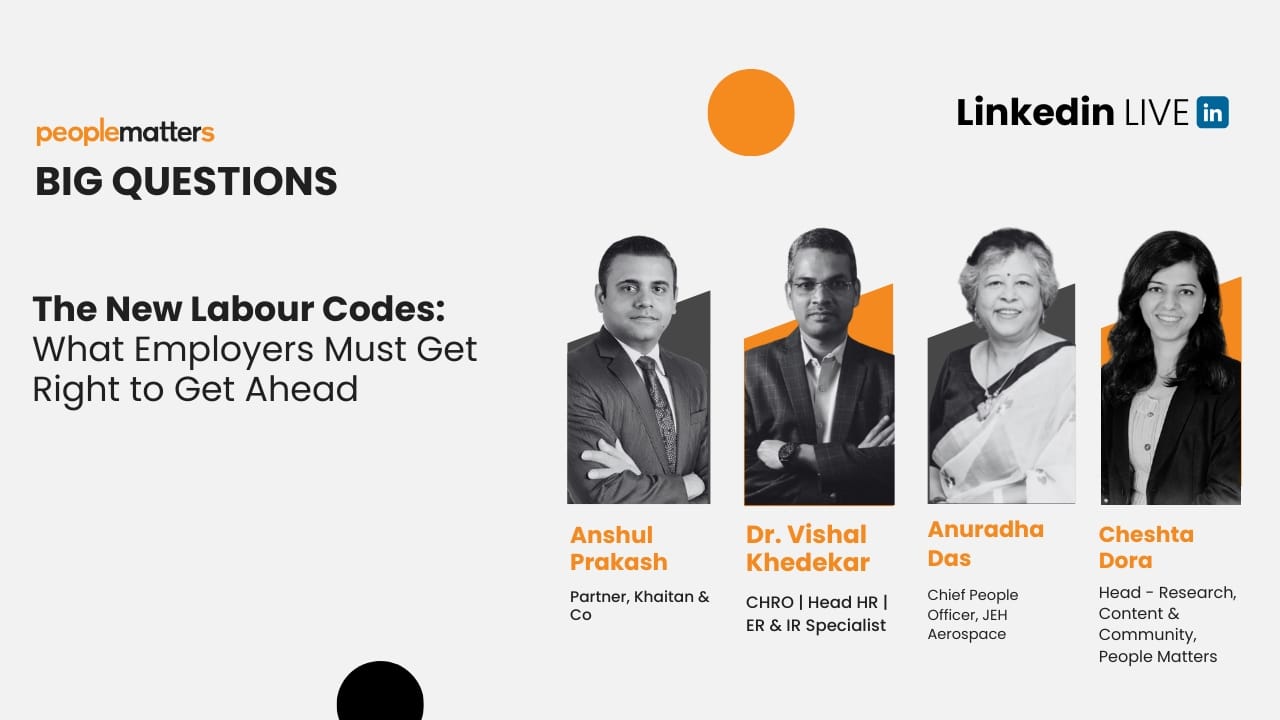
That was the context for People Matters Big Questions’ recent LinkedIn Live, which brought together Anshul Prakash, Partner at Khaitan & Co; Dr Vishal Khedekar, HR, ER and IR specialist and Visiting Faculty at TISS; and Anuradha Das, Chief People Officer at JEH Aerospace. Their aim was not to re-list the four codes—wages, industrial relations, social security, occupational safety—but to answer a more urgent question: what are employers still underestimating?
Across the discussion, one message came through sharply: the codes are not just a legal checklist. They are forcing employers to confront the fundamentals—how wages are built, how work is classified, how grievances are handled, how safety is documented, and how change is communicated. And in that churn, myths are doing real damage.
Myth 1: “The law mandates CTC restructuring by a deadline”
This is the rumour that has travelled fastest—and triggered the most unnecessary panic.
Prakash’s intervention here was direct: “The law never asks you or tells you to restructure.” What it does, he argued, is redefine the statutory concept of wages and set parameters for what is ordinarily payable to an employee as wages. Employers then need to compute statutory contributions on that base.
“There’s a lot of confusion all over the media around restructuring of CTC,” he said. “But the whole premise that you have to restructure by first of January or 31st of March—that’s not really called upon.”
He did not deny that some organisations may end up changing structures. But he was careful about why. If employers choose to adjust components, they must be honest that this is about managing liability and aligning structures—not because the statute has issued an ultimatum.
That honesty is not a communications nicety. It is risk control. Prakash repeatedly returned to the danger of lazy internal narratives: “It cannot be the case that because of labour codes we are doing this.” If companies communicate changes that way, they will trigger suspicion at precisely the moment they need trust.
Understand the wage definition—and its ripple effects
Where Prakash was unequivocal is on the “material shift”: the new statutory definition of wages. Employers, he said, are underestimating both the scale of misunderstanding and the downstream consequences.
“There is a direct impact on all statutory contributions,” he said, referring to wage-linked liabilities such as provident fund and gratuity, and also to wage-payment timelines. He flagged that the impact will not be uniform—some parts will be industry-specific, particularly where workforce deployment models intersect with contract labour restrictions in core activities.
This is where the labour codes stop being a payroll-only issue. Compliance begins to shape business design and workflow strategy—not just HR documentation.
Myth 2: “The labour codes are mainly about organised sector compliance theatre”
Dr Khedekar approached the reform from the opposite end of the telescope. Where employers often treat the codes as a corporate compliance burden, he framed them as an attempt to widen the safety net.
He argued that the reform’s broader purpose is ease of compliance and a changed enforcement process—moving away from the era where inspectors were primarily seen as prosecuting employers. “Now it has been completely changed,” he said, describing the inspector’s role as shifting towards facilitation.
But he placed even greater emphasis on the unorganised sector, noting that India’s workforce reality is dominated by informality. “Around 90% of the population is in the unorganised sector,” he said, adding that extending social security coverage to this segment is a key intent of the reform.
He put it plainly: “It is not in favour of the employer. It is in favour of the workers and employees.” At the same time, he argued the design also seeks to protect industry growth—because “if industry grows, the country grows.”
Take enforcement change seriously—without getting complacent
Prakash echoed the risk from another angle: many organisations are still taking a “wait and watch” approach based on the assumption that enforcement will be lighter while systems calibrate.
His warning was sharp: “Please avoid being complicit.” Employers should focus on what must be immediately implemented—compensation structures, disciplinary frameworks, grievance processes, and harmonisation across central and state rules, including overtime.
The deeper risk, he suggested, is delaying the one thing that actually reduces exposure: a structured impact assessment.
Myth 3: “Fixed-term employment is a free lever now”
Fixed-term employment emerged repeatedly as a point of misreading. Prakash agreed it is recognised—but warned of “added baggage.”
He flagged a common pattern: employees renewed year after year on fixed-term arrangements. Under the new framework, “the whole aspect of continuity of service will have its own impact,” particularly in how gratuity and related benefits are computed.
Das reframed this from the practitioner’s lens. Organisations, she said, are dealing with multiple workforce categories, including fixed-term employees now eligible for gratuity and benefits. The objective is not fear—but intelligent workforce mix and equal treatment.
Workforce classification must be auditable—and owned
Asked about non-negotiables, Das began with organisation design and workforce planning. Employers must be clear on how contracts are structured and how people are treated across segments.
Her second non-negotiable was unequivocal: “Contractor and workforce classification… these are auditable.” And crucially: “As a principal employer, we need to own it and cannot outsource it.”
Myth 4: “Safety is a manufacturing issue, not a whole-of-business discipline”
Das challenged this head-on. While acknowledging her manufacturing background, she insisted safety compliance must be used as a behavioural lever, not a paperwork exercise.
“Safety plays a very important role,” she said, stressing digital reporting and documentation—not as compliance theatre, but to change behaviour in the workplace.
Khedekar added a concrete example: mandatory annual medical check-ups at the employer’s cost. Done transparently, he argued, welfare provisions can become trust-building moments, not just legal obligations.
Digitise, document, act—and explain why
Das returned repeatedly to digitisation—internal audits, documentation, proactive action. But she paired it with a warning about communication.
“Gone are the days of notice boards and top-down messaging.” Under the codes, leaders must explain the ‘why’, not just the rule.
She named the real fault line: “Trust erodes the fastest at manager level.” If managers are not equipped, confusion fills the gap.
Myth 5: “White-collar and blue-collar are legal categories under the codes”
Prakash dismissed this outright. “There is nobody called a white-collar employee or a blue-collar.” Salary thresholds are not the deciding factor people assume.
Even highly qualified individual contributors can qualify as “workers”, depending on role characteristics. He reminded viewers that even pilots have been determined as workers under earlier jurisprudence.
He also tackled another misconception: wage timelines. The law focuses on payment dispersion timelines, not the myths around full-and-final settlements.
Waiting for rules is not a strategy
While acknowledging evolving state rules, Prakash cautioned against paralysis. Employers must still examine their structures because “the base is all-encompassing—it looks at everything that is ordinary.”
Where organisations will break first
Das outlined a three-part readiness checklist:
-
Salary components and CTC logic: what counts as wages
-
Workforce management: fixed-term and contractual compliance, social security coverage
-
Industrial relations and safety: documentation, digitisation, incident reporting, corrective action
“This applies to GCCs, services, retail—everywhere we deal with people,” she said.
Khedekar reinforced that social security expansion is the reform’s backbone.
Prakash added a final caution: change communication matters. Poor explanations will turn labour codes into a scapegoat for decisions employees interpret as cost-cutting.
▶️ Watch the full People Matters Big Questions conversation here.
The takeaway: less fear, more discipline
The session ended where it began—the gap between policy and organisational reality.
-
Prakash: Don’t hide behind “wait and watch.” Do the impact assessment.
-
Khedekar: Don’t fear the reform. Move from interpretation to execution.
-
Das: Own the change. Don’t outsource accountability. Communicate early, clearly, repeatedly.
The labour codes are doing more than rewriting law. They are exposing employer habits—outsourced accountability, informal process, weak manager communication—that no longer survive scrutiny.
Now that the codes are live, those habits will be tested.
And if this Big Questions discussion made one thing clear, it is this: The employers who get ahead won’t be the fastest to react to rumours—but the ones who build the calmest, most defensible systems beneath the noise.
To learn more from leaders on the biggest questions shaping work today, stay tuned to People Matters Big Questions on LinkedIn.