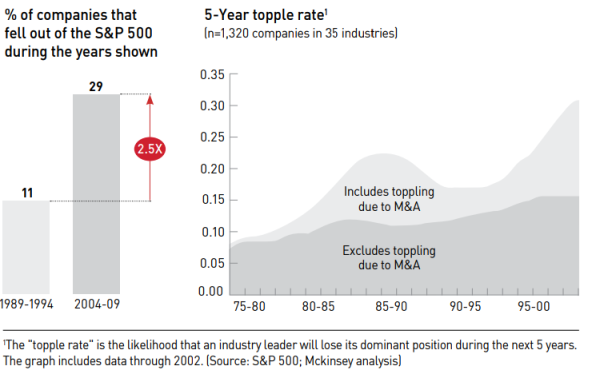
In 1965, the average tenure of companies on the S&P 500 was 33 years. By 1990, it was 20 years. It's forecast to shrink to 14 years by 2026.
Fortune 500 turnover is a proxy for agility at organizations. If you were to look closer at what is happening:
Couple this with the fact that Aon’s 2018 Best Employer India study shows that CEOs at the Best and Market (Participants) at large are all also narrowing down on similar outcomes to drive their business:
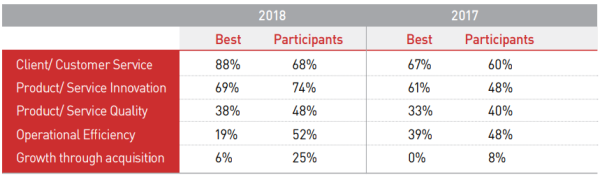
Given that there is synergy in what organizations are aiming for, it becomes imperative to not just move quickly but also move with purpose and alignment across levels. An agile organization hence is not just able to set direction and pace but also maneuver at high speeds without getting impacted by those maneuvers.
With the constant and abundant customer feedback available, organizations can identify and understand the changing demands of the customers, which provides strong support to build and deliver product and services that the customer needs. At the same time, organizations also need to be agile to create a minimum viable product (design thinking) and test acceptance and not spend a vast amount of money to see their offerings succeed or fail.
Agility in current construct is about “setting direction and not chasing a destination"
What does being agile mean?
It means the ability of the organization to respond quickly to change with both speed and ability to change directions. In order to be so, organizations need to have outcomes which work in parallel and have minimal interdependence with the parallel tracks to eliminate points of friction. Organizations focused on being an agile need to focus on being agile while being consistent, and not just being one of those outcomes at the cost of the other.
What does this mean for businesses?
It means while they need to be nimble footed and agile to proactively deal with the ongoing changes in technologies and changing customer preferences, in parallel, organizations also need to calibrate this fast responding strategy towards the long-term mission and purpose for which the organization exists.
They need to be agile and still be consistent (in delivering value) at the same time to meet the short-term and long term-needs of different stakeholders. Hence, agility in the current construct is about, “setting direction and not chasing a destination”
Agility in action
Agility in action suggests that organizations just don’t need to be agile while in planning but also in execution, and therefore agility is an ‘always on’ phenomenon. Most often organizations lose the plot during execution as they focus on creating the best possible outcomes without testing the market. In today’s context market doesn’t remain with a product/service even if it meets its demand because there is always a new/shinier/simpler offering which would do the work in an enhanced manner. Thus in the current context, being agile will mean being perfect in delivering customer needs/wants in the present and at the same time experimenting with what the changing and future needs could be. It’s a mixture of what is now and here and also what the future holds for the market in which the organization operates
Hence to drive agility, organizations need to balance strategy with purpose, while leaders balance agility with consistency.
Supplementing ‘Consistency’ with ‘Conformity’ can be a recipe for disaster and organizations need to understand what is core to them and how to ensure they stay true to their users current and future need while expanding to be everything to everyone.
But then the question is how can organizations embrace agility?
The 2018 Aon Best Employer India study has revealed that the realization of the need for agility is universal. However, the thinking around agility seems to be scattered, tactical and paradoxically, and mostly unsustainable for long-term business success. Through the study findings, therefore, we attempted to bring together extensive experience of understanding what makes organizations effective to put forth a construct that will bring together and guide the pursuit of agility within organizations. It was discovered through empirical evidence and logic that this construct brings together everything that organizations are designing, executing and communicating today under the broad banner of agile. It builds thereon to describe what it takes to be consistently agile.
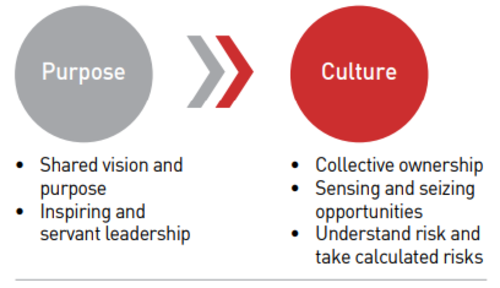
Being Agile: Having a unified purpose, a strong vision and organizational culture that supports an agile environment (Strategy & Culture)
The starting point for Agility in the organization context is aligning on the purpose and vision of the organization. Senior leadership plays an important role in creating and communicating this with the internal and external stakeholders of the organization.
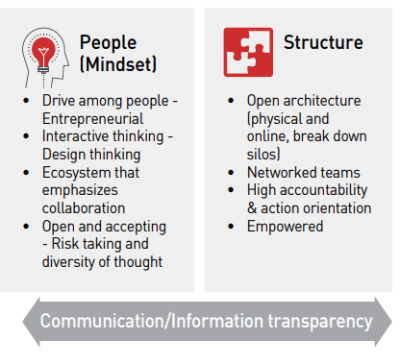
Thinking Agile: Fostering agility through the right mindset and open architecture – Communication & Collaboration, innovation, and empowerment (structure, people)
Building for an agile organization requires the complete organization from a structure and mindset perspective to work in a manner that lends the organizations to be fast and decisive in the real world. To be successful in creating a consistently agile organization, it is imperative for organizations to spend a disproportionate time in ‘Thinking’ Agile. This will determine the success or failure of creating an ecosystem where agility will/can thrive. Given that agility is an ‘Always On’ phenomena, organizations need to continuously build and foster an environment in which employees can be agile. Building for and fostering agility thus requires enabling the right mindset through the right structure (team and organization) and enabling infrastructure.
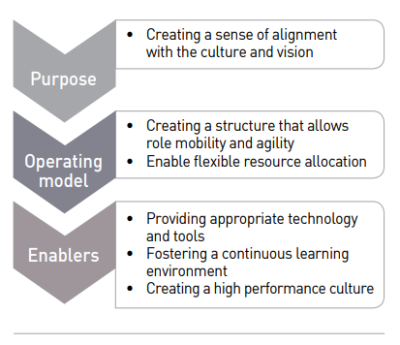
Doing Agile: Emphasize on the need for the right “enablers” (Technology, Resources, and Processes)
While ‘Being Agile’ and ‘Thinking Agile’ address the ‘how and where to start’ consistent agility; ‘Doing’ decodes ‘what needs to be done’. The answer for ‘what’ lies in the vision which will provide direction into the implementation plan. Some organizations start small by prototyping changes in smaller parts before scaling them up; others make more foundational changes which impact the whole organization. While there is no right or wrong to the approach, we are providing inputs on creating an ecosystem where agility thrives.
Given that agility is an ‘Always On’ phenomena, organizations need to continuously build and foster an environment in which employees can be agile
So to drive agility, organizations need to balance strategy with purpose, while leaders balance agility with consistency. That said, organizations are at a nascent stage in figuring out the ‘doing’ part of the journey where alignment is more important than the practices.
Through the construct below, it is our attempt to help organizations understand how the three pillars of creating a consistently agile organization (Being-Thinking-Doing) can be linked.
In an ideal world, all 3 would be concentric circles on top of each other, but in current context organizations seek maximum overlap among the 3 to drive agility. While Best Employers have begun their journey to be agile in the right way to institutionalize the agile mindset, however, there is time for them to be ‘consistently agile’. The learnings from Aon’s research and Best Employer 2018 study clearly indicates that the biggest mistake that organizations make in the quest to be agile is to jump to ‘Doing’ before ‘Thinking’.
There are enough and more examples within the Best Employers to reinstate the importance to go from “Being to Thinking to Doing”.