A banking customer stuck in traffic applies for a ₹5 lakh loan on the way to the airport. Before the signal turns green, the loan is approved. By the time the customer boards the flight, the money has been disbursed.
On the same day, the employee who helped sell that loan raises a query with HR: why is their salary ₹2,000 short this month? The response arrives 48 hours later.
This contrast, shared by Sandeep Chaudhary, CEO of PeopleStrong, captures the unfinished story of digital transformation in banking. Over the past decade, financial institutions have radically improved customer journeys. Transactions that once required branch visits, paperwork and several days can now be completed within minutes.
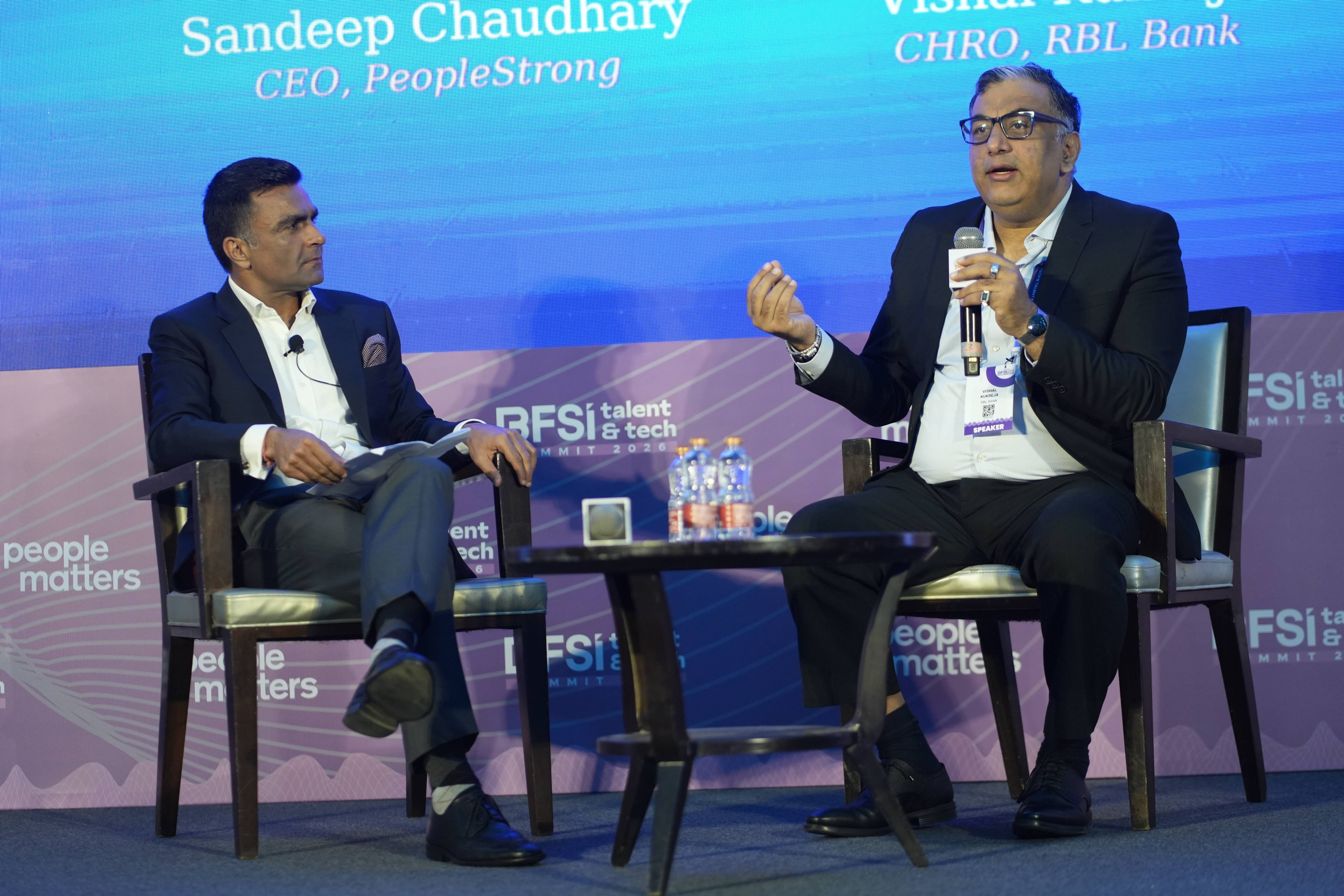
Yet the employees delivering these experiences often continue to navigate fragmented systems, delayed responses and transaction-heavy HR processes. At the People Matters BFSI Tech and Transformation Summit 2026, Sandeep Chaudhary, CEO, PeopleStrong, and Vishal Kukreja, CHRO, RBL Bank, explored what this structural shift means for HR, AI adoption and trust.
“Banking digitised the customer extremely well, but we never really got down to doing the same for employees,” Chaudhary said.
The industry’s first digital era was centred on customer access, convenience and speed. Its second digital era, he argued, must bring the same focus to the workforce.
Customer centricity is only half the story
Banks have invested heavily in building customer-centric operating models. Mobile banking, digital lending, automated service channels and personalised offers have reshaped how financial services are accessed and delivered.
But customer experience cannot be separated from employee experience. Loan officers, business correspondents, relationship managers, insurance agents and branch employees are the people who ultimately deliver the brand promise.
If their everyday experience is defined by slow processes, disconnected platforms and limited access to information, the quality of the customer experience will eventually suffer.
“Our story of customer centricity is only half complete if we have not been able to deliver employee centricity,” Chaudhary said.
This makes the next stage of transformation more than another technology upgrade. It requires organisations to reconsider how work is designed, how employees receive support and how HR creates value.
The traditional HR operating model remains heavily weighted towards transactions, administration and query resolution. AI and automation create an opportunity to invert that structure, reducing the transactional load while allowing HR to focus more deeply on decisions, relationships and business impact.
“This is not incremental. It is structural,” Chaudhary noted. “The HR pyramid will have to turn upside down, from being heavy with transactions to becoming heavy with decisions and impact.”
Regulation and innovation are not opposing forces
For banks, the transformation cannot take place without addressing governance, security and regulatory responsibility.
Vishal Kukreja, CHRO of RBL Bank, challenged the assumption that organisations must constantly choose between regulatory compliance and innovation.
“I do not see it as regulation versus innovation. I see it as regulation and innovation,” he said.
Customers expect both convenience and security. A fast digital transaction can build trust when it solves a customer problem, but the same speed can also amplify risk when fraud, compromised credentials or incorrect decisions are involved.
Regulation, therefore, should not be viewed merely as a constraint. It establishes the safeguards that allow innovation to scale responsibly. “The regulator is keeping organisations honest and setting standards that make the system safer,” Kukreja explained. “Trust comes from ease of doing business, but it also comes from security.”
Responsible transformation must also recognise that technology does not benefit every user equally. While digital banking has improved accessibility for millions, some groups, particularly senior citizens and people with limited digital familiarity, can struggle with mobile applications, passwords and authentication processes.
Progress cannot be measured only by how quickly a system is introduced. It must also consider who may be excluded and how organisations will continue supporting them.
Move from ‘AI for HR’ to ‘AI for employees’
Much of the enterprise conversation has focused on using AI to improve HR productivity. But that framing risks making the technology primarily about the function rather than the people it serves.
Chaudhary proposed a different question: instead of speaking only about “AI for HR”, should organisations begin thinking about “AI for employees”? Kukreja agreed that this distinction matters.
“AI is ultimately a means to an end. What matters is the end you are using it to deliver,” he said. “I would stay away from AI for HR. I would say AI for employees.”
The immediate opportunity lies in removing friction from everyday employee experiences. AI-powered systems can respond to payroll questions, explain policies, guide employees through processes and resolve routine requests without requiring them to wait for manual intervention.
An employee asking why their salary is lower should not have to wait two days for an answer that could be delivered through a secure conversational interface within minutes.
However, AI effectiveness depends on the quality, accessibility and governance of organisational data. Many enterprises have spent years integrating workforce information. The next challenge is to use that data credibly and responsibly.
Curiosity must be balanced with supervision
AI adoption also requires employees and leaders to move beyond passive observation. Kukreja encouraged professionals to experiment with the technology and understand both its strengths and limitations.
“We run the risk of becoming obsolete if we do not learn how to use it,” he said. “People need to dabble with it, explore it and understand what it can do better than them.” At the same time, curiosity cannot mean handing over complete control.
AI systems can produce incorrect information with remarkable confidence. This makes human supervision particularly important in regulated environments and in decisions affecting employees’ careers, compensation and opportunities.
“At this point, AI can be a very efficient assistant, but it needs human supervision,” Kukreja observed. “If you get that combination right, it can work extremely effectively.”
The future of HR will therefore not be defined by removing humans from decision-making. AI may analyse information, surface patterns and present possible courses of action, but leaders will continue to provide context, exercise judgment and take responsibility for consequences.
From transactions to relationships
AI’s greatest contribution to HR may not be efficiency alone. By taking over routine processes, it can create space for HR teams and managers to invest in relationships. Kukreja described the emerging phase as an “era of relationships”, where organisations compete not only through the sophistication of their systems but also through the strength of the trust they build with customers and employees.
“AI makes analytics and knowledge available, but human intent is what makes them useful,” he said.
That distinction will shape the evolving role of HR. The function must decide whether it sees itself primarily as a service provider, an enabler, a governor or an architect of organisational capability.
As transactions move to intelligent systems, HR’s value will increasingly come from the questions technology cannot answer independently: What does the organisation stand for? How should managers lead? How should talent decisions be made? Where must judgment override optimisation? How can trust be strengthened?
Banking’s second digital era will not simply digitise more processes. It will redesign how employees experience the organisation and how HR contributes to its success.
The technology will provide speed, analysis and agency. But the intent, accountability and human judgment behind it will determine whether the transformation genuinely works.