"Now more than ever before, we’re counting on our best people to find new ways to drive growth in this brutal marketplace. Reaching out to support, sustain, and fully engage top talent is central to our strategy."
- Jeffrey B. Kindler, former Chairman, and CEO, Pfizer
Globally, the digital shifts, changing political scenarios, cryptocurrencies, and industrial disruptions are reshaping economies and societies of today and will continue to do so in the future. If organizations aim to stay sustainably successful in the 21st century, they need to remain ‘lean’ and ‘agile’. This new agility is about gaining competitive advantage by intelligently, rapidly and proactively seizing opportunities and positively responding/planning to mitigate the risk of threats. However, to succeed in the global marketplace, just having the right strategy is not enough. Such success requires the ‘right’ kind of willing and talented people, who can focus on the ‘right’ things and remain engaged in the digital non-wired networks through remote engagement.
Research on engagement routinely focuses on its correlation with high performance and business results. A Gallup survey indicates that in an organization only 1/3rd of the employees are fully engaged, while nearly 17 percent of the employees are actively disengaged. This exposes the HR practitioners to the risky and huge task of managing engagement during Transformations.
According to a Prosci study, only 35 percent taste the success of business transformation, while it attributes not facilitating end-to-end change as the key reason for the failure of others. The study also adds that such organizations start with all the hype and go through unexpected tailwinds within the establishment resulting in failure to manage the headwinds too.
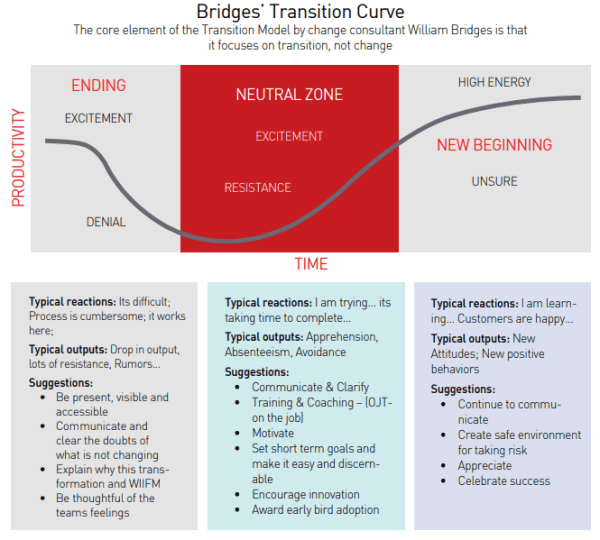
Any business transformation inevitably goes through a change curve as ascribed by Bridges Transition Curve. Common pitfalls in any transformation that are ascribed to the leadership and employee engagement are:
- Very high alignment at the senior leadership level leads to significant orientation drop as it cascades down.
- With high perceived negative impact of transformation, the mid and junior-level employees continue to play within their comfort zone leaving the new intent to oblivion.
- Ineffective support from senior leaders.
- With only 33 percent of the employees engaged, heavy resistance to change is expected from other employees.
- Organizations fail to give importance to the softer human elements of what employees seek for: “Communication”, “Flexibility”, “Transparency” and “WIIFM” (what’s in it for me).
- Organizations go wrong by not doing a 360-degree scan of their stakeholder’s claims, which include factors such as the pace of changing customer expectations, cultural transformation, outdated regulations, and delay in identifying and accessing the right skills – to name just a few.
Every change is expected to have a natural and predictable path that people will like to take. A prudent HR practitioner should primarily take care of the two important zones namely ‘’Denial Zone and Neutral Zone’’, which play a crucial role to the organization’s success. In fact, the impact of Employee Engagement can make or break a transformation in an organization.
Sometimes we over-resource transactional changes or under-resource transformational change by not allocating our best talent to the change efforts
As outlined, it’s the employee engagement in these two zones, which makes or breaks the transformation change in any organization.
- During the launch phase, though there is an excitement in the air, the employees have to let go of the old ways of doing things. Whilst the truly engaged employees (33 percent) take on the new wave of fresh thinking, the 17 percent disengaged employees and 50 percent fence-sitters choose to adopt a wait and watch attitude. They tend to start rumors and false stories and poke the fence-sitters to not to adopt and adapt the transformation.
- If the HR proactively manages the 50 percent associates, who are neither actively engaged nor disengaged, with a clear communication, buy-in and continue to stay in constant touch with them listening to the disturbing issues, during the depth of the Denial Phase of the Ending zone and the early phase of the Neutral zone, it will make the recovery path to the new paradigm faster. Any increase in the depth of the Denial phase will lead to delay in the come out of the Ending phase and in turn will cost more for the organization.
- Sometimes we over-resource transactional changes – spending significant time on alignment to the change. Other times, we significantly under-resource transformational change by not allocating our best talent to the change effort and not mandating our leaders to spend the time/energy necessary to make the change successful, or by not budgeting the funds necessary to carry out the implementation. HR practitioners need to provide sufficient budget, high caliber talent, constant communication, training, and employee engagement at all levels.
Organizations usually fail to give importance to the softer human elements of what employees seek for: Communication, Flexibility, Transparency, and `What's in it for me'
We are living in interesting times with multiple transformation triggers, all present at the same time, all equally intense, that make the transformation change more complex than the Transactional and Transitional Change.
Transformation Change needs to be approached keeping in mind the following elements:
Important elements of Engagement and Transformation:
- Being relevant to the employees: Purpose, end-state, detailed plan and being inclusive in the transformation
- Buy-in: Communicating and sharing WIIFM (What’s in it for me) to the employees along with the key reasons of transformation
- Behaviors: Help the employees internalize new behaviors through active L&D tools, scorecards and dashboards, Transformation Metrics
- Budget: Allocate sufficient resources in every stage of transformation
- Best Team: Have a Transformation Team with representations at every stakeholder level
- Execute: Accomplish every stage of transformation change through commitment and a pledge to make the change last for a long time
Every organization goes through the transformation curve at different speeds. Some may move quickly to visualize and accept a bright future; others may move much slower and possibly get derailed along the way. The good news is that it’s predictable and manageable if you are self-aware and willing to act and manage your reactions through the change process. Also, a great leadership can make a real difference in how he/she and the team manage through the transition. Reactions are always natural and normal. Knowing this, a critical question to ask ourselves is “How do we want others to see us?”
Deliberate about how changes have impacted you and those close to you before. What made you most proud of, what helped you the maximum? We naturally feel better when we begin to experience a whirlwind of change once we can find the aspects we can control. It helps us accelerate our progress through this natural curve of emotions.
If you can recognize what you are really feeling, and willing to take actions, you can genuinely move with more ease and agility through the ups and downs.
The great change myth we all have is “People resist change” but Mickey Connolly the Co-Founder and Chairman of Conversant puts it differently “People resist threat, loss, insecurity, and failure”.
(The views, thoughts, and opinions expressed in the article belong solely to the author, and do not reflect the views of the author’s employer, organization, committee or other groups or individuals.)