The next breakout phase for India’s Global Capability Centres will not be decided by technology alone. It will be decided by who can hold a difficult conversation across three time zones, two cultures, and one ambiguous deadline.
The era of the back office is dead! According to the NASSCOM–Zinnov India GCC Landscape Report 2026, India now hosts 2,117 GCCs generating $98.4 billion in revenue and employing 2.36 million professionals, and more than half of them have already evolved into portfolio and transformation hubs. GCCs in India no longer just execute; they now drive innovation, transformation, analytics, customer experience, product development, and enterprise decision-making for the global organisations that built them. But the closer they sit to the centre of the business, the more visible one limitation becomes: technology has scaled faster than the human layer of work that surrounds it. Trust, clarity, influence, and cultural understanding still don’t happen automatically, no matter how connected the tools are.
For GCCs, the next stage of growth will be shaped by Human Skills: the capability to understand, empathise, and connect effectively across languages, cultures, and business contexts.
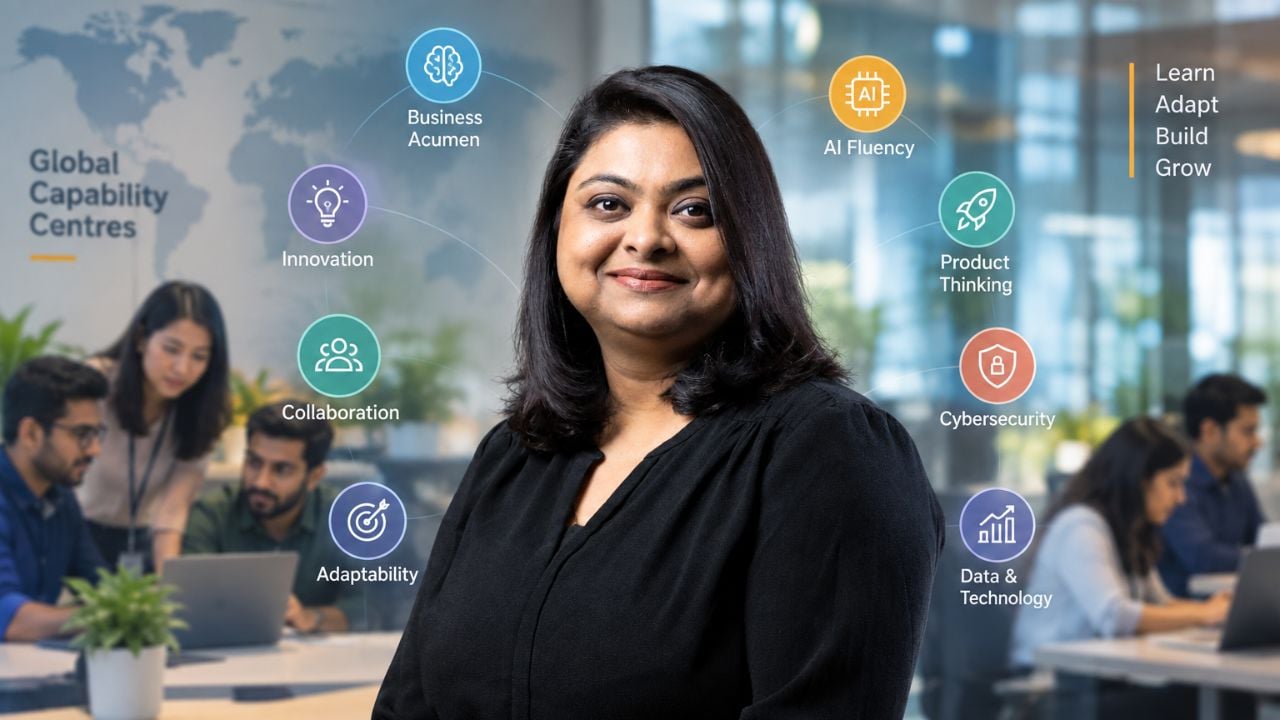
"The conversations we're having with India GCC leaders have shifted dramatically.. It’s no longer - can your team deliver? Everyone already knows the answer is yes. The real question now: can your team be heard? Communication confidence and fluency, cultural intelligence, and the ability to influence where it matters, are now the capabilities that determine which centres get the high-value mandates — that's what Human Skills development is really building." - Aparajita Ajit, Chief Revenue Officer, Learnlight
From technical delivery to global influence
The work has changed. Employees in Gurugram, Bangalore and Hyderabad are now collaborating daily with stakeholders in New York, Paris and Singapore. They are managing relationships, influencing decisions, and supporting transformation programmes that span continents.
That brings a new set of expectations. Communicate with clarity. Adapt to cultural nuance. Build trust across screens. Lead conversations with global stakeholders. In many cases, these are the capabilities that decide whether a project moves forward or stalls in misalignment.
And as AI and automation absorb more routine tasks, the human layer becomes more important, not less. Empathy, judgement, influence, cultural intelligence, relationship-building, the things that cannot be automated, are becoming the real differentiators.
The Human Skills advantage
For GCCs, Human Skills sit at the intersection of three connected capabilities: language, intercultural, and interpersonal.
Language gives people the confidence to express ideas with precision. Intercultural skills create the awareness needed to work across different expectations, behaviours, and norms. Interpersonal skills turn that awareness into impact through influence, negotiation, feedback, and collaboration.
A technically strong employee may still struggle to challenge a stakeholder diplomatically, adapt to a different decision-making style, or manage conflict in a multicultural team. The opportunity for L&D leaders is to stop treating these as separate training categories and start treating them as one connected capability system for global performance.
Language: Building confidence across borders
English is widely spoken across India's GCC talent pool, but business-level fluency differs from functional English. Employees hired for technical work are now expected to influence global town halls, present to senior stakeholders, and shape decisions made continents away. And as GCCs increasingly support LATAM, EMEA, and APAC markets, engaging stakeholders in their own language—Spanish, French, German, Portuguese, Japanese—builds trust and opens commercial conversations English alone cannot reach.
Building this kind of capability requires more than content libraries. It requires practice—real practice, with real feedback, in the moments that actually matter: the executive presentation, the difficult conversation, the customer call. Learnlight combines expert human trainers with AI-enabled practice and CEFR-aligned progression, so learners gain confidence in the situations they actually face at work, not just on a textbook test. And the same model that strengthens English confidence builds capability across the other languages a global GCC increasingly needs. For L&D leaders, the opportunity is to elevate language from foundational capability to one of the highest-leverage investments a GCC can make in global voice, commercial reach, and the readiness of Indian talent to take on more strategic work.
Intercultural skills: Reducing friction in global work
Even when teams share a business language, culture creates friction—a direct style reads as efficient in one context and abrupt in another, silence signals agreement here and hesitation there, and expectations around hierarchy, feedback, time, and risk vary sharply across regions. For GCCs operating as extensions of global headquarters, intercultural competence isn't a soft skill but a performance lever: it helps employees build trust with international stakeholders, avoid misinterpretations, and collaborate effectively across geographies.
Learnlight's intercultural portfolio gives teams the tools to navigate that complexity: country-specific learning across 100+ markets, intercultural assessments and dashboards that surface the friction points quietly slowing collaboration, and expert-led training at scale. The shift is to move intercultural learning from a one-off intervention into a continuous source of strategic workforce insight.
Interpersonal skills: The leadership multiplier
As GCCs mature, their people are increasingly expected to influence without authority, manage stakeholders, lead hybrid teams, and navigate complex conversations—making interpersonal skills a leadership multiplier. For Learnlight, these go beyond soft skills; they are advanced human capabilities—the ability to influence, motivate, negotiate, mediate, build trust, and form authentic relationships that unlock true collaboration and impact.
Developing this requires more than a one-off workshop. It requires structured, applied practice that turns awareness into habit—learning that lets professionals try, adjust, and improve in a safe space, until influencing in difficult conversations becomes second nature. Learnlight's interpersonal portfolio is built for that kind of journey: a practical, personalised approach that spans the core capabilities of communication, influence, leadership, and connection. For L&D leaders, this is where capability becomes a commercial outcome: more confident leaders, stronger stakeholder relationships, and the soft-power influence that turns GCC professionals into trusted partners for the global business.
Scaling Human Skills with impact
For GCCs, getting Human Skills development right starts with a question that sounds simple but rarely is: where are the gaps? Capability frameworks designed at headquarters often miss the realities of distributed Indian teams. Self-reporting captures intent more reliably than ability. And without a clear baseline, even well-funded learning programmes risk becoming generic content delivered at scale. Learnlight's diagnostic assessments help L&D leaders find the answer—surfacing the specific language, intercultural, and interpersonal gaps that are slowing performance, by team, by region, and by capability, so that investment goes where it will matter most.
"Something I hear consistently from L&D leaders: they know what good looks like. They’ve defined the capabilities. They’ve built the programmes. What’s often missing is a clear view of where the real gaps actually sit. When you can map capability by team, by region, and by role, the conversation with the business changes entirely. Training stops being a cost and starts being something leadership actively wants to fund" - Aparajita Ajit, Chief Revenue Officer, Learnlight
For example, Learnlight's AI-powered language assessments make it easier to place employees at the right level with precision and ease by evaluating them across all four skills (speaking, writing, reading, and listening). Aligned to the CEFR and calibrated to the international standards global organizations already use, these assessments reflect how language is actually used at work and provide a consistent, objective starting point for every learner.
Scaling from that baseline is the second challenge. Learning has to reach thousands of people across roles, time zones, and seniority levels, and still produce real behaviour change. Learnlight's model is built for that: every learner engages with programmes designed for the workforce, expert human trainers turn practice into mastery, and ongoing measurement gives L&D leaders the evidence to demonstrate progress and ROI to the business. The whole system is designed to do what content libraries cannot: drive practice, feedback, and real application across a distributed workforce.
That model produces results. In 2025, Learnlight and Salesforce India won Bronze at the Brandon Hall Group Excellence in Technology Awards for a programme that delivered more confident communication, stronger cross-regional collaboration, and learning that actually stuck—the kind of outcomes that turn capability investment into commercial advantage.
Because at scale, Human Skills development cannot be reduced to content consumption. Employees need practice, feedback, and real application. The goal is not a completed course. It is a different conversation, a stronger collaboration, a more confident leader.
The way forward
GCCs are becoming central to the future of global enterprise. But their next phase will be decided by how effectively their people connect across borders. Language helps employees express ideas with clarity. Intercultural skills help them read differences with empathy. Interpersonal skills help them influence, lead, and build trust. Together, these Human Skills turn technical talent into global talent.
For L&D leaders, the timing matters. Building Human Skills at scale strengthens collaboration, accelerates leadership readiness, lifts stakeholder confidence, and turns GCCs into more strategic partners to the businesses they serve.
"We’re at an inflection point for GCCs. The centres that scaled on headcount and cost efficiency have already proven their value. It’s the organisation whose people can sit in any room, in any market, and be trusted to represent the global business at the highest level. That’s the real return on Human Skills. And the leaders who see that clearly are already ahead." Aparajita Ajit, Chief Revenue Officer, Learnlight
In a world where work is increasingly global, digital, and AI-enabled, the most powerful advantage may still be profoundly human.
If you're an L&D leader building Human Skills capability for your GCC, see how Learnlight can help. Request a demo to explore how language, intercultural, and interpersonal learning can work as one connected system across your global teams.