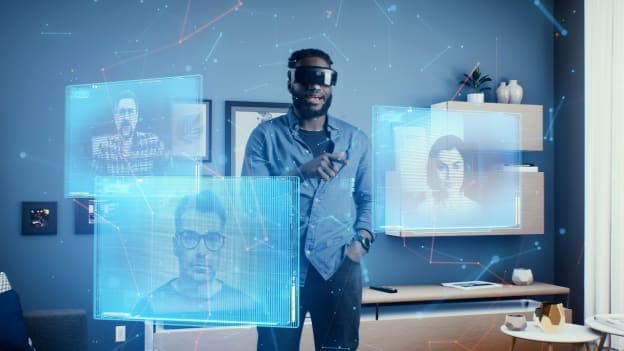
Imagine a scenario in the future where you could attend a meeting at the beach, teleport from Berlin to Tokyo for a client meeting or send your digital twin to meet colleagues.
At the same time, you finish up some documentation work. Sounds fictional, right? The scenario might soon become a reality in the metaverse that promises to redefine the future of work.
The metaverse has become a lucrative industry, with technology titans, gaming behemoths, and others building their virtual worlds. The metaverse uses various technological platforms, including gaming, machine learning, blockchain, 3-D graphics, digital currency, sensors, and (in certain situations) VR-capable headsets.
Many current workplace metaverse solutions only need a computer, mouse, and keyboard. However, to fully experience 3D surround sound, you will typically need to put a VR headset on. There have been significant advancements in computer-generated holography, which do away with the headset requirement.
Metaverse at the workplace
Historically, the metaverse was primarily associated with the gaming industry. Recently, there has been some interest in its application in the workplace.
The pandemic's consequences, particularly restrictions on in-person meetings and travel, have encouraged businesses to look for more genuine, cohesive, and hybrid work experiences. New immersive forms of team collaboration, the emergence of new digital, AI-enabled coworkers, and the acceleration of learning and skills acquisition through virtualisation and gamified technologies are significant ways through which the metaverse appears to reshape the world of work.
Metaverse will enable employees to socialise, form teams, conduct training, and collaborate virtually, bringing the best of virtual and real-life interactions.
Real-time engagement powers the shift
The biggest realisation now is that work is an activity that can happen from anywhere. Hybrid models that embrace remote work are just as productive while giving workers more flexibility. Remote collaboration, engagement, and access are at the core of the next generation of business solutions. Hybrid work includes embedding communications directly into business applications that provide streamlined collaboration with a shared context.
The metaverse looks set to reshape the world of work in at least four significant ways:
- Team collaboration in newer immersive ways: A future of virtual work will benefit from higher levels of social interaction, mobility, and cooperation thanks to the metaverse. Your avatar in the virtual workplace will give you a way to communicate your status, such as whether you're in a meeting or out for lunch. The metaverse makes it simpler to stay in touch with coworkers without feeling tethered to your computer or phone, a common stress source in traditional remote work situations. The metaverse introduces elements of adventure, spontaneity, and surprise, opening up new options to rethink the workplace.
- The emergence of new digital, AI-enabled colleagues: There will be more than just your real-life coworkers' avatars among your colleagues in the metaverse. Avatars will work alongside various digital coworkers, including incredibly life-like, AI-powered bots resembling humans. In the metaverse, these AI agents will serve as advisors and helpers, handling a lot of the heavy lifting of work and, in theory, freeing up human workers for higher-value, more productive jobs. Digital humans may be deployed in numerous locations simultaneously and are very scalable. Digital humans could be the way forward for monotonous, risky, or repetitive tasks in the metaverse. Conversational AI systems—algorithms that can read text and voice dialogues and interact in natural language—have made significant strides in recent years.
- Acceleration of learning and skills acquisition through virtualisation and gamified technologies: The metaverse has the potential to substantially reduce the amount of time required for skill acquisition and training. AI-powered digital coaches may be available to offer career guidance and help with staff training. Every item in the metaverse will be made interactive, with 3-D displays. Virtual-world training can have significant advantages over traditional instructor or classroom-based training since it provides more scope for visually demonstrating concepts and work practices. The metaverse offers an excellent opportunity for learning by doing and overall higher engagement through immersion in games and problem-solving through "quest-based" methods.
- The eventual development of a metaverse economy with completely new enterprises and work roles: The internet did not just introduce new ways of working; it also introduced a completely new digital economy, which included new businesses, jobs, and positions. The immersive 3D economy will grow over the coming decade, and so will the metaverse.
The advent of remote and hybrid work environments has significantly altered assumptions about why, where, and how people work. And also the workplace of the decade already looks very different from what we could have anticipated only a few years ago.
However, this is not where the tale of workplace development ends. Even though it is still in its infancy, the emergent metaverse offers businesses the chance to rebalance hybrid and remote work and reclaim the spontaneity, interaction, and enjoyment of group learning. All these are possible while keeping in mind the adaptability, productivity, and convenience of working from home. It is still difficult to understand how we may use the metaverse to our advantage to enhance both our personal and professional life. Since users will need to learn the technology and the skills necessary to participate in virtual worlds. Again the learning curve for collaborative scenarios may also be challenging.