The word disruption describes the transformation happening at rapid scale. Today, organizations need to be prepared to tackle cultural and technological shifts. More so, they need to deal with paradoxes to evolve successfully.
Disruptive forces
What are some of the disruptive forces that are going to matter in the future? Majorly there are four disruptive forces. Any one of the forces by itself is one of the largest economic forces, greater than the industrial revolution. All four of them together can bring in a monumental change.
1. Shift in economic center: The economic center of gravity is shifting east and south at an unprecedented speed. 50% of the world GDP by 2025 is going to come from middleweight cities.
2. Rate of adoption of technology : Adoption of new technologies is accelerating. The time between advancement of technology and its adoption rate is drastically reducing. Phone and radio took around 75 years and 38 years respectively to reach 50 million users. Internet reached 50 million users in 3 years and Facebook took just one year. What’s groundbreaking is that Angry Birds took just 35 days to reach out to 50 million users, which is an impressive adoption rate.
3. Aging world: the aging population is increasing. The stats show that by 2025, advanced economies will have 13 retirees for every 10 children. In advanced economies, there will be 3 retirees for every 10 children. By 2040, about one in four people in advanced economies and china will be 65 years old or older.
4. Greater global interconnections: In 1990, United States and Western Europe were the main hubs for trade flows with interregional trade of USD 1.9 trillion. In 2013, trade flow became an elaborate web as Asia and Middle East became large players with interregional trade of USD 11.2 trillion.
For organizations to evolve must deal with 4 paradoxes
1. Become highly stable and highly dynamic at the same time
To be on the road of progression, organizations need to be highly stable and highly dynamic at the same time and organizations which have these characteristics fall under the category of Agile Organizations.
Agile organizations are those which have both speed and stability. They are much more successful in terms of output metrics, performance rate and finance they generate. An agile organization need to create a stable backbone and dynamic capability together across structure, process and people.
Structure: Under structure, agile organizations need to be built on small modular cells and its top team is instrumental in setting directions for the company.
Process: It includes fluid reconfiguration for being ahead and processes support value adding work in an organization.
People: In agile organizations, engaged people drive results and values hold the company together.
Examples of agile organizations are:
Spotify: Spotify, music, podcast, and video streaming service company believes in agile principles. They have autonomous squads which work efficiently but they don’t sub-optimize. Spotify consists of robust product development process and also fluid cross pollination across squads. They have highly effective informal networks and guilds and along with this they have institutionalized in ways to spread their culture.
ING Group - ING is a multinational banking and financial services corporation, whose new model resulted in an Agile and lean HQ. They moved from silos to agile organization consisting of new culture and empowerment. From 5 layers they moved to 3 layers. They adopted a tribe, squad and chapter structure (all together) across its HQ functions. So, they are different in the ways from how organization normally works.
2. Change less by changing constantly
Today, companies are reorganizing themselves more than ever before. Executives are experiencing a redesign at their organization. The question needs to be asked is - How often organizations change their structure? As per the research, almost 60% of organizations have made some redesign in last two years, out of which only quarter have actually succeeded.
Examples of organizations who have adopted this successfully:
Alibaba: Alibaba, Chinese e-commerce Company, which started with as B2B player and then in first two years it created a C2C platform. It kept adding different elements and continuously reorganized into smaller businesses to ensure nimbleness.
Haier: Haier, a multinational consumer electronics and home appliances company, continuously evolved its operating model and changed from self- operating unit to micro enterprise.
3. Move faster by getting more people involved
It is a paradox in itself - to move faster an organization would require more people onboard and then how can it move faster by rapid and mass involvement of people?
Examples of organizations practicing this principle:
Huawei: Huawei, networking and telecommunications Company adopted democratic decision making through rotating CEO and top teams. Its 17 top executives elected by all stakeholders.
P&G- Procter & Gamble , one of the leading consumer product company , opened innovation and crowd sourcing of product development .
4. Get more control by giving up control
Organizations have adopted whole new way of doing things and it gives them control by giving up some.
Example of an organization practicing this strategy:
Kyocera – Kyocera, a Japanese electronics and ceramics manufacturer, created Amoeba management model to drive profitable growth by extreme decentralization. It has an independent accounting unit and end to end value creator. Also, it runs on self-management model.
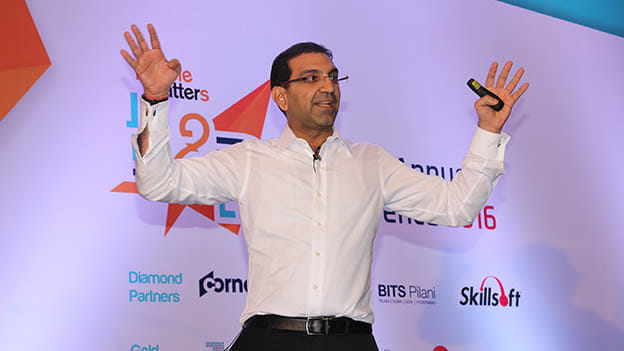
This story has been built from the session delivered by Faridun Dotiwala , Master Expert , partner , Lead Human Capital Practice , Asia at McKinsey & Company at #L&DLeaugue Annual Conference 2016 on 20th October, 2016