








The importance of skilling existed even before the COVID-19 crisis; and this pandemic has only accelerated the need. The context has changed but the purpose has remained intact: securing a better future for the workforce, making them more employable, and bridging the skill demand-supply gap, thereby building the organization of tomorrow.
Exploring skilling needs in the context of current times, People Matters TechHR India 2020 hosted a mash-up discussion with industry leaders. Moderated by Ester Martinez, CEO and Editor-in-Chief, People Matters, the session paved the way for talent leaders from across industries to brainstorm on critical business challenges and identify the skills needed to overcome these challenges, stepping beyond the perceived notions on the boundaries of the HR function.
Read on for highlights from the discussion.
Step 1: Identifying critical business challenges
The global sphere of work was learning and adapting to the demands of industrial revolution 4.0, when the curveball of coronavirus came rolling over. Business and talent leaders were still contemplating the pros and cons of digital adoption when the outbreak of COVID-19 forced organizations across the globe to swiftly shift gears to a remote working model, leaving little to no choice to go digital. Digital transformation was suddenly replaced by digital acceleration with two priorities in mind:
- Business continuity
- People Safety
Now that we are five months into the pandemic, with little experience and decent data around the extent and scope of impact of COVID on business and life, leaders are better equipped to navigate the uncertainties. Yet, some challenges persist as organizations strive to adapt to the new virtual workplace in a post-COVID world. The mash-up room brought forth challenges that remain critical and demand immediate attention of leaders. The top challenges identified by industry leaders were:
- Change management: Change management has been a business challenge for years, however the current scenario makes it a critical one.
The scale and pace of change is unlike anything we have ever experienced before. This has made conducting business difficult in many aspects, not just operational but cultural as well.
Translating organizational culture into a digital culture comes with its share of obstacles. Some of the biggest concerns under change management from a physically workplace to a virtual workplace include:
-
- People engagement in a digital workplace
- Managing a multi-generational workforce with different responsibilities
- Onboarding new hires and making them feel connected in a virtual workplace
- Frequency and transparency in communication from leaders and managers
- Managing employee and employer expectations
- Ensuring a culture where employers are sensitive to employee needs and at the same time, employees step up in their responsibilities to protect the business in this tumultuous time
The entire ecosystem is changing and managing this change remains a major concern.
- Skilling: Disruption brought on by industrial revolution already had triggered a much needed focus on skilling, however the aftermath of COVID-19 has made skilling more of a challenge than an opportunity. Lack of digital skills as well as soft skills, to manage people and organizations, both small and large, is keeping the workforce, top through bottom, from becoming agile, adaptable and innovative to come up with solutions that could beat the mountain of challenges brought along by COVID.
Beyond inadequate skills, the existing learning programs would need to be modified to match the learning needs of today. Skilling is not only essential to benefit the workforce, but in fact to keep existing talent updated with relevant skillsets without having to invest in hiring external talent. Additionally, L&D leaders need to revamp the learning journey, factoring in the new workplace and effective learning methodologies as employees work remotely.
- Cashflow and cost saving: Cashflow has been a persistent challenge ever since the global outbreak disrupted the business environment. Organizations took to immediate cost saving measures like avoiding non-essential travel, deferred bonuses and appraisals, implemented pay cuts, layoffs, shutting down of business units, and much more. Beyond costs, sales in itself became a challenge for many as every organization and individual began restricting expenditure in anything beyond the necessary. The extended dip in sales and sharp decline in demand for anything beyond essentials pushed many businesses through heavy losses. While there have been little improvements in managing expenses and keeping costs in check over the last few months, a healthy cash flow remains a distant goal for many.
- Tech & Digital challenge: Working and living in a VUCA world encompassed by COVID-19, made adoption of technology non-negotiable. While for some that was a respite to be able to stay connected, for many it became a bigger hurdle.
Not every individual is comfortable with technology invading ther lives in the way that COVID has mandated, and while technology is in itself a challenge, keeping up with the rapid evolution of technologies and adapting on an ongoing basis is a bigger challenge.
It’s not just about adopting technology, but keeping pace with it.
- Productivity in a distanced world: Performance and productivity were the two terms that gained significant attention once there was acceptance around the need for remote working in the face of COVID-19. Once it was established that employees are going to have to work from home, the challenge around measuring productivity and performance, as well scaling productivity and performance became the next big thing to address. Interestingly, while some reports indicate working from home has improved productivity owing to flexible working hours, the blurring of boundaries between work and home triggered a fall in employee well-being, ultimately impacting both performance and productivity. As goals remain unadjusted, productivity and performance remain pressing concerns.
- Competition, customers and business models: As mentioned earlier, sales and restricted spending resulted in significant losses for businesses across the globe. In such circumstances, some organizations have been agile enough to adapt to the demand of the situation and diversify business. While this was possible for some, it remains a challenge for many. Customer expectations around safety and hygiene have soared in recent months, irrespective of a product or a service. Viability of business when revenue has gone down, building a new sustainable business model, comprehending rapidly changing consumer needs, and keeping up with competition, all are major stressors for any business today.
Step 2: Identifying critical skills to drive business success
Once the critical business challenges were identified, the next step in the discussion had leaders break out into groups to determine skills that were key to overcome these challenges in the present business environment.
The expectations from talent leaders have clearly evolved over the years. From a cost center to a business partner to an advisory role. A CHROs perspective has never been more critical to determine the way forward for an organization. To fuel his/her/their perspective today, CHROs are going to need their teams to be equally equipped with the right knowledge, tools and aptitude to grasp the emerging business challenges and opportunities and recommend suitable, scalable solutions. This requires stepping beyond the perceived boundaries of the HR function and addressing business challenges head on with the required business and people skills. Here are some of the skills that talent leaders recommend to equip oneself with:
- Business acumen: It’s a well known fact that HR is no longer just the softer aspect of business, HR is integral to business decisions. However, the ability of HR to influence business decisions strengthens when HR leaders, managers and teams have an understanding of how the business essentially operates.
Possessing business acumen helps a leader and employee understand and navigate through the numbers and data, identifying red flags, identifying cash cows and stars, and be in a position to recommend data and number backed people strategies and investments with consequential economic benefit to the organization.
To be able to do that, HR professionals will need to get familiar with various aspects of business such as the product and financial aspects of the business, P&L, building a data-driven approach, recognizing power skills to help people and business improve performance, essentially stepping beyond the perceived limits of the HR function, and thinking holistically while bringing about a balance in business and people requirements.
- Change management: Change management is a bigger umbrella that carries several individual pockets that need to be taken care of - employee engagement, agility, adaptability, emotional intelligence, and mental well-being, among others. From overnight changes in working models to how the business functions, delivers, operates, every aspect has undergone a substantial amount of change. Be it infrastructure challenges or people challenges, operational challenges or workload challenges, the magnitude of change certainly requires an expertise to direct efforts in the right pockets, recognizing where immediate attention is critical.
Change management in a digital workplace also requires HR to cater to a scattered and fluid workforce structure - employees working from office, working from home, permanent employees, gig staff, contractors, blue-collared and so on and so forth. New people policies must be inclusive of diverse employee needs. This is an opportunity for organizations and leaders to be empathetic and provide employees with the support they need. Such care and focus on relationship building with employees, will go a long way in terms of loyalty, as well as performance.
- Digital dexterity: Given the uncertain duration of a hybrid working model, dependent highly on the COVID situation, HR leaders are going to need their teams to be digitally proficient. Technology, analytics, data intelligence - all three are going to be the strongest tools available for the workforce to think strategically and work effectively. There is an urgent need to overcome the barriers to digital adoption and understanding, and encourage efficiency through technology.
- Agility and resilience: All the above contribute in their own way to building an agile and resilient workforce. These two skills enable quick-decision making and trigger swift and timely actions. A lot of activities that were done face to face will now be done online, with expectations of a similar impact. But how are organizations going to now capture new markets and acquire new customers, in a remote world? How will the workforce deliver on sales and meet targets operating remotely? A majority of these business challenges will rely on the ability of the employees to be agile and innovative. Driving the need and avenues to build these skills, will rest on HR.
- Effective communication: The importance of effective communication cannot be emphasized enough. In a virtual workplace, communication is the only way to let the workforce know what’s happening, while also understanding what’s going on with the workforce. There can be no room for assumptions. Communication needs to be clear, transparent and frequent to ensure an open line of communication, in addition to providing clarity in intent and the message.
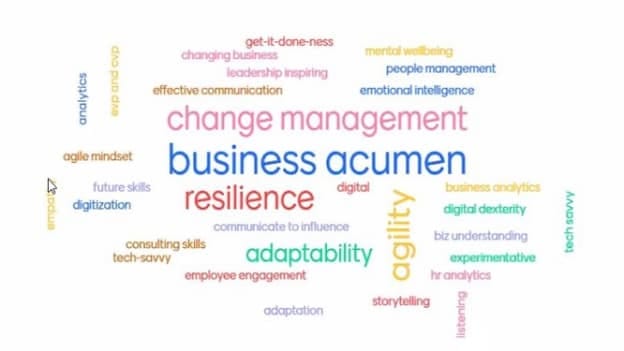
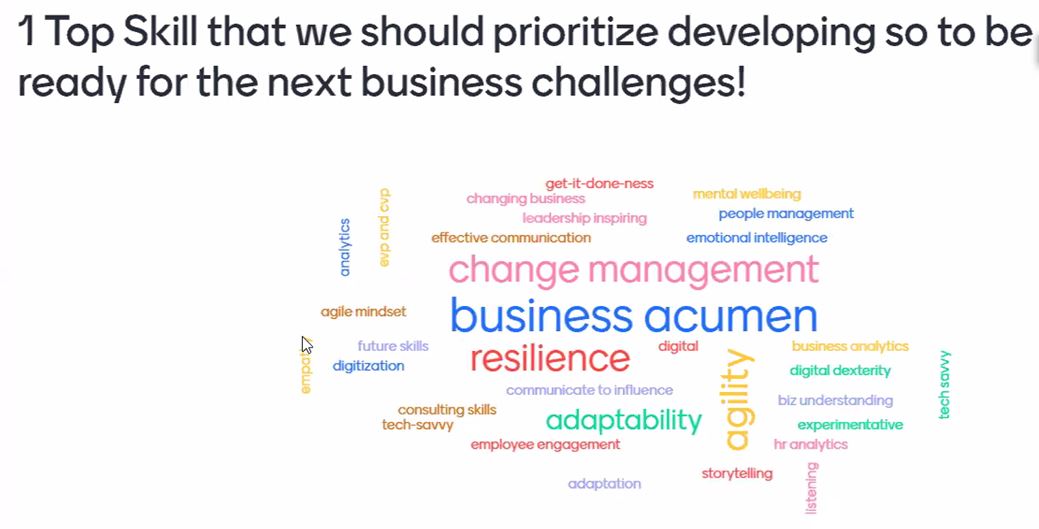
While the above emerged as major trends in critical skills, here’s a word cloud that captured responses from leaders on what is the one skill that needs to be prioritized to prepare for upcoming business challenges:
 Step 3: Identify buds
Now that business challenges and critical skills have been identified, the next step is to identify opportunities. Despite significant challenges that have become roadblocks in moving forward, accompanied by the lack of needed skills, talent leaders acknowledged the existence of budding opportunities that can enable teams to scale and progress through the uncertainties thrown their way. Some of these opportunities are:
- Reskilling: This goes to say that we are not working on skilling from the scratch. With reskilling the workforce the focus remains on making them proficient in skills that bolster their ability to contribute to the business. When an employee was hired, he/she/they came with a set of skills. All an organization needs to do now is invest in honing these skills and exploring adjacent skills to make the workforce capable of managing diverse challenges.
The current scenario also provides an opportunity to relook at learning and development programs and identify the scope for bringing in more personalized programs that align with employee interest and career path, accessible and effective in a remote working setup.
- Culture change: Culture and flexibility are becoming synonymous in the present times.
While change management is a critical business challenge, it presents an opportunity to reset the clock on people management with flexibility, empathy and compassion.
This will not only help employees feel cared for and drive engagement and productivity, but also build loyalty and commitment from employees in reciprocation, which for many organizations is a challenge.
- Cross-functional teams: Another opportunity that has presented itself today is the growing number of cross-functional teams. With leaner workforce structures, businesses have brought together expertise from all functions in the form of cross-functional teams to address various business challenges. By bringing the brightest minds together, such practice provides exposure to data and decisions beyond their individual functions, widening their understanding and expanding the scope of their role.
- Better business understanding: The outbreak and its consequences has forced several businesses to relook at how they are doing business, where all to save costs, explore new avenues to earn revenue, modify people practices, and do all this keeping business sustainability and people safety at the centre. Such an environment has led to every individual donning the hat of a CEO and figuring out opportunities, challenges, and solutions. The silos of independent functions has been replaced by an integration of efforts focused on achieving business goals. In the pre-COVID while decisions were revolving around whether to go digital or not, the post-COVID world has adapted to digital with all efforts streamlined towards one common goal - survival.
The talent community is finding itself in uncharted waters with the outbreak, as feelings of uncertainty and anxiety continue to rise among employees. Reskilling HR, and thereby the workforce at large, to better serve the organization of tomorrow is the need of the hour.