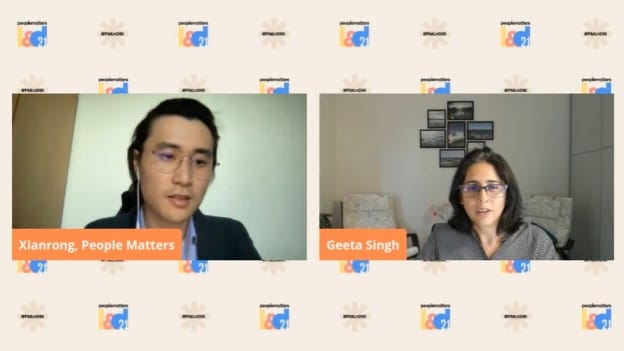
One thing is certain. In a hybrid work environment, it is imperative for managers to have an ambidextrous mindset to meet the multiple challenges that come up as a result of employees working in different contexts with varied experiences. This is what Geeta Singh, Director-Global Learning and Delivery, Talent & OD at Google points out at her session in the People Matters L&D Conference India 2021.
Organisations in order to aid this endeavour must fully support managers and carry out initiatives at organisational, cultural and developmental levels in order to build new learning capabilities. A continuous learning process is a must to thrive in the hybrid workplace and to keep up with the multiple challenges that arise not simply for the organisation as a whole but for the workforce in general.
Geeta outlines three challenges:
- Higher productivity in the virtual workplace is creating an exhausted workforce. Most are predicting mental health to be the cause of the next pandemic. In light of this, managers need to be empowered to support their employees at all levels.
- Employees tend to want the best of both worlds: personal flexibility as well as cultural consistency. Infrastructures need to be set up to ensure that same level of collaboration that earlier existed in physical spaces to create strong cultural tenets and an active sense of belonging.
- Critical relationship building has become a key investment at the workplace. Organisations need to use relationships as a lever to drive a sense of collaboration and team building in the workplace and accordingly build critical manager capabilities along the lines of promoting wellbeing, sustaining productivity gains, demonstrating social flexibility while enabling a consistent culture across the organisation.
Culture is an important facet and it is in the cultural space that team norms come into play. Respect is important be it in terms of respecting the opportunity, each other and even the users. This is something Geeta had outlined as an example of Google’s cultural values. What one must be cautious of is a potential bias in hybrid teams and in order to effectively combat this, manager capabilities need to be scaled and built upon to ensure that they lead in an inclusive environment.
Re-imagining the way work gets done is also an imperative in a hybrid space. One must keep an eye out for possibilities and find new ways of collaboration even in physical spaces. Simultaneously, internal tools and technology need to be evolved to make collaboration easier. What this ultimately boils down to is what Geeta started off with in this session. Managers need to be geared up with critical capabilities to develop an ambidextrous mindset to keep pace with the hybrid work environment. One important insight that must also be taken into account at this juncture is the need to have clarity on employee expectations and accordingly drive that consistency within the organisation. Moreover, a continuous learning approach can only be developed with investment in internal research in what’s working and what isn’t. An intersection of support at the managerial, organisational and employee level is key to enabling the workforce to continue to thrive and innovate at the workplace.
In conclusion, we know what are the steps to be taken. In line with this, three key questions can aid organisations in the journey ahead to develop critical managerial capabilities:
- What resources are immediately needed for supporting the learning and development of managers?
- Which if the hybrid workplace challenges need to be catered to at the individual managerial level and which require the support of higher leadership?
- What are the organisation's strategic priorities in considering manager investment for the coming year?
The answers will be varied but will help lay the foundation for a process of continuous learning at the managerial level which gains new urgency in the hybrid workspace.