








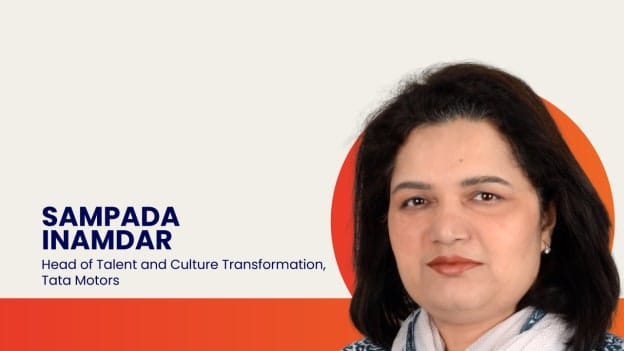
The post-Covid digital transformation has led to key shifts towards remote working, DEI, and ESG. Each of these impacts the skillscape because the content, reach, delivery and impact of skilling are important factors in learning and growth. All in all, more and more organisations are giving serious thought to building a culture of learning, across all aspects like organisational learning, individual learning, and a culture of reflection and innovation. In conversation with Sampada Inamdar, Head of Talent and Culture Transformation, at Tata Motors, we explore what drives their learning ecosystem and culture.
The Continuous Learning Model at Tata Motors
Today, with Tata Motors’ entry into the EV segment, there is a shift in identity and skills, from a largely mechanical engineering organisation to an electronics and software engineering organisation, to having greater automation and digital transformation. This growth resulted from the below levers:
Skillset: There was a need to address 3 aspects: Reskilling, Domain Expertise and Talent pipeline for business and Technical leadership. The need was to reskill people from mechanical to auto electrical and electronics know how, to get the entire organisation to move in a new direction, and to stay relevant. The need for domain experts in diversified technologies addresses industry and mobility challenges by building champions across hierarchies and domain areas. Tata Motors’ flagship business leadership programs for Emerging Leaders and Future Leaders ensure a talent development pipeline by grooming the right talent across hierarchies. Apart from this, there is also focus on developing technical leadership i.e. developing technocrats through functional leadership.
Mindset: With conventional businesses and new-age digital businesses running under one roof, comes the challenge of size and expanse. Not to mention the multiple generations operating together. From a learning standpoint, the focus is on how we can continue to glean wisdom from legacy businesses while embracing the innovation of new-age segments. This is a mindset change at the leadership level.
Systems and processes: Last but not least, making sure systems and processes are in place to ensure availability and access of knowledge, best practices and to support a growth culture.
These levers will converge to cultivate the right culture.
A Commitment to Culture Building
Culture is the way one experiences things in an organization. At Tata Motors, a strong leadership commitment and role-modelling are top priorities in building a conducive culture. Sampada shares that regular communication, facilitated conversations through cohorts within Tata Motors, review mechanisms, and recognition from senior management, are aimed at conveying the significance it holds. To enable this, many models have been introduced:
- Encouraging Innovation: “Imagineering” is a practice which encourages employees across levels to think out-of-the box to ideate on various organizational challenges. Capability building programs are conducted to educate people on the structure, process, techniques and tools of innovation, and also creates an environment conducive to taking risks. Innovista is a recognition platform for innovation, whereby senior leadership encourages and recognizes risk taking, and experimentation from entry level to higher up in the hierarchy. Sampada shares that innovation has been a longstanding focus at the Tata Group as a whole, and at Tata Motors, they are fortunate to have the support and partnership of the entire Tata Group. In the Tata group as a whole, role-modelling helps sustain innovation and creativity. The Tata Group Innovation Office runs many innovation capability modules and Tata Motors partners with the larger group to help drive innovation.
- An SME ecosystem: There is a need to drive learning around the new-age space of autonomous vehicles, connected vehicles, electric vehicles, safe and shared mobility, etc. Tata Motors drives partnerships with external facilitators in this space, while parallelly building talent and expertise internally.
- Build from within: Grooming of entry-level talent i.e. campus freshers is done through culture-building initiatives, functional or domain learning, and professional skills learning. Exposure through Project-based work is given to freshers. Sampada expresses that for them, the success of the one-year-long induction program is assessed based on the projects implemented, development journeys completed and how seamlessly they are integrated for further development. Focus on 3E (Experience-Education-Exposure) is the approach taken for building inhouse talent for experienced employees.
- Enabling external education: To groom talent, Tata Motors also ties up with prestigious technical and management institutes to make learning accessible and flexible for its people. Typically weekend learning models near factory locations like Jamshedpur, Pune, and Pantnagar work best. She shares how they jointly curated and co-evolved the content for BTech and MTech programs in the areas of EVs and made it available to everybody in the industry.
- Business-centric learning: A large part of learning is business-driven, but also considers individuals’ requirements. A mix of just-in-time and just-in-case learning works. Proactive learning (around 80%) is driven by forward-looking needs like digitalisation, ACESS and sustainability. The rest is just-in-time learning to adapt to immediate business needs. ‘Learning Advisory Council’ is a forum that represents businesses across functions, with each business sharing its business priorities from a capability-building standpoint. These inputs are then actioned for learning. Also, role-based competency mapping is done for an individual in a role, basis the skill gap, individual development plans are initiated. Hence, business-unit learning requirements as well as individual learning needs are considered.
- DEI focus and Wellbeing-Led: Leaders are encouraging a move beyond the classic understanding of DEI. Beyond gender diversity, functional diversity, and industry diversity are considered important perspectives at Tata Motors. To build internal mobility and talent pipelines, the organisation leverages experienced people from within, as guides to mentor the incoming diversity. Reverse mentoring is also encouraged to expand diverse views from a generational diversity perspective. There is a focus on the vitality and well-being of Leaders and employees.
- Digital Skills focus: Tata Motors ensures three-tiered capability-building through basic-level interventions, the creation of digital champions for industry 4.0, and the building of domain experts in areas of Analytics, Gen AI and Digital Catalysts. The fourth important plug-in is to ensure the digitalisation of business processes also happens parallel to expedite organizational capability building. Sampada adds that the end goal is ensuring there is enough critical mass being created such that the organization benefits from it.
Thanks to such a holistic focus on capability building, learning sticks. Sampada shares that the organization aims for two learning days per employee, but ultimately individuals end up engaging in significantly more. This outcome reflects Tata Motors' core learning philosophy: For continuous learning empowerment and ownership, access to learning opportunities should be easy and available.
Ensuring Learning Sticks and Measuring ROI
To sustain learning, Tata Motors measures the ROI of learning at three levels:
- Level 1: Good-to-have knowledge: The number of people who attended and enjoyed learning is analysed through knowledge tests and quizzes.
- Level 2: Application of learning: This involves doing projects by defining domain experts, identifying projects for people, and getting people to contribute.
- Level 3: Sense of Community: Building a sense of belonging and critical mass via ‘Centres of Excellence’ and ‘Centres of Competence’ enables the creation of a community of facilitators, mentors, digital champions, etc. This helps create a snowball effect.
Tata Motors' Innovative Approach to Leadership Development
A lot of emphasis on business and technical leadership development is at the core of Tata Motors’ learning ethos – the ‘T-model’ for capability building and culture building serves as the design principle. The horizontal breadth of organisation-wide capability centres around sustainability, and business leadership competencies such as entrepreneurship, design thinking, etc. Longitudinal depth focuses on functional expertise in areas of digitalisation and more.
Tata Motors engages with premium prestigious partners to not just create cognitive change, but to drive richer and fulfilled experiential learning. This leads to a depth of learning with curiosity and agility and leaving behind a legacy.
A Senior leadership development initiative explores areas such as what kind of responsible culture we are building for both conventional businesses and start-up businesses, best practices in digital initiatives across industries, and also individual reflections on where they stand as individuals. This development initiative largely uses case study methodology, immersions and reflection to build both depth and breadth of leadership takeaways. Tata Motors believes in catering to all learning styles, it therefore has a robust systems architecture – Learning Experience Platforms (LXP) exist, LMSs and digital learning platforms have always been around, and now AI-enabled learning journeys are here. The ask is to introduce true ‘learning in the flow of work’. Sampada presents a beautiful personal analogy, explaining how for her, buying a pizza for her kids is about helping them understand the concept of geometry through the process of cutting and eating the pizza. Similarly, these LxP and AI-enabled pathways will enable employees to look up learning while doing their jobs, hence learning in the flow of work. Tata Motors has created platforms to foster such flow by encouraging employees to share their learning experiences in steering committees and all-hands meets. But to make a lasting change, Tata Motors strives to ensure a last-mile connection with learners, through the right platforms.
We are thrilled to announce the release of the Skillscape 2024: Navigating India’s Talent Horizon. Brought to you by UNext Learning & People Matters, this report offers valuable insights into navigating the future of work. Download your copy now!