








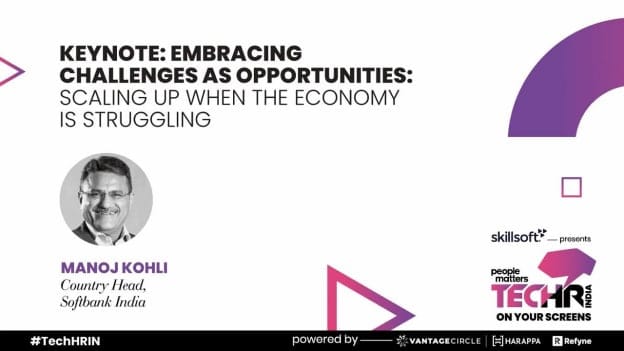
“This is the time to flourish, this is the time to blossom. This is the time when talented people can showcase their worth and rise to the occasion,” said Manoj Kohli, Country Head, Softbank India at People Matters TechHR India 2021, as he kickstarted a truly inspiring conversation, one that surely prepares leaders and startups founders to rise through the rubbles of the prevalent crisis.
In his keynote address on ‘Embracing Challenges as Opportunities: Scaling up When the Economy is Struggling’ at People Matters TechHR India 2021, Manoj highlighted the key pillars for emerging startups to fast track recovery and scale up post-COVID, encouraged founders to not lose sight of ‘LTC’ in these ever-changing times, and reflected on the common pitfalls that startup founders must be wary of.
Read on for highlights from the session.
Embracing the rise of digital
“Opportunity for digital businesses are great. We have, in terms of consumer behavior, taken a leap of the decade in last 18 months. Digitization across the world was taking place at a slow pace, and now, the last 18 months have given way to rapid digitization internally in organizations as well as externally with all the stakeholders. And that is leading to scale ups, with companies growing double digit a month, with aspirations to scale up by 10X or even 20x.”
Optimistic about the potential of Indian talent in the technology sector, especially young talent, Manoj noted that these young minds are not only fantastic in building software, but also in utilizing digital technologies.
Manoj emphasized that the focus for startups now, as we go through this period, is how do they swing back, how do they recover? How do they come back stronger? “I think that is a question all of us, all of you have in mind and I have extensive experience of working with great founders, CEOs, organizations, and they have really recovered fast, they've done very well and I'm sure they're heading for major growth in the coming years.
Strategic pillars to fast track recovery and growth
Helping startup founders decode the essentials of bouncing back from the disruption triggered by COVID, Manoj laid down seven key pillars which he believes are the cornerstones for recovery and growth. These pillars are:
- The innovation engine: The innovation engine, and the new product development process has to be picked up, the momentum has to be picked up, said Manoj, adding that customers will go to that brand which is innovative, superior, unique and offers differentiated products, services and features.
“If you're able to attract and retain more customers, you will be able to grow faster than competition, and outpacing competition will become easier.”
- Financial fitness: Manoj further divided financial fitness into two aspects:
- Frugality: This includes the cost efficiency, the productivity standards, which are very important. You cannot have wastages in the organization. “We need to utilize every penny to the fullest, and hence frugality, war on waste, has to happen.”
- Healthy revenue: Healthy margin, on per unit basis, margin should be growing. Which means that margins grow, and the levels of debt - if there is a debt in any company - has to come down, not go up.
- Business model: The business model also has to change and it is changing. The digital behavior of the customers, even in small towns and villages, has changed dramatically. Even people who are less educated in small towns are becoming comfortable and trusting digital transactions, digital payments.
“This digital behavior change will lead to a new business model, which means enabling a business model of end to end digital both inside the organization, as well as externally with customers, dealers, vendors with everyone, and all the systems and processes have to be digitized. The utilization of AI has to increase dramatically to make processes and systems predictable, thereby making customer behavior predictable.”
“The moment you do that the agility and the speed of the company will go up automatically, decision making will rise, speed of decision making will rise dramatically. It will be good for business.”
- Brand: “I remember when I was in Airtel, Airtel started with ground zero, and became number one brand across categories, across products within 10 years. Airtel was also a startup company, a startup brand. Same thing is happening now. There are so many startups which are doing well, which are trying to take a position in the minds and the perceptions of people, to not only attract but also retain them, boosting loyalty. Branding is a very crucial part of a startup.”
- Funding: Investors from across the world are coming to India over other countries. Startups use leverage this opportunity seriously, because if you have a good business model, if you have a good product and if you have a great execution team, then funding becomes easy. “You will get funding. You may not get funding at the right time, a bit early or a bit late, doesn't matter, but you will get funding if the viability is good, if the execution is good quality, and if the business model and product is what customers love.”
- LTC: This is the most important issue. ‘Leadership, Talent and Culture.’ “People want great leadership which is open, transparent and shows strategic direction regularly. People also want good talent to be promoted, to be recognized, rewarded. And we promote a culture which is very transparent. That's what youngsters, especially the millennial generation wants."
"The millennial generation wants an open, flexible, transparent culture which recognizes talent and merit, which is always fair and which works for a purpose.”
Emphasizing the relevance of leadership in scaling startups, Manoj said, “The most important thing as startups grow and scale up is the leadership determination to win. Leadership strategy to win. Leadership is crucial for upcoming Indian multinationals and startups to grow, scale up and globalize.” He also added that the people aspect led by the leaders is crucial. “The pandemic has taught leaders to be more empathetic, more sensitive to the needs of the people, sensitive to how they should respond to people's needs. At the end of the day, it's the people who will make the company. If employees are happy, then customers will surely be happy.”
- Compliance: New startups must ensure compliance with the country and industry regulations from day 1. “Once they follow the compliances, then the business becomes more robust and your focus on business is always very high. Once compliance is taken care of by startups, then globalization of the startup is easier, because then the product can be globalized, business model can be globalized, people can be globalized.” This will contribute to the country’s mission to build Indian multinationals, added Manoj.
Focus on technology is need of the hour for HR leaders
The changing times have made it imperative for HR leaders to focus on technology by thinking about how HR processes, systems, and people can be made more efficient, productive, satisfied and happier in terms of technology induction. “HR colleagues have to take a leap. By that I mean they have to take a leap in their own mindset.”
Manoj shared that in the past, HR was neither technology oriented, nor business oriented. They didn't understand technology, they also didn't understand the problems of business. “High time now that HR managers have to go deep into business, understand the issues of business, especially the emerging issues of tomorrow, understand the emerging.”
“HR colleagues have a very crucial role to play, and that role is of leadership - Business and Technology Leadership - I believe that this is be a big leap which HR colleagues can take.”
Manoj insisted HR leaders to take a leadership position in technology change, as well as business model change. By embracing technology, the HR function is helping the organization take a big leap from an Indian market point of view to a global market. “I feel that there is a responsibility upon HR to take this leap and assist the CEO, the founder, the entrepreneur to really take this leap, jointly.”
Speaking about the key challenges that leaders should focus on in enabling greater adoption of tech, Manoj noted that there is only one key challenge – training. “Employees, young employees especially, are always ready to change. They're always ready to learn. They're always ready to practice something new, or try something new. It is only training which they need to be provided with to use new technologies.”
Building a competitive edge in a crowded market
“There is no better way to teach yourself than competition. I'm a product of competition, I love competition. I embrace competition because it makes me work better, smarter and makes me more efficient.”
Manoj further advised startups to have a very lean cost structure, and low compared to competition. He also recommended building a very enthusiastic, positive and open-minded culture, which is full of celebrations. “Every victory, every win, whether it's small or big, should be celebrated so that people feel like winners every day. If they feel like winners, then every day they'll go to the market and win, and get ahead of competition and retain the customer. So a great culture, positive, enthusiastic culture will be a big edge over competition.”
Commenting on the one thing that startups should keep in mind to build a sustainable growth strategy, Manoj highlighted ‘Talent’. “Startups should ensure that talent coming in from small and medium companies should be at the front end of customer facing functions: sales, distribution, marketing, customer service.” This segment of talent shared Manoj, is very hungry - hungry to do more, hungry to win everyday. “At the back end of the company which is processes, systems, automation, digitization, startups should pick talent coming from large companies, large multinationals who have already worked on processes, automation, and are very mature in it.”
“If you do this very smartly, you will be able to get the right talent at the right place, because the rule is, get the right people on the bus, get the right people on the right seats in the bus and get the wrong people off the bus. That's the rule I advise startup entrepreneurs to follow. It enables them to succeed and scale up faster.”
From dramatic shifts in digital behaviour to positioning startups for globalization and focusing on the critical LTC, Manoj sure enabled a deeper understanding of how the startup landscape has evolved and continues to evolve. While the pandemic made several dents in progress for startups and established organization, it parallelly paved the way for new opportunities, for growth.
With the above reflections, how swiftly and smartly leaders leverage the potential of technology and scale their talent, capabilities and operations, will shape their ability to not just multiply growth but also outpace competition and solidify their standing in a global competitive market.