Having deployed over 1.5 Mn digital workers already, Automation Anywhere is on its way to becoming the world’s largest digital workforce platform. For organizations wanting to tread this path, it is an example of how you can leverage the digital workforce for their cognitive automation skills and augmented intelligence, what fears continue to exist in the industry and what concerns you need to keep in mind as you head on to deploy a digital workforce.
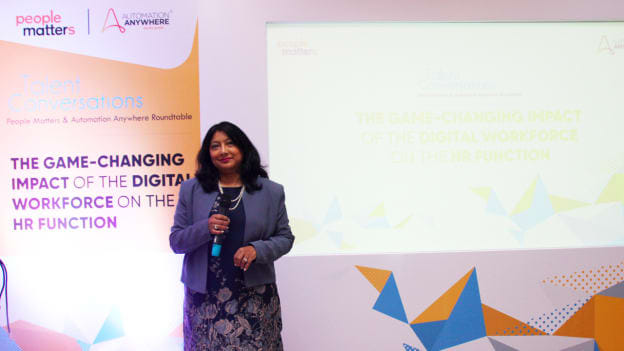
In a recent roundtable hosted by People Matters and Automation Anywhere, industry experts from across organizations came together to discuss the game changing impact of the digital workforce on the HR function.
The session kick-started with the keynote session presented by Anurag Aman, Partner with Management Consulting (People and Change Advisory) at KPMG. Anurag brought to light some interesting statistics on the use of RPA and Cognitive Automation in the HR function, followed by a discussion led by Sonali De Sarker, Senior Director HR - IMEA, Automation Anywhere.
Sharing her insights on the impact of the digital workforce on existing processes and the physical workforce, Sarker said, “It’s important that we as HR practitioners actually move the needle rather than waiting for it to happen.”
‘HR is no more just a soft aspect of the organization’
Discussing findings from a recent survey by KPMG that assessed focus areas for HR ahead of the gradual shift to a digital labour force, Anurag Aman shared the following:
- The global market for robots and artificial intelligence is expected to reach $152.7 Bn by 2025
- Robots to replace 100 Mn knowledge workers
- Digital workforce brings in a 30 percent increase in productivity
- Digital workforce brings in an ROI of 600 - 800 percent with seamless implementation in specific tasks
- Deploying a digital workforce is among the top 5 investment opportunities for CIOs
Sharing that ‘HR is no more just a soft aspect of the organization’ Anurag highlighted how cognitive platforms help augment and leverage human knowledge to perceive, reason and learn across functions. Interestingly, Intelligent Augmentation which is nothing but a partnership between humans and machines can be leveraged to drive impactful business outcomes, with both humans and machines focused on what they do best.
When it comes to strategizing and decision-making, intelligent automation happens in three stages. While humans continue to act and think like humans, machines are more occupied with providing information in the form of rules (workflow automation), learning (enhanced automation) and reasoning (cognitive automation and predictive analytics).
With the extent of impact of robotics and cognitive automation, there is definitely a resistance to bring them in as well. Addressing the dilemma on the right time to bring in the digital workforce and readiness of both the people and organization, Anurag said, “Ask yourself, are you doing it for efficiency, or are you doing it to really create an experience.” Some of the factors he suggested to consider as you tackle the dilemma are benefit of realization (cost vs impact), degree of transformation and availability of data.
With the augment of cognitive automation and RPA, there are a plethora of specialty roles expected to emerge within the HR domain. Some of these are:
- People planner
- Service delivery leaders
- Robotics capability manager
- Behavioural scientist
- Process Optimizer
- People Data analyst
- Performance consultant
- Employee experience consultant
- People performance architect
- People Strategist
What you need to know about digital workforce
HR can deploy digital workers across multiple functions. From sourcing profiles and coordinating interviews within talent acquisition, facilitating seamless documentation at the time of on boarding, staffing process automation, to leave record management and triggering messages to managers to intervene after gathering relevant data points, digital workforce does it all when it comes to transactional processes. As shared by Sonali De Sarker, bots in staffing process automation can result in reducing costs by 60 percent and time by 2x. Their team was able to save 140 minutes per new hire, by deploying over 20 bots within their HR team for hiring and onboarding, and they hired 700 employees in the time period. “Bots can enable the human in your employees, with less focus on transactional conversations and more time for meaningful conversations,” added Sarker.
Emphasizing on leveraging the physical-digital partnership between humans and bots, Sakshi Khosla, Associate Director - Human Capital, Max India said, “You need humans to infer insights, to make logical conclusions and use the data generated by bots”. She further added that a common mistake that organizations make in tech adoption is that they try to make it one size fits all. “That’s the issue, because every organization is different, every context is different, every context at a particular point is different,” added Khosla.
Stating how humans have always been resistant to change and how crucial it is to step up now, PepsiCo’s VP - HR India, Suchitra Rajendra added that while it is good to have a parallel process and see how things shape up, it is important to recognize the resistance and realize the impact, “If we don’t do it, we will be left behind.”
Key things to take care of as an HR
While a digital workforce significantly helps in timely tracking and updating of records, bringing down inaccuracy in data, streamlining processes, thereby providing much more time to the physical workforce to leverage their human skills, there are concerns that need to be taken care of before implementation. HR leaders need to focus on these critical concern areas as they think about bringing in a digital workforce.
- Process understanding needs to be excellent: Employees who will be working with digital workers need to have the right understanding of how automation works. Get the right people to map the processes and educate them on how automation works and how to work with bots.
- Upskilling/reskilling teams: Leaders need to identify what kind of jobs employees can take over, as bots take over transactional and routine work. A recurring concern in the digital age is the threat to job opportunities for humans. Addressing this concern, Sarker said, “It does not threaten the job of your team members, rather it upskills them. Design the bots according to your requirement, and make it accessible and usable for your team.”
- Change management with business: Have conversations with business about where HR as a function needs to deploy bots. Understand the scope and assess the impact. With deploying a digital workforce being among the top five priorities for leaders today, it is important to understand the investment perspective before trying to bring in digital workers just to join the bandwagon.
- User experience perspective: With your employees being the ultimate users, and co-workers of bots, it is essential to understand where to implement them. When you face an issue, you do not want a machine, you want to interact with a human. “We need to understand when we need to pause the machine interaction and interface directly. We need to make sure we know when to intervene and make the experience right,” added Anurag.
In the digital age and what appears to now be a race, organizations have been contemplating implementation, and struggle with adoption. In the race to on board digital workers and stay ahead of the market, one must not forget to evaluate and assess if the organization and people are ready for that change.