The online weekly Arabian Business reported in June that a team of NYU Abu Dhabi students designed an AI-based simulation “Survival of the Best Fit”. “The goal was to teach people how the transition to automation happens,” explained Alia ElKattan, one of the team members. The game was designed to teach its participants how machine learning can be biased, particularly when it comes to the hiring decisions. The students came up with the idea when they saw in class how biased data sources could lead to erroneous hiring decisions if not monitored by human oversight.
This news is instructive for two reasons. On the one hand, new technologies (AI in this case) are pushing traditional organizational boundaries to transform. Students are teaching the elders. On the other, the roll out of the new tools is slowed if employees are not using them no matter how smart those tools are. According to McKinsey's Insights, only eight percent of all firms have transformed their core practices that support adoption of AI in the organization. Given the challenge it is worth reviewing today how technology and people are intertwined at work and why HR’s role can become the great enabler of this transformation.
It is about time we demystified the hype and laid out a practical agenda for HR’s adoption of AI. This article aims at breaking down how AI may work across the employee life cycle and illustrates in the case of IBM how the HR organization successfully integrated AI at scale into its own operations.
How IBM HR leads through AI
The business case for the next generation HR is shared in 2018 IBM Watson Talent report: The Business Case for AI in HR. Diane Gherson, IBM’s Chief HR officer summed up her organization’s transformation through AI in the introduction: Enabling to solve pervasive talent issues such as knowing our skills, preventing unwanted employee turnover, reacting quickly to employee hotspots, matching employees and external candidates with career opportunities, supporting managers with better salary investment guidance, eliminating manual tasks in benefits administration and payroll through robotic process automation, and creating an irresistible platform for employees to learn on the go. With some upskilling, ethical operating guidelines, and a healthy dose of technical curiosity, the HR function is now positioned to truly drive strategic advantage while better supporting the workforce we rely on to put the strategy into action.”
At IBM, AI is applied across the entire Employee Life Cycle. Here we review key lessons to be learned by reviewing 1) traditional practices that needed to change 2) how AI innovated the process 3) what tangible outcomes the innovation delivered.
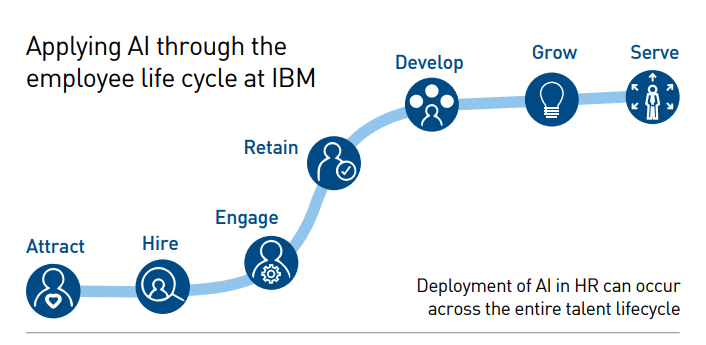
Attract: Reimagined candidate experience
- Traditional: Job seekers use keyword search words on Google, job boards, and employer’s websites to identify available jobs then apply.
- AI solution: IBM’s recruitment chatbot“ gets to know” the candidates before they apply, helps answer key questions and serves up appropriate roles based on the analysis of their skills.
- Result: Improved quality and qualification of job applications, higher attraction rates, better candidate experience, longer term retention.
Hire: Efficient and effective hiring process
- Traditional: Recruiters are under time pressure to fill many roles while selecting from a large pool of candidates. Mistakes are inevitable.
- AI solution: IBM Watson Recruitment (IWR), uses AI to analyze past data to predict time to fill and identify the candidates most likely to be successful. IWR lets recruiters focus on the moments that really matter in hiring and machines do the rest.
- Result: Faster and more accurate hiring, a better candidate and recruiter experience. AI helps minimize the impact of unconscious bias and build better targeted job descriptions.
Engage: Enhancing motivation
- Traditional: Engagement surveys are conducted once per year with the results delivered with delay. Too little, too late actions are taken. Disengagement is inevitable.
- The AI solution: AI enabled manager prompt the manager what actions need to be taken with their team members. Unstructured content from annual and pulse surveys, as well as social media chatter within the corporate firewall are analyzed on the ongoing basis. No delay and prompts about the actions to be taken.
- Result: Timely and effective problem solving by managers leading to higher engagement levels & trust.
Retain: Smarter compensation planning
- Traditional: Annual formulaic compensation adjustments based on external market data and bell curve performance evaluations.
- The AI solution: AI-based compensation advice examines many more variables than those traditionally considered. The focus is on employee skills, the going rate for those skills, and whether those skills are increasing or decreasing in demand.
- Result: Compensation consideration enabled by AI cuts out thousands of hours of manual work and minimizes chances of subjective decision making.
Develop: Personalized learning
- Traditional: Traditional classroom based training and development is time consuming and ineffective.
- The AI solution: AI-customized accelerated skills development at the individual level. In aggregate, organizational learning is optimized as well. AI supported learning system includes: open learning platform, customized content channels and employee-specific experiences serving the needs of the business directly.
- Result: Strategic organizational capability to lean and change is enhanced through AI. Learning dashboards show progress towards closing skill gaps in a business.
Grow: Career development
- Traditional: Line manager assigned episodic training delivered by HR or outsourced to vendors. Individual career coaching reserved for the handful of high potentials
- The AI solution: AI enabled coaching and skills development as well as internal career marketplace allows for high touch customization at scale.
- Result: Increased employee engagement, retention and organizational capability growth.
Serve: AI for 24/7 employee interaction
- Traditional: HR business partner service was limited to senior management and shared services were impersonal, rules based, and standardized.
- The AI solution: IBM broadly deployed Chatbots that became the principle way for HR to improve employee experience. Chatbots are easy to create, customize, improve and scale. Chatbots deliver real-time answers at any time, customized to the individual employee.
- Result: HR service is extended to all and every employee at scale.
The future is already here, and the future of HR’s success through AI has already begun. For the first time in business history, HR has an opportunity to impact the world of work like it never had before
According to Diane Gherson: “In HR in 2017 alone, IBM realized $107 million in savings as a result of AI.” But while cost savings and efficiencies have been important, the benefits of IBM’s deployment of AI are far reaching.
Start doing AI today
The principle lesson for all organizations to learn is to stop talking about AI as the thing of HR’s future and start doing AI today. From NYU students in Abu Dhabi to the global technology giant, IBM, AI is emerging as HR’s most critical tool and the engine of renewal and transformation at scale. The future is already here, and the future of HR’s success through AI has already begun. For the first time in business history, HR has an opportunity to impact the world of work like it never had before. Let us get into action.
The future is already here, and the future of hr’s success through ai has already begun. For the first time in business history, hr has an opportunity to impact the world of work like it never had before