








We live in an era of risk and instability. Globalisation, new technologies, and greater transparency have combined to upend the business environment and give many CEOs a deep sense of unease. Just look at the numbers. Since 1980, the volatility of business operating margins, largely static since the 1950s, has more than doubled, as has the size of the gap between winners (companies with high operating margins) and losers (those with low ones). With the COVID-19 pandemic hitting us, this volatility and uncertainty has quadrupled.
Given the new level of uncertainty, many companies are starting to ask:
- What model do you have in place to assess potential risks and define responses in the event of a crisis?
- When a crisis has significant financial impact, how can you adapt your business model to reduce costs, both in the short and medium term?
- How will demand disruption impact you and how will you recover from its aftermath?
- Is your business model resilient enough to recover from the impact of a crisis and manage potential crises in the future?
- When the environment is so unpredictable, how can we apply the traditional forecasting and analysis that are at the heart of strategic planning?
- When we’re overwhelmed with changing information, how can our managers pick up the right signals to understand and harness change?
Companies who will thrive will be quick to read and act on signals of change. They have worked out how to experiment rapidly, frequently, and economically – not only with products and services but also with business models, processes, and strategies.
In short, ‘adaptability’ will prove to be the new competitive advantage to respond to the uncertainties brought about by the novel COVID-19 virus.
The third edition of the Alight Solutions’ State of HR Transformation Study in partnership with People Matters truly demonstrates this sentiment, i.e., “The next curve of business impact is Adaptable HR”.
The agenda of this year’s study is Adaptable HR and it could not have been more relevant than today when everything at the workplace is undergoing a dramatic transformation. It is critical that HR teams accelerate the change of their HR Service Delivery Model and drive the shift needed in organisations to adapt to this new business model.
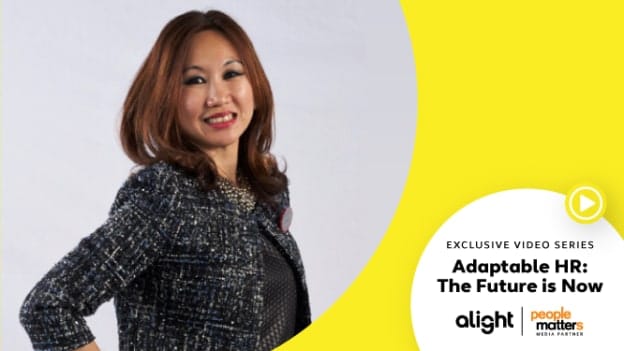
In this sixth episode of the video series, Adaptable HR - The Future is Now, Nadiah Tan Abdullah, CHRO, SP Setia Berhad, shares how adaptability is the core to the business of SP Setia Berhad and how COVID-19 has accelerated the criticality of businesses to embrace adaptability as a skill.
Chapter-1: Adaptability in HR: A brief overview
The conversation was led by Shaswat Kumar Vice President & Asia Head - Payroll, Advisory and Cloud Solutions, Alight Solutions who presented some interesting insights that are driving the current world of work and will help organisations to transcend into the future of work as they understand transformation better in the context of business and HR both, based on the Asia Pacific State of HR Transformation Study 2020. Some of the key insights from the report were:
- Focus of HR Transformation is all about enabling Business Transformations
- Combination of HR Operating Model, Digital Tools and Disciplined Governance drives success
- HR Function always had clarity on HR’s Effectiveness agenda; yet the top gaps remain consistent
- Digital is key for HR to deliver on both Employee Experience and Compliance
- HR Technology satisfaction improves as buying behaviour changes
- Governance is HR’s Achilles Heel
- Tipping points for HR are moving targets
Chapter-2: CHRO’s take on adaptability in HR
In the second chapter of this episode, Shaswat Kumar, Vice President & Asia Head - Payroll, Advisory, and Cloud Solutions, Alight Solutions answers the following key questions that might puzzle you when you activate your Adaptable journey:
- What does adaptability look like?
- What are the signs of adaptability?
- What are the kind of outcomes one should expect from their adaptable HR journey?
Moving ahead, Shaswat delves deeper into the insights of the State of HR Transformation Study 2020 as Nadiah Tan Abdullah, CHRO, SP Setia Berhad poses questions on how can one navigate through the following key milestones in the Adaptable HR journey which addresses themes like:
- How can a combination of HR Operating Model, digital tools, and disciplined governance drive success?
- How can digital deliver on both employee experience and compliance?
- Enabling business transformation through HR transformation.
Chapter -3: CHRO’s take on Adaptability in HR
Reflecting on the enablers of successful transformation from the Asia-Pacific’s largest study on the State of HR Transformation, it was found most of the success comes through when HR is willing to change itself. In fact, resistance to change from HR is the biggest barrier in realising transformation. In the third chapter of the episode, Nadiah Tan Abdullah, CHRO, SP Setia Berhad reflects on the findings of the study and shares how the organisation is approaching a logical, disciplined, and impactful strategy towards the art of becoming adaptable.
Here are the excerpts from the interview:
Q1. What does adaptability mean to you in today’s context?
We have been talking about adaptability from ages but it is mostly accelerated now as we deal with COVID-19. “As early as last quarter of the year 2019, we have been talking about businesses being impacted by trade wars, digitisation, etc. However, the impact created by the pandemic is incomparable. And hence, in this context, adaptability is a competitive advantage. You need to move quickly and cannot be behind time. We need to have the ability to look macro, skim through tons of data, macro analyse it and funnel it down to micro deployment.
Q2. Going through the State of HR Transformation Study 2020, what are some of the trends you relate with the most?
There are three trends that I relate with the most:
- Talent Management
- Digital Transformation
- HR Operating Model
I would further like to elaborate on the talent management piece as in this ongoing crisis, we led certain talent management programs that made us realize that adaptability is a wise choice and why it needs to be integrated into your talent management practices.
As you know, the current crisis made many roles redundant and it put us in a situation – whether we should try to fit into new emerging roles or hire new talent? Aligning our strategy on “adaptability”, we followed a 70:30 approach, where 70% of the time was to be spent on core roles and 30% on new projects. What made this step interesting now is that hierarchy wasn’t a part of this program. Anyone could lead the new projects irrespective of the roles and designation. Further, debrief sessions were held to reflect on what went right and wrong while leading and executing the projects which were beyond the core role of these project leaders.
What made this project great was that it proved to be a great leadership platform where employees at each level and across functions were given the opportunities to show their leadership capabilities. For leaders, it gave them enough insights to observe talent in action on project planning, EQ, and other skills. This program gave us an opportunity to see succession planning beyond business verticals but making it a fair opportunity to identify talent which might not be able to display their skills due to lack of opportunities.
Q3. What are some trends that will be further amplified in the future?
Undoubtedly, digital is a way to go and digital transformation will become more critical than ever. However, having said that, as we embrace new trends, we should be culturally ready for these trends and make sure these trends do not intimidate our culture. While it is good to be in the bandwagon of embracing new trends, one should not disconnect with one’s culture.
(To download your copy of Asia Pacific’s largest study on the State of HR Transformation 2020, click on this link.)