For financial institutions, trust has traditionally been established through documentation, background checks and multiple layers of approval. But as organisations hire at greater scale, adopt AI and process larger volumes of candidate data, these systems are coming under pressure.
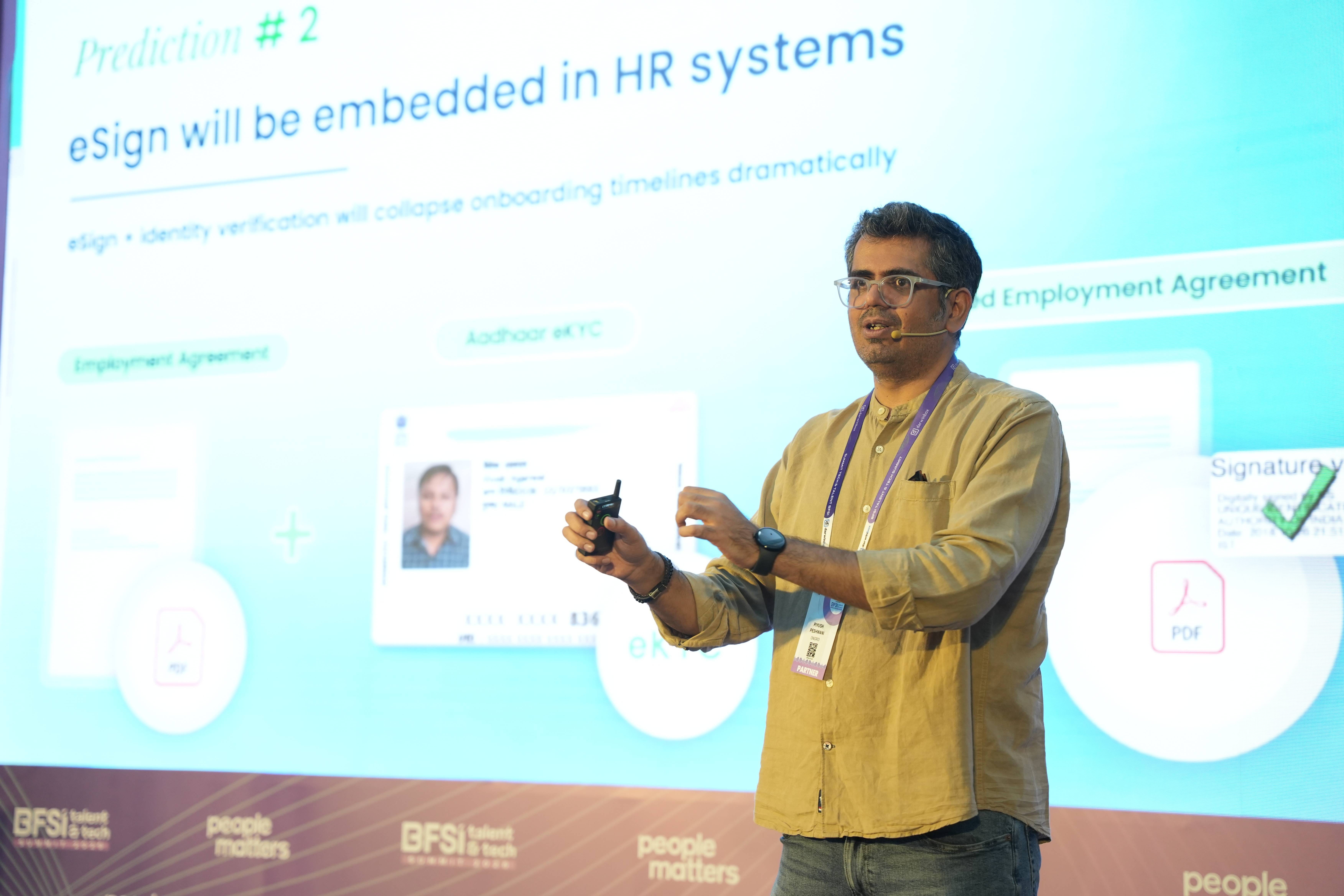
At the People Matters BFSI Tech and Transformation Summit 2026, Piyush Peshwani, Co-founder and CEO of OnGrid and eLockr, argued that compliance must move beyond being a back-end legal or administrative function. Instead, it must become part of the technology through which organisations hire, onboard and manage employees.
“Organisations that recognise these shifts early will win,” he said, outlining five changes that could reshape trust and compliance in hiring.
1. Verification will become embedded in HR systems
The first shift will be the movement of verification processes from separate background-checking exercises into core HR platforms. Peshwani pointed to India’s digital public infrastructure- including Aadhaar, UPI, FASTag, DigiLocker and electronic signatures- as evidence of how shared digital building blocks can simplify complex transactions.
A similar model is likely to emerge in HR. Identity verification, bank account validation, criminal record checks and employment history verification could increasingly become APIs integrated directly into recruitment and onboarding systems.
Instead of transferring candidate information across multiple vendors and platforms, employers could initiate checks from within their HRMS and receive verified results in the same workflow.
“What was earlier part of a background verification report will increasingly become a set of building blocks integrated into the HRMS,” Peshwani said.
For employers, this could reduce onboarding delays and manual intervention. For candidates, it could create a more transparent and connected process.
2. Consent will sit at the centre of digital identity
Embedding identity into hiring workflows does not mean employers should automatically gain access to every piece of information linked to an individual.
Peshwani emphasised that future verification systems must be consent-led. Individuals should be able to decide which elements of their identity they share with a particular employer or service provider.
A candidate may, for instance, choose to share their name, photograph, date of birth and address without disclosing their phone number or email address.
This principle becomes particularly important as organisations adapt to stronger data-protection expectations. Collecting more information than required could expose employers to both regulatory and reputational risk.
Peshwani also clarified that Aadhaar should not be viewed as proof of citizenship. Its primary role concerns identity and residency, and its use must be supported by appropriate authentication, encryption, and consent mechanisms.
The objective is not to create a system that allows employers to access everything about an individual. It is to create secure, purpose-specific pathways for the sharing of verified information.
3. Employment verification will shift from emails to credentials
Employment verification remains one of the slowest parts of background screening. Recruiters and verification providers often depend on former employers to respond to emails, fill out forms, or manually confirm employment records.
The process can take days or even weeks. Peshwani questioned why such an important activity continues to depend on email, particularly when email-based information exchange is slow, difficult to audit and vulnerable from a data-security perspective.
He predicted that employers will increasingly issue verifiable digital credentials to current and former employees. These could confirm details such as role, tenure, income, notice period completion, or eligibility for rehire.
When an employee applies for another role, the credentials could be shared directly with the prospective employer after receiving the individual’s consent.
This could make verification almost instantaneous while reducing the administrative burden on former employers.
Peshwani compared the opportunity to UPI. Its success did not come from technology alone, but from financial institutions agreeing to participate in a common ecosystem. “If organisations begin issuing credentials, everybody’s verification problem starts to go away,” he said.
However, the use of negative or disciplinary information would require much stronger governance. Organisations would need clear rules around accuracy, access, correction and the consequences of disputed information.
4. Video profiles will reshape candidate evaluation
The traditional résumé may also begin to give way to video-based candidate profiles.
Rather than uploading only a PDF, candidates could respond to a series of questions via short recorded videos. Recruiters could then use these responses to assess communication, motivation and suitability before conducting a formal interview.
This shift will be driven partly by volume. As technology makes it easier to apply for jobs, employers may receive hundreds of applications for a single role. Reviewing every résumé or video manually will become impractical.
AI will therefore play a larger role in shortlisting candidates. Employers may configure systems to identify evidence of specific capabilities or behaviours, such as communication, customer empathy or ownership. AI could analyse the responses and recommend a smaller group for further evaluation.
Yet this also creates governance challenges. Behavioural qualities are more subjective than qualifications or years of experience. Organisations will need to ensure that AI recommendations are explainable, regularly reviewed and not treated as definitive assessments of a candidate’s personality or potential.
Technology may support judgment, but accountability for hiring decisions must remain with people.
5. Hiring will become a contest between candidate AI and employer AI
The final prediction concerned the rise of AI agents on both sides of the recruitment process.
Candidates will increasingly use AI to create résumés, generate video applications, prepare interview responses and apply automatically to multiple roles. An AI agent could identify relevant openings across several career sites and submit applications with limited human effort.
This will dramatically increase application volumes, but not necessarily the number of suitable or genuinely interested candidates.
Employers will respond with their own AI systems. These tools will evaluate applications, verify identities, detect generated content and identify potential deepfakes in video interviews.
Peshwani described the emerging landscape as “employee AI versus employer AI”, with each side attempting to stay ahead of the other.
Deepfake detection will become particularly important. As synthetic video improves, recruiters may no longer be able to identify manipulated content with the naked eye. Hiring systems will need to analyse recordings for inconsistencies and assess whether the content is authentic.
But stronger detection tools alone will not be enough. Employers will also need to redesign hiring processes so that authenticity does not depend on a single document, video or interview.
Identity, skills, employment records and candidate claims will need to be validated through multiple consent-led signals.
Building trust into the workflow
The central message was clear: trust cannot be added after a hiring decision has already been made. It must be embedded in the recruitment architecture, from identity and consent to employment credentials, AI screening, and digital contracts.
This also expands the responsibility of HR and business leaders. Selecting the right technology provider will not be enough. Leaders must decide what information should be collected, how automated recommendations will be reviewed, who remains accountable for decisions and how candidates can question or correct their data.
As hiring becomes faster and more automated, the strongest organisations will not simply be those that remove the most human involvement. They will be those that use technology to make trust more visible, verifiable and accountable.
In the next phase of digital hiring, compliance will not sit outside the employee experience. It will become one of the foundations on which that experience is built.