In a business landscape shaped by rapid change and fierce competition, few leaders are as pivotal to organisational transformation as
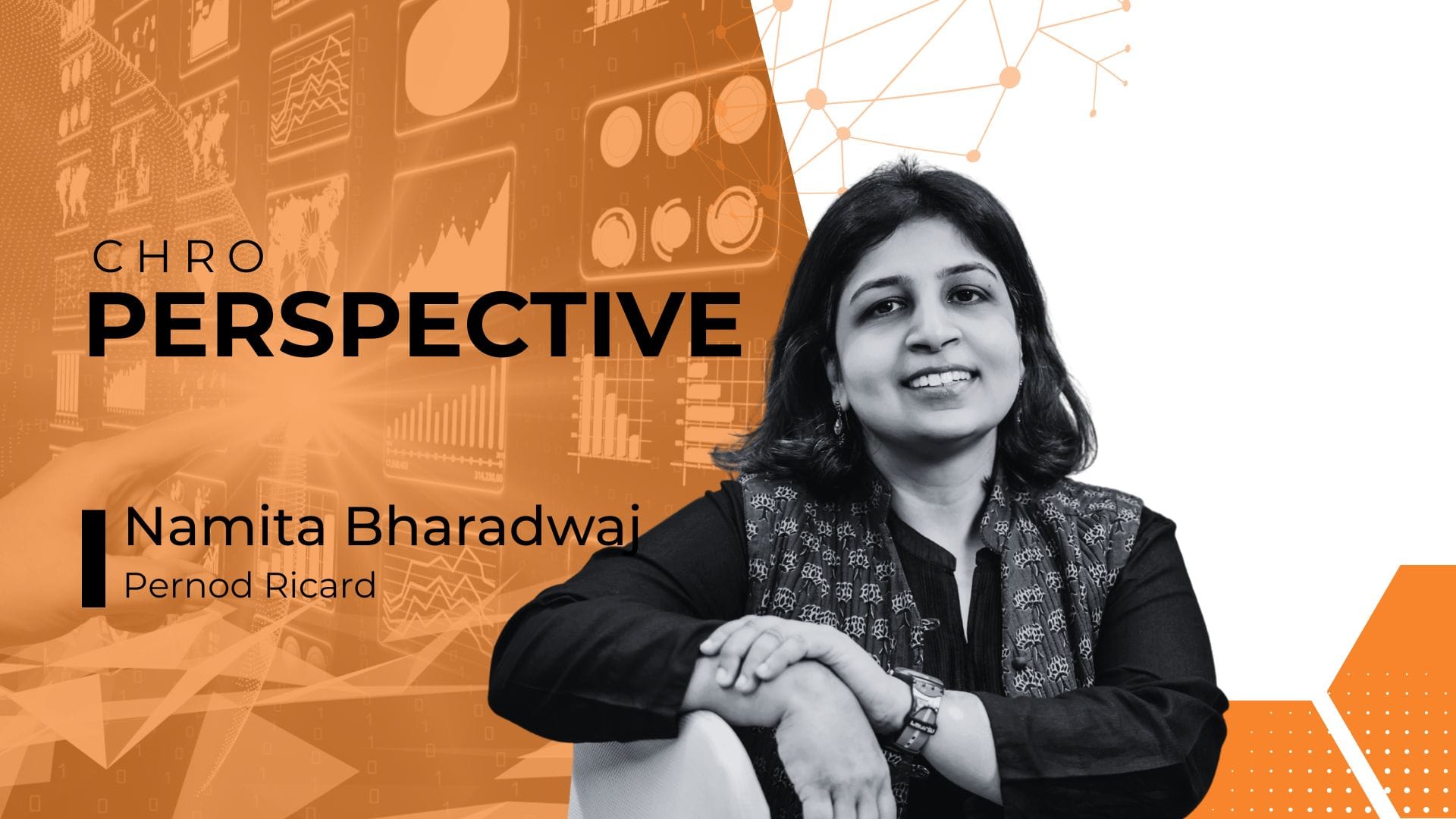
Namita Bharadwaj, Chief Human Resources Officer at Pernod Ricard India. As a leadership architect with a forward-looking approach, Bharadwaj is redefining what it means for HR to be a true strategic partner. Moving beyond policies and processes, she is helping co-create business strategy, drive digital innovation, and foster a culture built on diversity, agility, and purpose.
In this exclusive People Matters
CHRO Perspective interview, Bharadwaj shares how she and her team are leveraging data, artificial intelligence, and immersive technologies to attract and develop top talent, build an authentic employer brand, and ensure sustainable growth in the highly regulated alcohol beverage industry. From leveraging AI to nurturing top-tier talent, her insights offer a refreshing look at how bold leadership can drive sustainable growth without losing sight of the people who make it possible.
Edited excerpts
As CHRO, how are you redefining HR's role as a strategic business partner to drive growth and transformation at Pernod Ricard India?
The biggest shift is moving from being seen as “process owners” to truly becoming co-creators of the business strategy. Today, HR isn’t sitting on the sidelines—we’re right there in the room when key decisions are being made, bringing a people lens to every business conversation.
What that means in practice is that we’re using data much more intentionally—whether it’s insights into people metrics, capability gaps, or productivity. Additionally, the use of data & insights is not only “for the HR team’s purpose” but to enable & encourage managers to see their teams from the much-needed lens of objective parameters.
At the same time, we’re really focused on building agility into the organisation. That involves rethinking roles, simplifying structures, and evolving ways of working to respond faster to a highly dynamic market.
Equally, it is critical for the HR team to have a sharp understanding of how people costs are evolving, the impact these costs have on overall business performance, and how short‑ and long‑term investments translate into organisational value. Ultimately, it’s about making HR less about policies and processes, and much more about
enabling the business to move faster, grow stronger and stay future-ready.
How is Pernod Ricard India reimagining its talent strategy to attract and retain top talent in the highly competitive alcohol beverage industry?
One of the biggest ways we’re reimagining our talent strategy is widening the lens on where we hire from and not limiting ourselves to the alco-bev industry. We’re bringing in talent from FMCG, FMCD, manufacturing, and beyond. That diversity of experience really strengthens our capability depth and brings fresh thinking into the organisation.
At the same time, we’re very intentional about how we position ourselves as an employer. Pernod Ricard India stands for purpose, premiumization, and a strong culture of belonging that helps us stand out not just within our category but also in the broader talent market.
Retention, for us, is linked to growth. We focus on creating meaningful career pathways and enabling cross-functional mobility, so they continue to feel challenged and invested. Alongside this, we’re strengthening our campus and early talent pipelines to ensure we’re building a sustainable talent pool for the future.
And finally, to ensure a consistent employee experience, we take a very holistic view of Total Rewards, where it’s not just about compensation—it’s about the entire employee experience and how all the elements come together to create a compelling value proposition.

How is Pernod Ricard India leveraging artificial intelligence in HR and talent management practices, and what impact has this had on business and workforce outcomes?
We’re looking at AI not as a standalone tool, but as something that can meaningfully enhance the entire talent journey, right from hiring to development and engagement.
For instance, in hiring, AI helps us improve both quality and speed through smarter screening, better candidate-role matching, and even reducing bias in early-stage selection.
Beyond that, we’re using it to create much more personalised employee experiences aptly called ‘Horizons’, whether it’s tailored learning journeys, development plans, career recommendations, or even helping employees discover mentors and local & global gig opportunities within the organisation.
On the analytics side, AI provides predictive insights into attrition and engagement, enabling us to move from reactive to proactive interventions. And by automating routine processes, such as HR helpdesk queries, our teams can spend far more time on strategic, high-impact work.
Alongside AI, we’ve also been experimenting with immersive technologies. One example we’re particularly excited about is “Cheers VRorld”—an industry-first, VR-powered onboarding experience in the alco-bev sector.
It brings onboarding to life through a virtual journey where new joiners can interact with leadership, explore our culture, and even experience real market environments, all from the comfort of their offices. We’ve already piloted this with over 120 new employees across 14 locations, and as we scale it, it’s helping us create a far more consistent and engaging onboarding experience - no matter where someone is based.
What unique challenges and opportunities do you encounter when building employer branding in the alcohol sector, given regulatory and societal constraints?
Our organisational brand has been built over the years and reflects who we are as a global company and in India.
A big part of our approach is staying authentic and consistent in our narrative—whether that’s at industry forums or across talent platforms. We focus on telling a story that goes beyond our products and really highlights our culture, our people, and our purpose.
Employee advocacy plays a huge role here. Our people are our most credible ambassadors, bringing the inside view of what it’s truly like to work here and, in doing so, also helping shape how the industry is perceived.
Interestingly, one of our biggest strengths is the diversity of our talent. An increasing share of our workforce comes from outside the alco-bev sector. That, in itself, becomes a strong employer brand differentiator.
We also lean into responsible storytelling, especially around safety, responsibility, and the role we play as an industry. Combined with our focus on sustainability and social impact, along with some of our industry-first initiatives, it helps us build credibility while staying true to who we are.
At the end of the day, it’s about turning what could be seen as limitations into a distinctive, purpose-led narrative that genuinely resonates with talent. But till we continue to hear even one candidate ask the question “Would you hire a teetotaller?”, our work continues.

How does your organisation foster a culture of inclusion and diversity, and what specific initiatives have yielded the best results?
For us, inclusion and diversity aren’t a standalone HR agenda—it’s deeply embedded into how we think about the business itself. That shift has been imperative because it ensures inclusion shows up not just in policies but also in everyday decisions, behaviours, and outcomes across the organisation. More importantly, we have a diverse top leadership team, which not only reflects the diversity we want within our organisation but also pushes for diversity & inclusion across their respective teams as well.
We also take a fairly broad view of diversity. Of course, gender continues to be a key focus, but we’re equally committed to creating opportunities for persons with disabilities—where we now have over 100 workers across our sites—as well as to building an inclusive environment for LGBTQIA+ employees and talent from outside the industry.
A big enabler has been our policy ecosystem, whether it’s flexibility, parental support, unlimited well-being leaves, or ensuring safe and inclusive workplaces. Alongside this, we’ve invested in structured programs like ‘Beyond Labels’, which focuses on building awareness, strengthening inclusion as a skill, and embedding it into everyday behaviours.
All of this comes together to create a workplace where inclusion isn’t just talked about—it’s experienced consistently and reflected in both our culture and our people outcomes.
What have been the key barriers to greater gender diversity in manufacturing and operations, and how have you overcome them?
In manufacturing and operations, the barriers to gender diversity have historically come down to two things—mindset and infrastructure. And irrespective of the function or industry type, we are constantly working to break down the real & perceived derailers to greater diversity.
On the mindset side, there’s been a long-standing perception that these roles aren’t necessarily suited for women. One of the biggest shifts we’ve driven is moving that conversation away from gender and firmly towards talent and skills. Today, the question we’re asking is simple: do we have the best person for the role? That shift has been reinforced through structured tracking, including a Talent Health Scorecard across our units and regions.
At the same time, infrastructure has been another barrier and one we’ve actively invested in. Over the past few years, we’ve significantly upgraded our facilities to create an experience that’s far more inclusive and comparable to our corporate environments. And this is something we continue to build on.
What’s also made a big difference is visibility. We’ve consciously focused on creating role models and success stories on the ground because seeing is believing, and that plays a powerful role in changing perceptions.
Alongside this, targeted interventions such as the Diksha Mentoring Program have helped us take the next step in nurturing and growing talent within the system.
The impact of all of this has been tangible—we’ve seen a 30% increase in gender representation over the last three years. More importantly, it feels like a shift that’s becoming embedded and sustainable.

What is your approach to leadership succession planning in a fast-changing and regulated industry, and how do you ensure readiness for critical roles?
Our approach to succession planning has evolved over time. We’ve moved away from static, once-a-year plans to much more dynamic, continuously reviewed talent pipelines that keep pace with a fast-changing and highly regulated environment.
We start by identifying critical roles across the organisation and then build structured pipelines. At the same time, we also maintain an external pipeline for roles where we may not have immediate internal readiness.
A big enabler for us has been internal mobility. Through our Internal Job Postings, we’re able to surface high-potential talent and give them opportunities to move across roles and functions.
Beyond that, we focus a lot on accelerating readiness. This includes stretch assignments, cross-functional exposure, and giving people opportunities to operate in more complex, real-world scenarios so they’re prepared for larger roles.
Most importantly, succession planning is not done in isolation as it’s closely tied to our business strategy, leadership priorities, and the capabilities we’ll need for the future. That ensures we’re not just filling roles, but building a leadership pipeline that’s truly future-fit.
What advice would you offer to other talent leaders on building robust succession pipelines in sectors with unique regulatory and market dynamics?
Succession planning needs to be treated as a core business priority, not something revisited once a year as an HR exercise.
It’s important to build real depth in your pipeline. That means having multiple potential successors for critical roles and focusing as much on development as you do on identification.
Another useful lens is to track outcomes through clear KPIs, both leading and lagging. If you find that external hiring is still the default for key roles, it’s a signal to pause and recalibrate your approach.
And finally, in sectors like ours where regulatory and market dynamics are constantly evolving, agility is key. Succession pipelines need to be continuously refreshed and aligned to where the business is headed—not where it has been.
This story is part of CHRO Perspective. A People Matters series featuring bold ideas and real-world insights from India’s top CHROs. Stay with us for more perspectives that power the future of work.