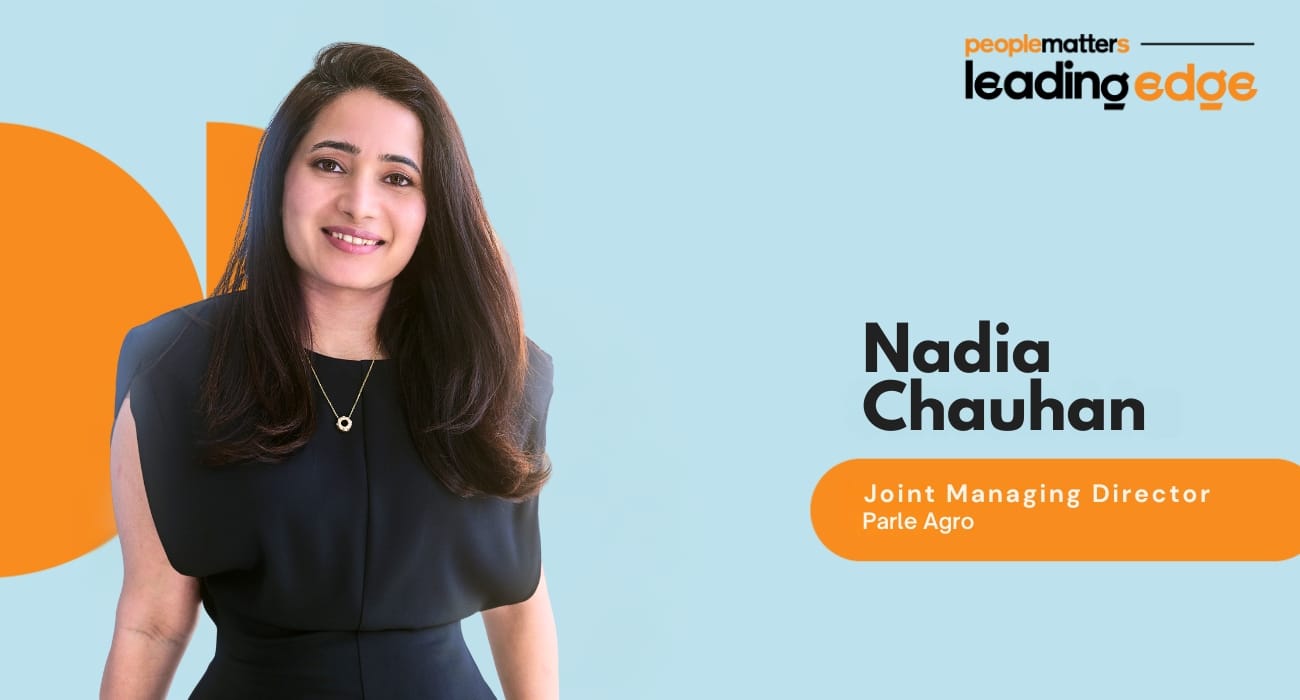
In the dynamic world of FMCG, where consumer tastes shift faster than ever, Parle Agro's Joint Managing Director, Nadia Chauhan, has a clear vision: the company's competitive edge isn't just in its products, but in its people. And at the heart of this philosophy is a fundamental redefinition of the Human Resources function, with the Chief Human Resources Officer (CHRO) evolving from a policy enforcer to a strategic co-creator of culture and growth.
She also believes that for talent leaders to lead a large FMCG company, they need to move beyond policy custodianship and become commercially astute, empathetic, and strategically impactful.
This People Matters' LeadingEdge article delves into Chauhan's leadership philosophy, her vision and passion that drives the company and how her collaborative alliance with the CHRO is rewriting the rules of talent management in the FMCG sector and for Parle Agro.
The Collaborative Alliance: Business and people intertwined
Chauhan is unequivocal in her assessment of the modern HR role. "At Parle Agro, we see HR not as a support function but as a strategic partner at the table," she states.
Her relationship with her CHRO is a "collaborative alliance" where business strategy and people strategy are seamlessly intertwined. This is not a superficial partnership; it is a deep-seated collaboration that co-creates policies directly linked to the company's core innovation agenda.
This partnership is visible in a range of strategic initiatives. Together, they design agile workforce structures that enable faster go-to-market execution, a critical advantage in an industry where speed is paramount. They also focus on embedding inclusivity into leadership development and creating recognition frameworks that fuel creativity across the board.
"Rather than focusing only on compliance or operational HR, our CHRO actively helps shape organisational culture, enabling us to unlock the full potential of our people as a competitive advantage in a rapidly evolving FMCG market," explains Chauhan.
Building a workforce for tomorrow, today
Innovation in FMCG is a relentless pursuit, and Chauhan understands that to stay ahead, her people must anticipate consumer shifts before they happen. This is where her collaboration with the CHRO becomes a proactive, forward-looking exercise. "Our CHRO and I collaborate on building a proactive talent pipeline that anticipates tomorrow's needs," she says.
And this is not just about reactive training; it is about a strategic investment in a comprehensive learning ecosystem. This ecosystem blends digital upskilling, cross-functional mobility, and experiential programs designed to equip teams with a dual skill set: functional expertise and entrepreneurial thinking.
Chauhan points to their leadership development programs as a prime example. These initiatives go beyond managing scale, instead focusing on cultivating agility and risk-taking, traits that are vital for disruptive innovation. By aligning learning and development with business foresight, Parle Agro ensures that it is not only ready for the future but also actively creating it.
Leadership as passion and purpose
Chauhan's leadership style is the bedrock of this culture. Her philosophy centres on bringing passion and purpose into every action. She embodies this by being fully immersed in the business, from the intricacies of product development to the dynamics of the sales floor. This hands-on approach ensures that the company's vision is a lived reality, not just a set of corporate values on a wall.
"When people experience that commitment first-hand, it encourages them to carry the same spirit forward and make it their own," feels Chauhan.
This philosophy is essential for leading a large and diverse workforce across a vast supply chain. Chauhan recognises that while data and analytics are essential for understanding market shifts, it is the culture of trust, empowerment, and shared purpose that ultimately unifies the organisation. "What unites us is a shared purpose—to create quality, innovative beverages that delight Indian consumers," she says.
This sense of a shared mission ensures that every employee, whether in a manufacturing plant or a sales team, feels a direct impact of their work on the larger mission, which in turn fosters ownership and engagement.
For Chauhan, this personal connection to the purpose is what keeps the workforce resilient and agile in an uncertain industry. She has learned that when people understand the "why" behind every initiative and feel empowered to act, they navigate challenges with greater confidence.
This is especially true for the new generation of talent, who bring bold ideas and a strong sense of purpose, as well as a work-life balance. "Their expectations are reshaping how organisations think about culture, and I see this as an opportunity to harness their energy to drive meaningful innovation," said Chauhan.
The Ultimate Differentiator: The human touch
Looking back, Chauhan's most critical lesson in managing talent has been to ensure that people do not lose sight of the larger purpose as the company grows. Her experience taught her that clarity, communication, and empowerment are the antidotes to the complexity that comes with expansion.
She has realised that her role is not just to lead strategy, but to nurture passion. "When you invest in empowering people, the business takes care of itself," she says.
Her vision for the future of the FMCG workforce is one where human talent and technology are "deeply intertwined." Technology will provide the tools and insights, but it is human creativity, passion, and intuition that will translate those insights into products and experiences. In this future, the workforce will be agile, data-enabled, and united by a strong sense of purpose.
Advice for HR leaders
On a broader level, Chauhan believes that for HR leaders to take on more prominent roles within large organisations in the FMCG sector, they need to move beyond policy custodianship and become commercially astute, empathetic, and strategically impactful.
"The single most important advice I would give HR leaders is this: move beyond being custodians of policy to becoming architects of culture and growth. In today's FMCG landscape, the CHRO must be as commercially astute as they are people-focused, understanding how talent decisions directly influence innovation, market share, and shareholder value."
To lead at scale, a CHRO needs courage to challenge conventions, foresight to anticipate demographic and technological shifts, and empathy to create workplaces where people can thrive. Ultimately, success lies in balancing the human touch with strategic impact—because in FMCG, our people are the true differentiator, Chauhan concludes.