The atmosphere in the boardroom is tense and laden with an overwhelming burden of uncertainty. Silence reigns with impunity across the assembled group of impassive faces. Wearily, the Chairman’s voice takes the courageous route to an evocative conversation, ‘Time to take the vote. Let’s see a show of hands’. The decision is taken with an inevitable sense of forlorn resignation. It’s time to find a new CEO...
Replacing outgoing top leaders with suitable internal successors has become a critical issue for many competitive organizations in recent times.

There seems to be a consistent dearth of talent as organizations struggle with experimentation of bringing ‘outside talent’ as seemingly ‘safe bets’, who look promising on paper, but, fail disconcertingly to deliver in terms of desired outcomes.
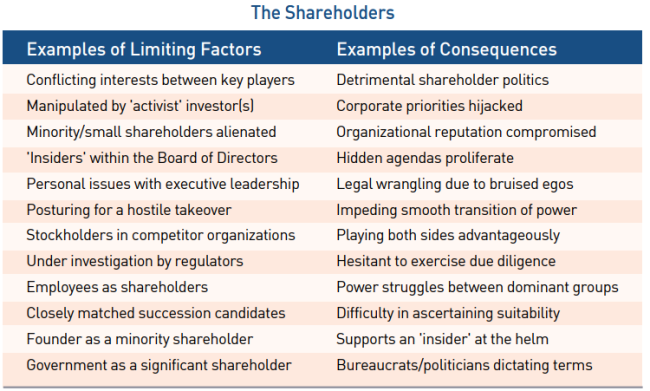
Showdowns between ‘activist’ shareholders and a jaded Board of Directors (BOD)/Executive Management on reversing the ‘death spiral’ of poor results are becoming commonplace. The alarming specter of ‘retired’ executives brought back to save worsening fortunes is bemusing market watchers, unnerving money managers, troubling regulators and sullying the pristine brand image. Unfortunately, this also casts doubt on the seemingly robust talent management practices that miserably fail to resolve such glaring imperatives for organizational survival. The following content takes an equitable view of why the current bastions of corporate success are facing the gradual march to oblivion due to limiting ‘primary stakeholder-related’ factors, that are analogous to a debilitating termite infestation, and provides salvageable options to avert meltdowns.
There are three key categories of stakeholders with a decreasing order of influence on the outcomes pertaining to the succession practices: Primary, Secondary, and Tertiary Stakeholders.

Key limiting factors pertaining to the primary stakeholders are:
The following four solutions are provided to ensure that the ‘felt fairness’ element pertaining to succession is optimized with a high probability of hiring the most suitable candidate:
- Internal Democratization of the Succession Process
- External Democratization of the Succession Process
- Engaging the Regulator in Proactive Oversight
- Subcontracting to an Independent Firm

Internal Democratization of the Succession Process
This refers to the formulation of the succession process as an election and not a selection. Following sequential steps are taken during the respective process:
- The Head of OD/HR/TM function maintains an updated and ranked confidential list of potential candidates, based upon defined competencies, agreed by the Incumbent Leader and ratified by the BOD. Examples of suitable parameters can include; academic qualifications, years of service, record of achievement, leadership experience, failure management, high emotional intelligence, strategic acumen, multidisciplinary knowledge, competitor(s) and industry insights, negotiating ability, presentation skills, assertiveness, charisma, decision making prowess, mergers and acquisitions exposure, reliability, confidentiality, pressure handling, 360 degree feedback, corporate citizenship behavior, approach to criticism, visionary capability, technology aptitude, key stakeholder understanding and management (e.g., shareholders, regulatory bodies, employees, union(s), client/customer, supplier/contractor, etc.)
- The top three candidates are approached by the Head of OD/HR/TM function, at least 6 months before the expected departure of the incumbent leader, to get their consent in terms of being considered for the top job. If the consent is given by all three, then the names of the candidates and their professional credentials are made public. However, if any candidate wants to withdraw from being considered, then the next best candidate is promoted to be within the top three, before the public announcement.

- The top three candidates are then invited to at least three debates, moderated by the BOD Chairman/Designated Director, in front of an ‘open house’ of employees, who are invited to ask questions from the candidates on various aspects of running the organization.
- Elections are conducted by the OD/HR/TM function and supervised by the BOD, at least three months before the expected departure of the incumbent leader, with the three candidates being on the ballot. Every ‘full time’ employee is eligible to cast one vote in person/mail/online, regardless of his/her position within the organizational hierarchy.
- Results of the respective elections are tabulated by the OD/HR/TM function and reviewed by its Head, who forwards it to the BOD.
- The winner is considered to the candidate who secures at least 50% of the cast vote. In case no candidate secures the respective percentage; a second round is conducted, within 15 days, between the top two candidates, and the one who secures more votes through simple majority is declared the successor to the incumbent leader.
- Results of the respective elections are tabulated by the OD/HR/TM function and reviewed by its Head, who forwards it to the BOD.
- The BOD authorizes the public release of the results and informs the regulatory authority.

- The Head of OD/HR/TM advises the selected leader about the successful outcome and arranges for the BOD to congratulate him/her publicly, while a relevant press release is issued by the Head of Public Relations Department.
- The Head of the OD/HR/TM function is instructed by the BOD to initiate the accession proceedings, coordinate the orientation activities in conjunction with the incumbent leader and the functional heads, and organize the farewell ceremony for the outgoing leader to reinforce the public image of a smooth handover.
- The Head of the OD/HR/TM proceeds in accordance with the instructions given by the BOD.
- The new leader takes office to drive the organization with renewed vigor.
External Democratization of the Succession Process
This refers to the formulation of the succession process as an election and not a selection. Following sequential steps are taken during the respective process:
- The Head of OD/HR/TM function maintains an updated and ranked confidential list of potential candidates, based upon defined competencies, agreed by the Incumbent Leader and ratified by the BOD. Examples of suitable parameters can include; academic qualifications, years of service, record of achievement, leadership experience, failure management, high emotional intelligence, strategic acumen, multidisciplinary knowledge, competitor(s) and industry insights, negotiating ability, presentation skills, assertiveness, charisma, decision making prowess, mergers and acquisitions exposure, reliability, confidentiality, pressure handling, 360 degree feedback, corporate citizenship behavior, approach to criticism, visionary capability, technology aptitude, key stakeholder understanding and management (e.g., shareholders, regulatory bodies, employees, union(s), client/customer, supplier/contractor, etc.)
- The top three candidates are approached by the Head of OD/HR/TM function, at least 6 months before the expected departure of the incumbent leader, to get their consent in terms of being considered for the top job. If the consent is given by all three, then the names of the candidates and their professional credentials are made public. However, if any candidate wants to withdraw from being considered, then the next best candidate is promoted to be within the top three, before the public announcement.
- The top three candidates are then invited to at least three debates, moderated by the BOD Chairman/Designated Director, in front of an ‘open house’ of shareholders, who are invited to ask questions from the candidates on various aspects of running the organization.

- Elections are conducted by the OD/HR/TM function and supervised by the BOD, at least three months before the expected departure of the incumbent leader, with the three candidates being on the ballot. Every shareholder/designated representative is eligible to vote and entitled to cast one vote in person/mail/online, regardless of the size of their shareholding.
- Results of the respective elections are tabulated by the OD/HR/TM function and reviewed by its Head, who forwards it to the BOD.
- The winner is considered to the candidate who secures at least 50% of the cast vote. In case no candidate secures the respective percentage; a second round is conducted, within 15 days, between the top two candidates, and the one who secures most votes through simple majority is declared the successor to the incumbent leader.
- Results of the respective elections are tabulated by the OD/HR/TM function and reviewed by its Head, who forwards it to the BOD.
- The BOD authorizes the public release of the results and informs the regulatory authority.

- The Head of OD/HR/TM advises the selected leader about the successful outcome and arranges for the BOD to congratulate him/her publicly, while a relevant press release is issued by the Head of Public Relations Department.
- The Head of the OD/HR/TM function is instructed by the BOD to initiate the accession proceedings, coordinate the orientation activities in conjunction with the incumbent leader and the functional heads, and organize the farewell ceremony for the outgoing leader to reinforce the public image of a smooth handover.
- The Head of the OD/HR/TM proceeds in accordance with the instructions given by the BOD.
- The new leader takes office to drive the organization with renewed vigor.
Engaging the Regulator in Proactive Oversight
This refers to the formulation of the succession process as a selection by the BOD in the presence of the Regulator. Following sequential steps are taken during the respective process:
- The Head of OD/HR/TM function maintains an updated and ranked confidential list of potential candidates, based upon defined competencies, agreed by the Incumbent Leader and ratified by the BOD. Examples of suitable parameters can include; academic qualifications, years of service, record of achievement, leadership experience, failure management, high emotional intelligence, strategic acumen, multidisciplinary knowledge, competitor(s) and industry insights, negotiating ability, presentation skills, assertiveness, charisma, decision making prowess, mergers and acquisitions exposure, reliability, confidentiality, pressure handling, 360 degree feedback, corporate citizenship behavior, approach to criticism, visionary capability, technology aptitude, key stakeholder understanding and management (e.g., shareholders, regulatory bodies, employees, union(s), client/customer, supplier/contractor, etc.)
- The top three candidates are approached by the Head of OD/HR/TM function, at least 6 months before the expected departure of the incumbent leader, to get their consent in terms of being considered for the top job. If the consent is given by all three, then the names of the candidates and their professional credentials are forwarded to BOD. However, if any candidate wants to withdraw from being considered, then the next best candidate is promoted to be within the top three and the updated list is forwarded to the BOD.
- The top three candidates are then interviewed by the BOD, assisted by the non-voting Head of OD/HR/TM, in the presence of the regulator’s representative, who is also a non-voting member of the interviewing panel.
- The selection of the new leader is done by a majority vote. In case of a tie, the side with the vote of the BOD Chairman decides the outcome.
- The Head of OD/HR/TM advises the selected leader about the successful outcome and arranges for the BOD to congratulate him/her publicly, while a relevant press release is issued by the Public Relations Department.
- The Head of the OD/HR/TM function is instructed by the BOD to initiate the accession proceedings, coordinate the orientation activities in conjunction with the incumbent leader and the functional heads, and organize the farewell ceremony for the outgoing leader to reinforce the public image of a smooth handover.
- The Head of the OD/HR/TM proceeds in accordance with the instructions given by the BOD.
- The new leader takes office to drive the organization with renewed vigor.

Subcontracting to an Independent Firm
This refers to the formulation of the succession process as a selection by an independent firm. Following sequential steps are taken during the respective process:
- The Head of OD/HR/TM function maintains an updated and ranked confidential list of potential candidates, based upon defined competencies, agreed by the Incumbent Leader and ratified by the BOD. Examples of suitable parameters can include; academic qualifications, years of service, record of achievement, leadership experience, failure management, high emotional intelligence, strategic acumen, multidisciplinary knowledge, competitor(s) and industry insights, negotiating ability, presentation skills, assertiveness, charisma, decision making prowess, mergers and acquisitions exposure, reliability, confidentiality, pressure handling, 360 degree feedback, corporate citizenship behavior, approach to criticism, visionary capability, technology aptitude, key stakeholder understanding and management (e.g., shareholders, regulatory bodies, employees, union(s), client/customer, supplier/contractor, etc.)
- The Head of OD/HR/TM facilitates in the search and selection of an independent firm that specializes in the recruitment and selection of C-level executives through defined criteria approved by the BOD. Examples of the defined parameters can include, years of relevant experience, references from past clients, professional credentials and relevant area of expertise of senior management/members of the interview panel, etc.
- The BOD reviews and approves the selection of an independent firm for the succession process, according to the defined criteria.
- The top three candidates are approached by the Head of OD/HR/TM function, at least 6 months before the expected departure of the incumbent leader, to get their consent in terms of being considered for the top job. If the consent is given by all three, then the names of the candidates and their professional credentials are forwarded to the selected independent firm. However, if any candidate wants to withdraw from being considered, then the next best candidate is promoted to be within the top three and the updated list is forwarded to the independent firm.
- The top three candidates are then interviewed by the independent firm in the presence of the Head of OD/HR/TM, who is only present as a ‘dormant’ representative of the client organization.
- The selection of the new leader is done according to the criteria devised by the independent firm with no inputs/guidance/influence from the client organization.
- The Head of OD/HR/TM advises the selected leader about the successful outcome and arranges for the BOD to congratulate him/her publicly, who also notify the regulatory authority. A press release about the selection of the new leader is issued by the Head of Public Relations Department.
- The Head of the OD/HR/TM function is instructed by the BOD to initiate the accession proceedings, coordinate the orientation activities in conjunction with the incumbent leader and the functional heads, and organize the farewell ceremony for the outgoing leader to reinforce the public image of a smooth handover.
- The Head of the OD/HR/TM proceeds in accordance with the instructions given by the BOD.
- The new leader takes office to drive the organization with renewed vigor.
Leadership changes in ‘too big to fail’ organization is fraught with huge challenges and the ramifications of a ‘good’ or ‘bad’ decision tend to significantly impact the economic health of an organization. Therefore, it is imperative that robust measures are taken by a dedicated and proficient BOD under the scrutiny of an impartial and infallible regulator, to ensure a seamless transfer of leadership to a deserving successor.
No hiring method is perfect; however, the probability of success is significantly increased with judicious and justifiable controls in place.
It is hoped that the four methods, highlighted earlier, for resolving the dilemma of hiring worthy internal successors within ‘too big to fail’ organizations will, at the very least, generate an honest introspection of hiring practices and lead to subsequent reformation in order to avoid the ‘heartburn’ of an imprudent selection, placate key stakeholders and unleash positive vibes for strengthening the foundations of a fragile economy.