








Removing unconscious bais in leadership development
From unconscious bias to conscious inclusion
There is a strong business case that diversity has multiple positive impacts on organizations – from driving innovation and product development to improved customer relations and retention of top talent – and intellectually, most organizations have woken up to this fact. In practice, however, they regularly miss the benefits of diversity. Efforts may be made to hire a more diverse workforce in order to build teams of people with differing backgrounds, skills and opinions, but unconscious bias operates in companies on a daily basis. Perspectives are dismissed because they are expressed quietly, individuals are overlooked for promotion while noisier and perhaps less competent peers advance, opportunities to reach a new market are bypassed because their consumers are not perceived to be ideal.
Although we all harbor unconscious biases, in the workplace they can have profound effects, dictating the kind of people managers hire, who they fire, and how rapidly individuals are promoted. Unconscious bias can reduce diversity, stifle talent and ultimately, affect the bottom line. As a result, unconscious bias training is much in demand. Leaders are encouraged to examine their behavior closely. Are they getting the best out of people and allowing diversity to flourish? Are all team members feeling positively engaged and motivated? Are leaders creating psychologically safe environments where people are confident to voice their opinions? In many organizations, the honest answer to many of these questions is ‘no’.
Recognizing biases and blockages is one thing; doing something about them is another. American orchestras started using blind auditions in the 1970s, at a time when the top five orchestras had fewer than 5 percent women. This simple step made it 50 percent more likely that a woman would progress to the final round and the number of women in orchestras rose accordingly. In most situations, unconscious bias isn’t so easy to identify or eliminate, but that doesn’t mean companies aren’t trying. Pete Sinclair, Chief of Operations at cyber security firm RedSeal, realized that – like many Silicon Valley organizations – his company had very few female engineers and few employees who weren’t white, Chinese or Indian. He sought advice and subsequently changed the wording of job postings and the structure of interviews to attract a wider range of candidates and mitigate the effect of bias during interviews. Job applications rose by 30 percent and the percentage of female engineers doubled. Since competition for engineers in Silicon Valley is stiff, the motivation for these adjustments was positive and business-oriented rather than entirely altruistic.
However, what this example shows is that positive action is needed. Awareness of unconscious bias on its own is not enough. Many companies that have sought to address unconscious bias, perhaps through training programmes, find that it is not having the transformational effect they anticipated. This is because they need to move from a framework of avoiding unconscious bias to a mindset of cultivating conscious inclusion on the part of their leaders, while simultaneously working with individuals who experience marginalization in the workplace. Guiding leaders towards this mindset, which recognizes that all leadership is about relationships with others, is more constructive than simply getting them to acknowledge their own self-limiting beliefs. Thus, the focus of conscious inclusion is not just on developing the leader as an individual, but on helping leaders to understand how they interact with others and how to make those relationships as positive and productive as possible. Relationships are key. With the benefit of psychological insights, leaders can be taught to create increasingly inclusive cultures.
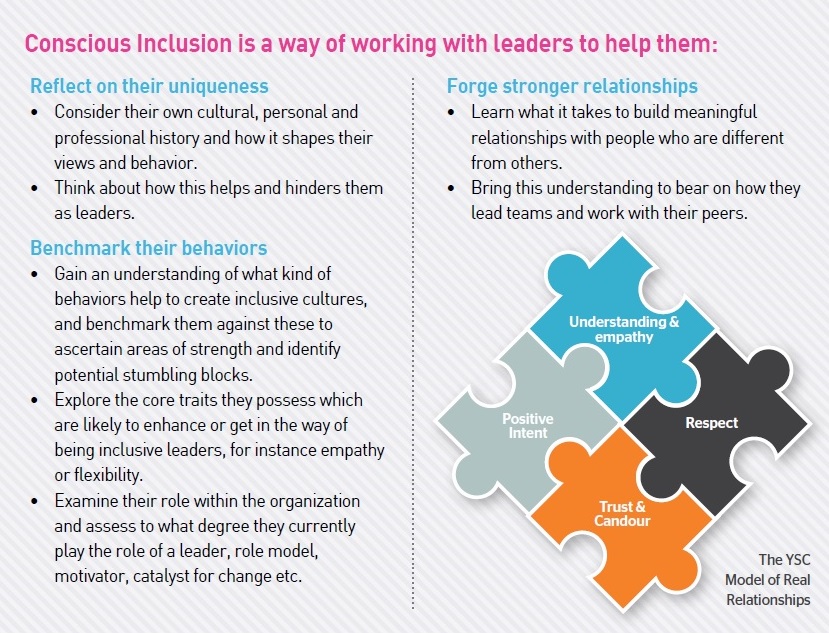
Conscious inclusion requires courage, open-mindedness, humility, the ability to question oneself deeply and a willingness to take a long-term view of interpersonal dynamics. Change does not happen overnight. Moving from addressing unconscious bias to cultivating conscious inclusion means questioning assumptions about what it takes to be successful, learning to manage frustration and even antipathy towards others, and a genuine, conscious appreciation of diversity and the positive impact it can have. Leaders need to know how to create an environment that is psychologically safe so that individuals feel they can contribute and will be listened to. Genuine respect for others – not just superficial respect – is critical.
While most leadership development programs focus on leaders in their formal roles, an inclusive environment is created not only by a leader inviting others to join in, but by whether individuals decide to participate or not. In some instances, an individual’s personal history or fears may mean they hold back when an opportunity presents itself. Female employees, for instance, may underestimate their skills and therefore not put themselves forward for a job or promotion. They unconsciously exclude themselves. In work, as in the rest of life, to thrive we cannot merely spectate. We need to look at ourselves as leaders, but also as participants in trying to create a culture that embraces each of us. We are all both.