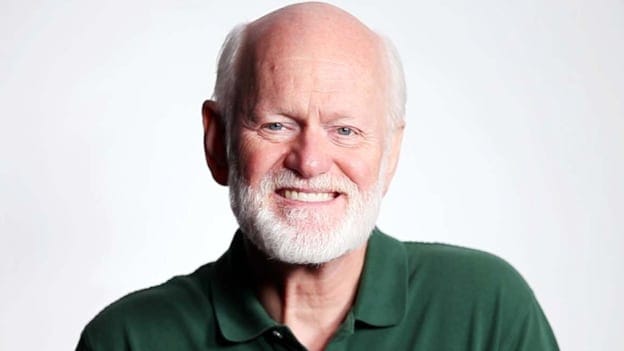
He gives practical, inspirational, and motivational coaching; and his mission is to enable leders to inspire and attain concrete and sustainable behavioral changes — for themselves, their people and their organizations. His client list includes the who’s who of the prominent global CEOs and his practical insights have enabled managements of many illustrious businesses to address transformation processes successfully.
He is Dr. Marshall Goldsmith — a venerated thought-leader and executive coach. Known as the #1 Leadership Thinker in the World, he has been recognized as a top-rated executive coach at the Thinkers50 ceremony in London since 2011.
His authored books have been bestsellers glob- ally including three New York Times bestsellers, Triggers, MOJO and What Got You Here Won’t Get You There – a Wall Street Journal #1 business book and winner of the Harold Longman Award for Business Book of the Year. Dr. Goldsmith has also served on the Board of the Peter Drucker Foundation for ten years.
You have coached leaders in organizations that have transitioned through different stages of evolution. From a leadership perspective, what are the leadership traits that are required during different levels of growth in an organization?
I have talked about this in my book ‘What got you here won’t get you there’. The qualities in leaders that are important and needed when an organization is starting can be different from when the organization matures. In the beginning, the individual founder, the entrepreneur, tends to be more of an achiever — this is a person who really does the work, this is a person with creativity and with innovative ideas. But when an organization evolves, there is a need to develop ‘leaders’ as opposed to developing ‘achievers’. One of the great leaders that I met once said that “For the individual achiever, it is all about ‘me’, and for the great leaders, it is all about ‘them’.” Transforming from an achiever to a leader involves a process of ‘let- ting go’ where you let other people make decisions and simultaneously develop the talent required to make decisions.
But one of the problems is that we all tend to hire people who remind us of ourselves. If you are an individual achiever, you will tend to hire other individual achievers who get put in the leadership roles and are often not well prepared for leader- ship. So it is important to realize that there is a huge difference between being an achiever, which is about me; and the leader, which is about them.
So how does a leader recognize that he is fall- ing into this ‘achiever’ trap?
One of the first signals of this is over-commitment. This is also one of the biggest problem of the people I work with. The way to know that you are into the trap is when you start to feel chronically stressed. If you don’t develop people, the more successful you become, the more over-com- mitted you get. So that’s a very good signal when a leader should realize that he/she is not effectively letting-go.
What is the path ahead for a leader who realizes that he needs to move from being an achiever to a leader? How can this be achieved?
Well, let me tell you the way I coach people. I interview everyone around my clients - all of their key stakeholders. Then I develop a profile based on this confidential feedback about how the leader is perceived. After this, I go over the profile with the leader and in this process, the leader is able to identify what he is doing well and what he needs to do better. After this, we pick important areas of improvement, develop a clear follow-up process with co-workers including me on a regular basis and then we measure change. I have a very unique billing approach, I don’t get paid if my clients don’t get better and ‘better’ is not judged by me or them, but everyone around them.
One of the great leaders once said that “For the individual achiever, it is all about ‘me’; and for great leaders, it is all about ‘them’”
Do you think every leader has the capacity to change?
Everybody can change but that does not mean that everybody should change. Some people really like the role of achiever, they are good achievers, and they should be happy in their role as an innovator or as an achiever. I don’t feel that everyone in the world should move into a leadership role nor should they feel obligated to be a leader, or feel guilty because they are not leaders. There are many great jobs in life other than being leaders. I think leadership is great for some people and it is not for everyone.
What would you say to the leaders who are scaling-up the quantity and quality of leaders?
I wrote an article called ‘Leadership is a contact sport’. This article is about scaling. In this article we concluded that “Leaders who discussed their own improvement priorities with their co-work- ers, and then regularly followed up with these co-workers, showed long-term positive change.”
I think it is always great for the leader to lead by example, not to encourage others to do something that you do not want to do yourself. This leader- ship by example starts with developing yourself as the CEO and then rolling the process down through level after level. So every organizational leader gets in the process of getting feedback while continuously improving and becoming a role model – this way a leader can scale the leadership development process from an individual to thousands of people in the organization.
Leadership development is a lifetime process. For all the leaders I have coached, most of them were already successful leaders, yet they are still trying to get better. Personally, I am still trying to get better.
Looking at your own journey as a leader, what have been the key milestones or turning points in your life?
Well again, I am a different type of a leader. I am a thought leader and do not manage a large organization. Let me describe the best coaching advice that I should’ve listened to which I didn’t for 12 years – When I was much younger, I met Dr. Paul Hersey, who invented situational leadership. Dr. Paul was a highly paid consultant at that time and was kind enough to let me follow him around and learn about what he did. One day he became double-booked and asked me if I could do what he did. That’s how I landed my first consultant job at the Metropolitan Life Insurance Company and I became phenomenally successful. That was 40 years ago and I was 28 years old. That was the good part. Now the bad part — a couple of years later Dr. Paul called me in and told me that I was too successful at what I was doing, but I will become like a hamster in a cage, spinning the wheel, repeating the same act over and over again. He told me that I was just selling business and not making an investment in my future as I should. For 12 years I lived out his prophecy but finally I started writing, thinking and investing in myself, becoming more of a leader in my field as opposed to just being a worker.
I don’t feel that everyone in the world should move into a leadership role, nor should they feel obligated to be a leader or feel guilty because they are not leaders
In life, one of our major challenges is the challenge of comfort — when things are going well and we become comfortable, it is hard to challenge ourselves. But we should continually ask ourselves the questions “Am I being the leader I could be?”
So how do you keep challenging yourself?
I’ll share what I do every day. This takes 3 min- utes a day, costs absolutely nothing, and enables you to get better at anything. On a spreadsheet, on one column write down a series of questions about the things that are most important in your life – friends, family, co-workers etc. 7 boxes across – one for every day of the week. At the end of the week each question must be answered with a yes or a no or a number (Yes=1/No=0). At the end of the week, you get a report card. When you do this every day, you learn something very quickly. Life is incredibly easy to talk. Life is incredibly difficult to live. And when you do this every day, you don’t learn your ‘talk’ values; you learn your ‘live values’.
One of the questions that I ask myself every day is “how many times yesterday did you try to prove that you were right when it was not worth it?” This answer is seldom a ‘0’! It is hard for me, the old professor, not to try to be ‘right’ all of the time. Simple questions about life can be easy to ask, but hard to live!
Tell us about your Wheel of Change model?
In my book Triggers, I talk about the Wheel of Change. This illustrates the interchange of two dimensions we need to sort out before we become the person we want to be: the Positive to Negative axis tracks the elements that either help us or hold us back. The ‘Change to Keep’ axis tracks the elements that we determine to change or keep in the future. Thus, in pursuing any behavioral change, we have four options: change or keep the positive elements, change or keep the negative.” The first one is called creating, that is creating a positive change — “Who is the new me I want to create?” or “What is that positive change you want to create? The second part of the model is called preserving — “What is the part of my personality/behavior that I want to preserve or maintain?” The third part is called eliminating. “What do I need to get rid of ?” and the fourth is the negative keep. This is called accepting. “What is it about life you do not love yet you won’t change it either.” But before anything else, ask this question to yourself: “Am
I willing, at this time, to make the investment required to make a positive difference on this topic?” If the answer is ‘Yes’, then do it; and if the answer is ‘No’, then take a deep breath and let it go. It is important to avoid vicarious living, that is, living your life through other people. One needs to invest in one’s own life.