









By Anand Shankar
Why the loudest word in Asia Pacific’s AI conversation is also the most misleading
This is the first of a two-part series on AI in HR. Part One examines the leap rhetoric currently dominating the AI conversation across the Asia Pacific, and what it asks us to ignore. Part Two turns from diagnosis to practice — what HR leaders can actually do, week by week, to build the muscle the leap was meant to skip.
The loudest word in the room
“Leapfrog” has become the loudest word in every senior conversation about AI in the Asia Pacific. From boardrooms in Mumbai and ExCo off-sites in Singapore to strategy reviews in Jakarta and regional investor decks, the word is everywhere. It carries a seductive promise: we will not have to do what older economies did. We can skip the slog and land at the destination without the journey.
There is something in this rhetoric that flatters us. The young economy, the catch-up nation, the late-arriving company about to overtake the incumbent—all want to believe the leap is real. There are genuine precedents to point to: mobile telephony bypassing fixed-line infrastructure across the developing world, India’s Unified Payments Interface (UPI) rendering Western payment systems obsolete within a decade, and Indonesia skipping credit cards in favour of QR-based commerce. The leap, the argument goes, is the natural strategy of the well-positioned latecomer.
I want to be careful here. The easy critique is to say the leap is a lie. That is not what I think. Some leaps are real, necessary, and exactly how the future arrives in our region. Instead, I want to explore the cost of leaping without knowing what you are leaving behind.
I have become increasingly attached to a posture I call future fury: the energy we usually reserve for being angry about the past or present, redirected toward shaping the future rather than being shaped by it. Most of us are letting the AI tide take us where it wants to go. The work is to face it more deliberately.
The data is starting to say something that contradicts the hype. Asia Pacific is leading the world in AI adoption, yet it is also leading in fears of AI-related job displacement. Crucially, the institutional and human capability to govern what is being adopted is lagging far behind deployment. These three things should not be true at the same time if the leap were what it is being sold as.
What the numbers will not quite say
While I do not want to bury this argument in statistics, the empirical picture matters because rhetoric so often outruns reality.
A few critical signals from recent research worth holding in mind:
Adoption vs Anxiety: Boston Consulting Group’s AI at Work survey (July 2025) of over 4,500 employees across nine Asia Pacific markets found that India leads the region with a 92% adoption rate, while Japan lags at 51%. Optimism is highest in China, Malaysia, and Indonesia. Yet, the same study reports that Singapore, South Korea, and Thailand register the greatest concern about AI-related job losses. The countries adopting the fastest are reporting the highest anxiety about what adoption will do to them.
The Governance Gap: Deloitte’s State of AI in the Enterprise 2026 report, surveying 3,235 leaders across 24 countries, found that only 21% of respondents say their organisations have a mature governance model for autonomous AI agents. This comes even as agentic AI deployment is expected to surge from a quarter of organisations today to roughly three-quarters within two years. The technology is being rolled out faster than the architecture to govern it.
The Skills Mismatch: The World Economic Forum’s Future of Jobs Report 2025, drawing on employers representing 14 million workers globally, sharpens this picture. Employers anticipate that 39% of core skills will change by 2030, and 63% name the skills gap as their single biggest barrier to business transformation. Furthermore, 41% expect to reduce headcount in roles exposed to AI-induced skills obsolescence, while 70% plan to hire for new AI-related capabilities.
Adoption is racing. Anxiety is rising. Governance is lagging. The workforce is in survival mode. These are the signals the leap rhetoric is not equipped to read, and they should force a critical question: What capability are we leaping over, and what will it cost us to bypass it?
Every leap was a slog first
To understand why the leap may be a mirage, look at the historical precedents routinely invoked but rarely read carefully. South Korea is the classic case.
Korea did not leapfrog. It spent roughly two decades—from the late 1960s through the late 1980s—in a deliberate sequence of imitation, adaptation, and progressive mastery. Foreign components were imported and substituted one by one. Systems were licensed, learned, and reverse-engineered. Local talent built capability piece by piece in factories and laboratories. By the time Korean brands competed globally, the leap looked seamless from the outside. Inside, it had been twenty years of slog.
The Taiwan electronics story follows an identical arc. The semiconductor industry that now dominates global supply chains was built across three decades of incremental capability accumulation, starting with basic assembly contracts and gradually moving up the value chain.
Even the canonical mobile-over-fixed-line story looks different on close inspection. The nations that successfully built mobile-first economies spent decades building the regulatory frameworks, operator markets, engineering capabilities, and consumer financial structures that made mobile penetration viable.
Much of the most valuable knowledge in any organisation is tacit—embedded in practice, apprenticeship, and the small, repeated repetitions that build human judgement. It cannot be downloaded or automated; it can only be built by people doing the work over time. When an organisation claims to be leapfrogging, it claims that tacit knowledge can be bypassed. History says it cannot.
What we lose when the machine thinks
The argument that AI usage atrophies human capability is no longer speculative. Over the past eighteen months, serious peer-reviewed literature has converged on alarming findings:
Recent studies across diverse age groups show a significant negative correlation between frequent use of AI tools and critical thinking abilities, mediated by “cognitive offloading.” Younger cohorts show a particular vulnerability, with greater dependence on AI tools and lower critical-thinking scores. In software engineering, research indicates that AI assistance improves task performance in the moment but reduces the long-term formation of underlying programming skills.
Furthermore, large language models tend to homogenise user reasoning, pulling diverse perspectives toward a narrow mean dictated by training data and alignment constraints.
The most striking evidence comes from an MIT Media Lab study (June 2025). Researchers monitored the brain activity of three groups writing essays—using ChatGPT, using a standard search engine, or using no tools—via electroencephalography (EEG) across 32 brain regions.
The ChatGPT users showed the lowest brain engagement of the three groups, underperforming at neural, linguistic, and behavioural levels. Their essays were polished, but their cognitive engagement was diminished. Crucially, when moved to the no-tools group later, their brain connectivity remained reduced. The capability had been offloaded and was not immediately recoverable. AI does not just lighten cognitive load; it alters how the brain processes thinking tasks in ways that persist.
This is the “use it or lose it” principle playing out at an industrial scale. Capabilities we do not exercise, we lose. The more aggressively an organisation leaps into AI, the more these atrophies compound. The mismatch will not announce itself immediately; it will show up in two or three years as a workforce that is highly fluent in tools but structurally incapable of the critical thinking the tools were supposed to support.
A view from inside the loudest markets
The leap rhetoric is louder in India than almost anywhere else in the region, migrating from an aspirational register (“we hope to” ) to a declarative one (“we are”). The national narrative reinforces this. The India AI Impact Summit (February 2026) framed the country as the leader of a Global South AI democratisation, supported by the IndiaAI Mission and massive foreign investments under the Viksit Bharat 2047 vision.
The most often cited historical justification is India’s Digital Public Infrastructure (DPI)—the identity and payments stack. But this comparison is fundamentally flawed. DPI was not a leapfrog; it was fifteen years of patient institutional infrastructure built by visionaries who knew exactly what they were building. The AI overlay placed on top of DPI may or may not have the same patience as the DPI underneath it. Serious voices in the national press have already warned that current AI deployments risk extracting data rather than empowering citizens, building civilisation on machine-learning systems opaque even to their designers.
Southeast Asia offers a varied array of contrasts, but Singapore deserves attention for handling the sequence differently. There, the primary question is often not what AI can be deployed, but what governance framework must be established before deployment. Singapore launched a leading agentic AI governance framework ahead of major implementation pushes, favouring flexible, human-centric guidelines.
A few months ago, I watched an executive team from a Southeast Asian conglomerate debate their AI strategy. The CEO opened with leapfrogging rhetoric; the CFO followed with the budget. Twenty minutes in, the CHRO asked: “What capability do we have in this room to actually use this well?” The conversation paused. They realised they had no answer. They have since slowed down, choosing to build human capability before buying the technology. That CHRO did the most important work in the room that day.
Looking, before you leap
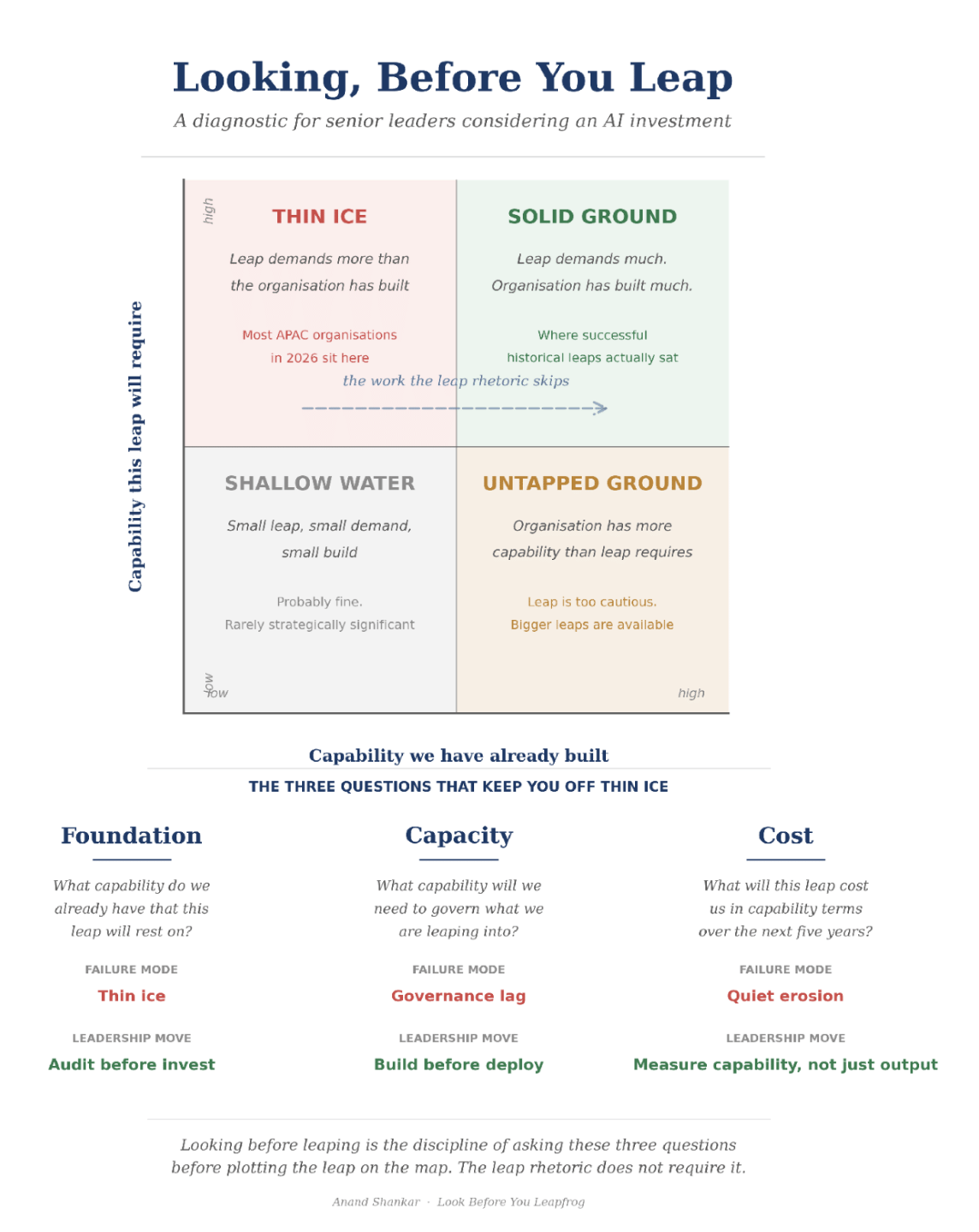
Looking before leaping is the discipline of asking three hard questions before committing to technology investments:
- Honesty About Existing CapabilityA leap is sound only when it rests on an accumulated foundation. Mobile telephony leapt over fixed lines because regulatory and financial systems were already mature. UPI succeeded because banking and identity infrastructure had been painstakingly built over fifteen years. Where underlying capability is absent, the leap puts the organisation on thin ice.
- Honesty About Required CapabilityAn AI leap does not deposit you in a world where AI runs itself. It lands you in an environment requiring more human judgement, not less. Organisations need senior leaders who can read AI outputs critically, managers who can distinguish between pattern recognition and pattern fabrication, and practitioners who know what excellence looks like because they have done the work manually. These skills do not arrive with the software.
- Honesty About Capability CostsIf AI use atrophies critical thinking, then leaping without compensating practices degrades your workforce over time. The bill is paid in the form of capability erosion. It comes due much later than the initial productivity gains, meaning many organisations will fail to connect the cost to the cause when the crisis arrives.
If Productivity Is the Floor, What Is the Ceiling?
If looking before leaping is the discipline, what should HR specifically be doing? The dominant answer in boardrooms right now is the wrong one: productivity and headcount reductions.
Productivity gains are real, but they are a hygiene factor. Any function should become more efficient year over year. Productivity is the floor, not the ceiling. The true strategic question is whether AI gives HR the opportunity to shift from process-focused to outcome-focused.
For its modern history, HR has organised itself around the verbs of running the system: performance processes, compensation policies, talent acquisition workflows. AI can automate these processes, freeing the function to organise around growth outcomes instead.
Two practical examples achievable today illustrate this shift:
The Internal Mobility Engine: Most HR functions track external hiring with precision while managing internal mobility loosely. AI changes this symmetry. Properly built, an internal mobility engine maps every employee’s latent experience, skills, and ambitions against project needs and stretch opportunities across the enterprise. The function shifts from reporting hiring velocities to reporting human deployment optimisation. This directly counters attrition; most people leave not because of pay, but because they cannot see their next step.
The Apprenticeship Engine: Traditional L&D is content-led—courses, videos, and modules. Yet the true mechanism of talent development—apprenticeship, observation, and repeated repetitions under supervision—remains invisible to management. An AI-powered apprenticeship engine can map who is doing what work, identify where genuine skill transfer is happening, and flag broken development pathways. This directly counters the cognitive atrophy mass AI usage creates, ensuring technology makes patient skill cultivation visible rather than skipping it.
The reason these growth-focused frameworks are not yet dominant is that the cost-reduction story is simpler to pitch to a board. But it should not be the only story HR tells.
Four moves the CHRO can make right now
To counter the incomplete leap rhetoric, the HR leader must execute four specific, positional moves:
Refuse the False Binary: When the board asks whether the company should lead with AI or fall behind, widen the frame. The strategic question is not whether to adopt, but which capabilities will remain after the transition. This is an enlarging refusal, not a conservative one.
Hold the Unfashionable Position: The CHRO is uniquely responsible for the slow work of an organisation: apprenticeship, judgement, craft, and psychological safety. Defending these assets against the headwind of rapid automation will sound conservative today, but it is a standard fiduciary duty. You will be vindicated when the capability bill arrives in a few years.
Insist on Diagnostic Questions: Before any major AI capital expenditure, ask openly: What capability does this build? What does it bypass? And what will this organisation be unable to do in five years if it depends entirely on the bypass? The act of asking alters the room’s risk assessment.
Translate the Long View: The leap rhetoric wins because it uses the language of velocity and competitive advantage. The HR leader must translate capability erosion into that exact vocabulary: long-term capability decay is a structural competitive disadvantage.
This is what future fury looks like in a boardroom. It is not passive anxiety about automation; it is deliberate energy directed at protecting the human capability required to manage our future.
What comes next
The leap rhetoric names what AI can give, but ignores what it takes away. The empirical evidence is clear: AI usage at scale, without deliberate countermeasures, atrophies the very capabilities needed to govern it. HR is being asked to lead an adoption strategy that risks destroying the conditions for its own most vital work.
This is the diagnosis. Part Two of this series will turn to the prescription: the staircase of practice. The bottom step consists of immediate micro-practices that any HR leader can deploy this Monday to augment human feedback and surface hidden talent. The top step is a strategic orientation that organises HR around human cultivation rather than quiet erosion.
Until then, the simplest question remains the most critical: What capability does this organisation have today that it will lose if it leaps without looking? And who is going to name it?
About the author: Anand Shankar is Chief Transformation Officer at Deloitte South Asia. He has spent over two decades in commercial, CEO, and functional leadership roles across Asia Pacific. The views expressed in this article are the author’s own and do not represent the views of Deloitte, any of its associated firms, or its clients. Anand regularly contributes to People Matters, with his articles published in the last week of each month.