








In leadership, every corridor opens into a forest of choices. The real challenge isn’t in following the familiar trail but spotting the untrodden path where purpose can truly shape outcomes. Great leaders don’t just choose what’s easy; they choose what’s meaningful.
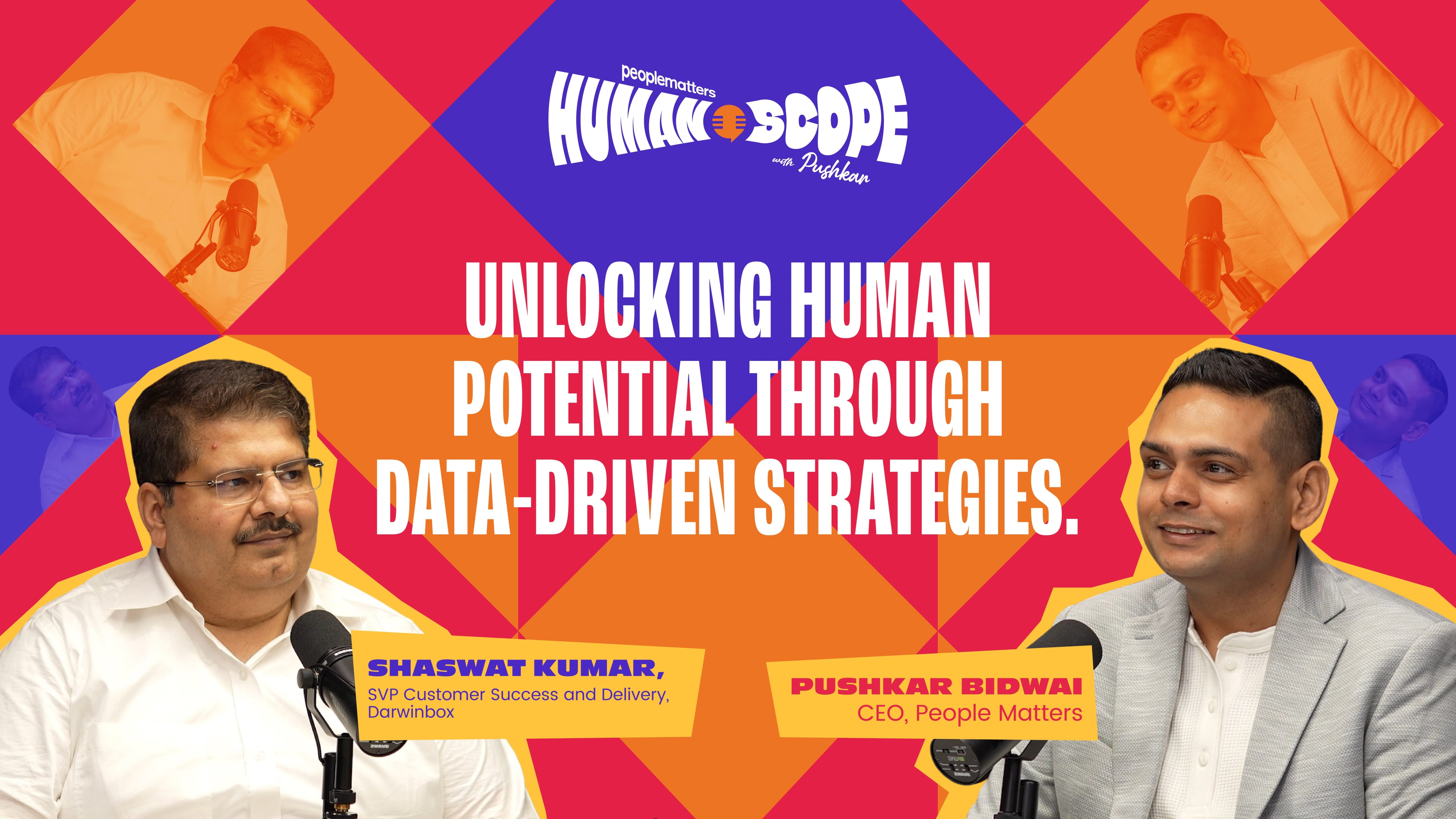
It is in these less obvious areas that transformation begins, and leadership moves from exercising authority to driving intent, from managing processes to enabling possibilities. That is the situation HR faces today. Pushkar Bidwai, CEO of People Matters, sat with Shaswat Kumar, SVP of Customer Success & Delivery at Darwinbox, a long-time partner of People Matters and a highly trusted voice in HR transformation, on the latest episode of Humanscope. Shaswat has spent nearly 25 years helping organisations rethink the purpose of HR: not just managing processes, but unlocking the human engine of business.
Taking the unlikely turn
Shaswat’s own career began with a fork in the road. “I am an international finance guy by qualification,” he recalls. “I did a couple of stints before joining consulting, including a startup during the dot-com era in 2000.” That path eventually led him to Hewitt Associates, where he joined a unique group focused not on products for employees but on making the HR function itself effective.
“What today is called HR transformation then was really HR effectiveness,” he explains. “That group’s purpose was to make HR deliver the value or the purpose it is there for.”
Over the next two decades, Shaswat has led HR transformation advisory services across the Asia-Pacific, the Middle East, and Africa before transitioning to the product side with Darwinbox.
The era’s tour
Looking back, Shaswat maps HR’s journey across two diverging paths, “Pre-2010, it was about HR for HR. Post-2010, it became HR for business.”
Before 2010, he explains, transformation was internally focused. HR functions were doing those programmes to set up HR shared services, to reconfigure their HR operating model. Their pain points were limited to making effective HRBPs, COE roles, and governance. It was primarily an HR-focused approach.
But post-2010, the view flipped. As businesses globalised, they began to experience “people failures” that dragged strategy down. “That’s when a larger set of CEOs started looking at the need for HR function to step up to enable this larger org change,” Shaswat says.
This was the turning point: HR’s mandate shifted from functionally efficient to business-critical.
The digital detour
The rise of digital programmes across procurement, supply chain, and finance revealed a hard truth: the real bottleneck wasn’t technology, but people. “Fortune 2000 companies were running on average 13–14 such digital transformation programmes,” Shaswat recalls. “And 14 of your mega programmes are failing because of people issues. So you come back and say, Oh, by the way, HR needs to come to the party.”
That’s when employee experience and design thinking began shaping the narrative.
The pandemic impact
The pandemic scattered milestones and redrew maps. HR leaders suddenly found themselves at multiple crossroads. As Shaswat describes it: “We are being asked to be more compliant, but also to empower. To think global but act local. To be agile, but also ensure privacy.”
These contradictions are not temporary. They are the new operating conditions for HR. The shift to hybrid work has made issues of fairness, inclusion, and culture even more complex. How do you design policies that respect personal boundaries yet foster collective accountability? How do you balance data-driven decision-making with the need to preserve human trust?
For Shaswat, the answer lies in intentionality. “Every choice HR makes today carries a duality. The role of leadership is to acknowledge these tensions and design with them, not against them.”
The candy-shop temptation
Yet not all roads lead forward. The rapid expansion of HR technology often tempts leaders into impulse buying. “It’s almost like a kid in a candy shop,” Shaswat says. “So much is available, and then I go shopping, start picking up stuff, and then I reach a point where I start thinking, okay, how do I now stitch all of that together?”
But tools alone can’t solve deep-rooted issues. “Tech itself cannot be the solution. Technology will accelerate it, allowing you to do it at scale, but you need to understand the problem first. Unless you understand the problem, how do you solve for it?”
Horizons ahead: AI and the future of work
As the conversation drew to a close, Shaswat turned to the next bend in the road: AI and automation. “Too many of us are in a panic mode to say AI will lead to jobs disappearing. I think it’s wrong. Each time technology and automation happened, there was a threat, and we reconfigured jobs.”
He sees AI not as a cul-de-sac but as a bridge. “The opportunity now is: can we take the most mundane parts of jobs out and make work more interesting?” he asks. Equally, he predicts delayering of organisations. “You don’t need a hierarchy of managers because it was just a pyramid to manage people. With better tools and data visibility, that will accelerate which means we’ll need to empower more people and trust them.”
The road not taken is not always glamorous. It is often quieter, riskier, and less lit by convention. But it is here, as Shaswat Kumar reminds us, that HR transformation finds its true direction. Not in authority, but in intent. Not in process, but in possibility.
And one day, looking back, leaders may find that choosing these quieter trails has made all the difference.
For further insights from this enlightening conversation, watch the full episode on the People Matters YouTube channel.