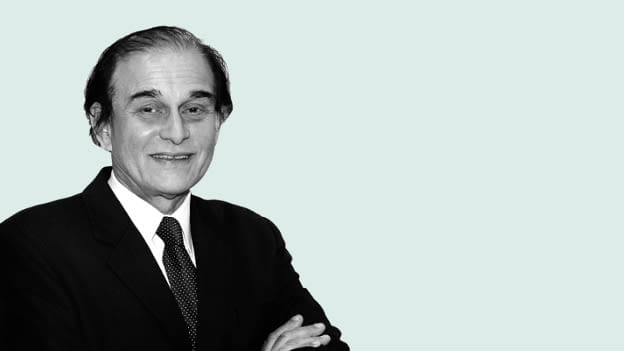
Take us through your journey of how you joined the family business. What led you to establish Marico?
I wasn’t fortunate enough to do management studies even though I wanted to. I couldn’t get into IIM-Ahmedabad at that time and I even wanted to go abroad but my father instead asked me to join the family business, the Bombay Oil Industries Limited. It was a small company with a turnover of Rs 5 crore in those days and it was managed by my father and his three brothers. I was the first person from the next generation to join the family business, but I had no one to mentor me. In my first year, I learnt how the business was being handled.
We were selling edible oil those days. While we had Saffola and Parachute brands, most of the sales took place through large 15 litre tin packs and the business was not doing that well. I thought to myself that if I could turn this into a branded business, then I would be able to create a sustainable and profitable business. Soon, I started retailing products from Jalgaon to Nagpur by road and the kind of response we got was truly amazing. To this day, I remember the excitement that I got from making my first sale and that feeling has never been surpassed. As the business grew, I started roping in more professionals to run the business. I read a lot of management books to help me hire MBA graduates as I myself didn’t have an MBA. I loved reading those books and still do. I have also learnt a lot from people I have met and that is how my journey in terms of learning has taken place. However, by 1988 it became very difficult to attract talent to the organization. Professionals entering the organization had rightly placed fears about their relationship with the company as there were many family members in the organization. So I proposed to my elders to hive off the company as a separate business. At that time, the business had grown from Rs 5 crore to Rs 100 crore, out of which Rs 80 crore came from consumer products. I just wanted the freedom to manage the enterprise on my own and was not really concerned about the ownership. Looking back, I think it was a very important decision as I would not have been able to operate in a company with so many constraints.
How does the organization’s culture help it to innovate?
Marico was born in 1990 and within a year we had recruited 30-40 managers. We didn’t have enough resources to attract good talent, but our ad agency managed to pull off a really good campaign. When you have high aspirations and low resources, innovation flourishes. One of my first recruits was the Head of HR and then with him on board we recruited 30-40 managers. We realized very quickly that our organization was a melting pot of different cultures and that we needed to define what we stand for. I sat down and wrote many pages about our values, culture and what we stood for. I shared those with my team who made it more structured into People, Products and Values. Creating values is the easy part. Converting those values into sustainable long-term culture is the difficult part. So, we asked the entire team to give their inputs about encoding the values. The two-day exercise helped me discover two things: One, when you involve people, you get their commitment and two, it helped us to identify the value gaps within the organization. A lot of people think that such involvement is a wastage of time. Participative style of management will take longer to produce results, but you will have the commitment of your people and this helps in the long term. For any values to take deep roots, you need to reinforce them on a perpetual basis. We decided to have an open house across our offices and factories where plans for the next year were drawn up and people were encouraged to ask any questions, no matter how awkward they were, to the management. Today, workers are very keen to know how the organization is planning its future rather than their salary or bonus. We wanted to keep a non-hierarchical way of doing things and make the environment more open. Openness involves a lot of dialogues, which ultimately leads to innovation. Openness is very important in an organization as it helps in getting new ideas and leads to discussion of ideas. One of our values is trust. We reinforced that by asking managers to maintain their own leave records and also by by not having an official sick leave but take sick leave as & when you are not well.
The biggest challenge comes when you acquire a new business, especially in a different country as you need to integrate those values with the ones you already have implemented.
What is innovation according to you?
Innovation is not just making new products, but it cuts across processes, products and manufacturing. Let me illustrate with an example. About 20 years ago, we wanted to set up our manufacturing facility and in those days the best place in terms of location, cost etc turned out to be Kerala. However, in terms of industrial relations, Kerala was not a good state to set up operations. Against all advice, my Head of operations and HR decided to take up the challenge. They personally selected workmen after talking to their parents! They also found that if the workmen were engaged with some activity, they did not indulge in unionism. Hence, the company divided the workmen into four houses like you do in schools and there was healthy competition between the houses. We also rotated the workmen through different parts of the organization to ensure that they did not get bored while working with us. That effort paid off. We have not lost a single day in production and it also gave us huge financial returns.
Another area where we did innovation was in putting Parachute in a plastic bottle. We wanted to be market leaders in the coconut oil segment, but were not able to increase the market share beyond a point. While it was cheaper than tin, many retailers were wary of using plastic oil bottles as rats used to gnaw at them and oil would drip out. But we got a specially designed round bottle made, in such a way that the rats could not bite the bottle. That played a major role in increasing the sale of coconut oil. Another thing that I learnt is that while innovation is necessary, it is also equally essential to follow it up with rigorous processes. Normally, people don’t associate rigour with innovation.
How should an organization define its purpose?
Organizations have a purpose and the business is accountable not only to its shareholders, but also all the other stakeholders – employees, the associates they are working with, the consumers and finally the society. There are some interlinkages between different stakeholders and whenever organizations in the West have concentrated only on one of those stakeholders, it has led to a crisis like the Enron or Lehman case. I am of the strong belief that if you give something to each stakeholder, it will come back to you. If I treat my members (that’s what we call employees at Marico) well, give them extra inputs in terms of training or coaching, they would be far more motivated to succeed, to do a better job and far more engaged. This will reflect in better results. If the results are good, the profits will increase. If the profits increase, then the shareholders benefit. You might not be able to directly link this with society, but you will be able to attract better quality talent if you have the good image of a responsible corporate citizen. It reflects in how the organization is perceived. A study conducted by Jagdish N. Sheth and Rajendra S. Sisodia, book – The Firms of Endearment has conclusively proven that organizations that have a purpose and took care of all their stakeholders fared much better than those who didn’t.
What is the purpose of an individual?
There are two important days of your life: One is the day you are born and the second is the day you find your true purpose in life. The search for realizing why you were born goes on for years and you have to constantly ask yourself why you are here. The day you start working towards finding the answer to the question, you will be more satisfied than anything else you achieve in life.