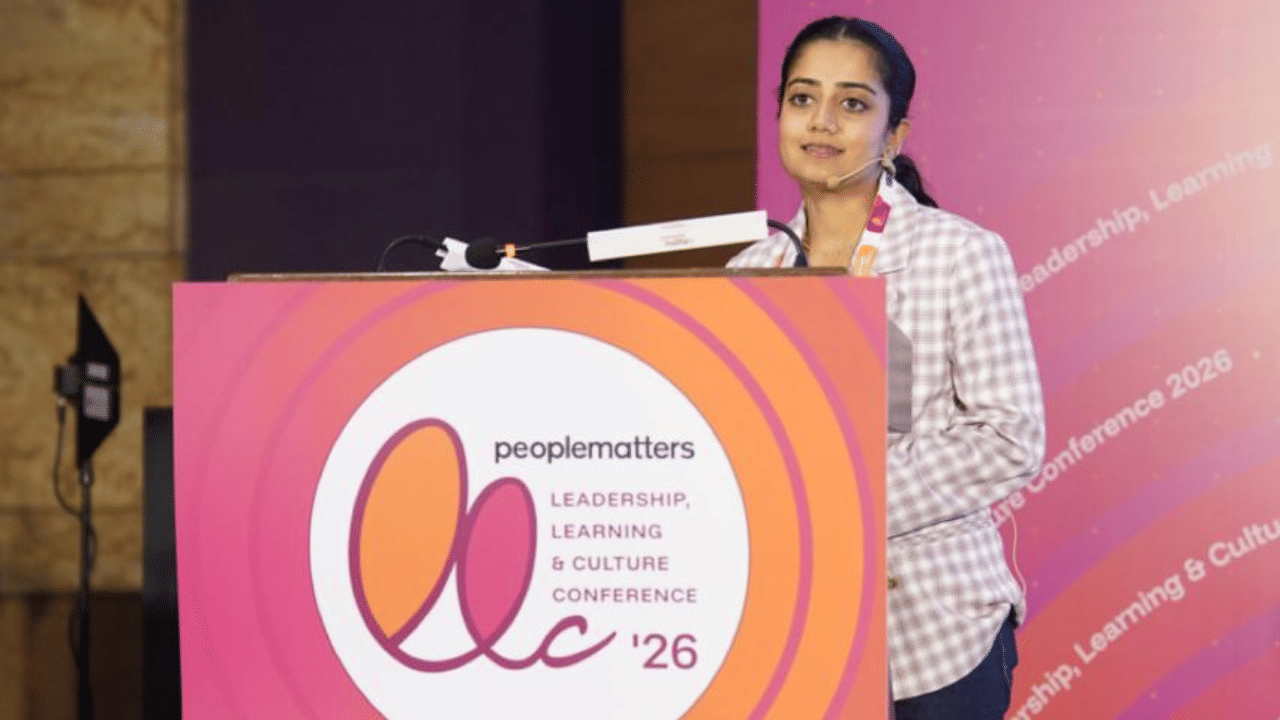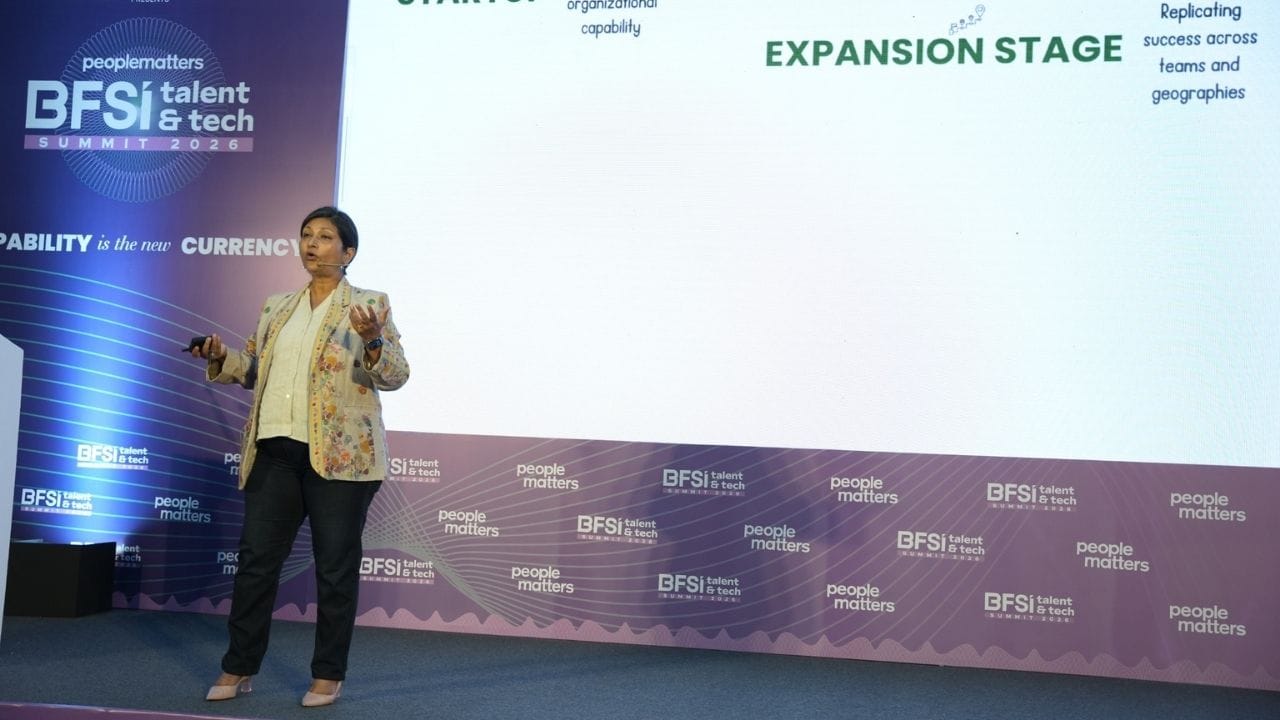
In a business world increasingly obsessed with digital dashboards, learning hours and upskilling targets, Ruchira Bhardwaja, Joint President and CHRO at Kotak Life, delivered a keynote at the People Matters BFSI Talent & Tech Summit 2026 that cut through the corporate noise. With characteristic wit and candour, Bhardwaja challenged the industry’s most cherished skilling assumptions, urging leaders to look beyond the numbers and certifications, and instead focus on the deeper, more complex work of reinventing their organisations for a future defined by perpetual disruption.
A keynote that asked more than it answered
Bhardwaja’s address was neither a recitation of best practices nor a celebration of success stories. Instead, she opened with a set of disarming questions, inviting the audience to examine their own beliefs about capability-building. “What really does scale mean?” she asked, her tone equal parts curiosity and provocation. “Is it about more certifications, more training hours, more online courses? Or is it something much more fundamental?”
Rather than providing immediate answers, she encouraged the audience to interrupt, challenge, and reflect—framing the next 30 minutes not as a lecture but as a shared inquiry.
To drive home her point, Bhardwaja posed three deceptively simple questions to the room. First: if an organisation’s entire workforce were replaced overnight with new hires from outside, would the company still succeed? The room wavered between yes, no, and the silent confusion of the undecided. For Bhardwaja, the lack of consensus was telling. “It’s a question about the very DNA of our companies. Are we building organisations that are truly resilient, or are we simply replacing parts in a machine?”
Her second question was sharper still: how many in the audience genuinely believed their skilling and upskilling efforts were preparing their people for the future? The show of hands was ambivalent. “Even as someone heading HR for a major insurer, I’m not sure,” she admitted. “We can’t predict with confidence that the skills we’re imparting today will be relevant tomorrow.
Especially in sectors like insurance, where change is relentless, and the pace is unlike technology or manufacturing.”
Her final question landed hardest: when was the last time a learning intervention genuinely changed behaviours or skills? Few could answer confidently. “For many of us, measuring real impact is a perennial struggle,” Bhardwaja noted, “and yet we persist with the same playbook.”
No ‘One Size Fits All’—The myth of universal scale
Central to Bhardwaja’s thesis is the rejection of cookie-cutter skilling solutions. “One size does not fit all,” she asserted. “A startup, a unicorn, a manufacturing giant, an insurer—a platform company—each is at different stages of their lifecycle, facing unique challenges and requiring entirely different approaches to scale.”
Using vivid examples, she illustrated how a startup’s challenge lies in transmitting the founder’s energy and ethos to new joiners, while a mature manufacturing firm may be grappling with process redundancy or a shifting customer interface. For a rapidly expanding enterprise, the pain point may be replicating culture and process across new locations or products. For the behemoths, it is about making the “elephant dance”—shortening both learning and execution cycles so that the entire organisation can pivot quickly in response to change.
Bhardwaja warned against the HR tendency to “do everything for everyone.” Instead, she advocates for focus: “Choose carefully, focus carefully on what exactly the organisation wants to scale up in terms of capability,” she urged. “The bottleneck is often not the frontlines, but leadership that isn’t keeping pace with the organisation’s growth.”
Moving from tick-box training to real business impact
Bhardwaja’s candour extended to her critique of traditional learning metrics. “Long ago, we stopped counting learning hours,” she declared. “We realised that what matters is not how many people we send to business schools or how many courses are completed, but whether we are actually solving business problems.”
The shift at Kotak Life was stark: learning interventions are now co-created with business teams, aligned with live challenges rather than theoretical skills gaps. “No more running after people to attend training,” she said. “Now, employees see value because the learning is curated with them, not for them.”
She described the company’s ‘EEE model’: Educate (classrooms, external programmes), Exposure (cross-functional projects), and Experience (job shifts and new roles). “We track outcomes, but we don’t obsess over targets. The magic is in people raising their hands for new assignments, propagating their knowledge and energy across the organisation.”
The Power of Organisational Mindset: Lessons from the world’s best
Bhardwaja drew inspiration from the playbooks of Microsoft and Netflix—organisations that have redefined what it means to scale talent. Microsoft’s shift from a ‘know-it-all’ to a ‘learn-it-all’ mindset, and Netflix’s mantra of ‘freedom with responsibility’ were cited as models for balancing curiosity, agility and process discipline.
“These stories resonate because they are about mindsets, not just methods,” she said. “It’s about building an environment where people feel empowered to learn, to experiment, and yes, sometimes to let go of the old ways.”
Reinvention: The only constant
Perhaps the most powerful message of Bhardwaja’s keynote was the need for constant reinvention—at the organisational and personal level. “With the pace of change and disruption, everyone has to reinvent themselves,” she insisted. “It’s not about putting structures in place, but about asking the hard questions: Are we actually shifting the needle? Are we prepared to let go of what no longer serves us?”
She left the audience with a final provocation: “Is it time to let go of the old? Is the skilling we need now about unlearning as much as learning?” The audience’s mixed response underscored the complexity of the challenge—and the reality that there is no easy answer.
The essence of leadership for the future
Bhardwaja closed by acknowledging that the journey of capability-building is messy, iterative, and incomplete. “We haven’t got it all right. We will keep reinventing ourselves, and that’s the beauty of it,” she reflected. “The environment at Kotak Life is such that anyone can do anything—move roles, take on projects, seek out learning in whatever form fits their career stage.”
For Bhardwaja, the measure of success is not the number of programmes delivered or hours logged, but the willingness of people to step forward, to pursue growth, and to propagate their learning through the organisation’s DNA.
As the BFSI sector faces the headwinds of digital transformation, regulatory flux and economic uncertainty, Bhardwaja’s message is both a challenge and an invitation. The future will not be won by those who simply do more of the same, faster. It will be shaped by those brave enough to ask difficult questions, embrace ambiguity, and focus on what truly matters—building organisations that can reinvent themselves again and again.
In an industry often distracted by the latest learning fad, Bhardwaja’s keynote was a timely reminder: real scale is measured not by the breadth of training catalogues but by the depth of transformation—of people, mindsets, and culture. For leaders willing to rethink what it means to build capability, the path forward is clear: less box-ticking, more boldness; less certainty, more curiosity; and above all, a relentless commitment to reinvention.