








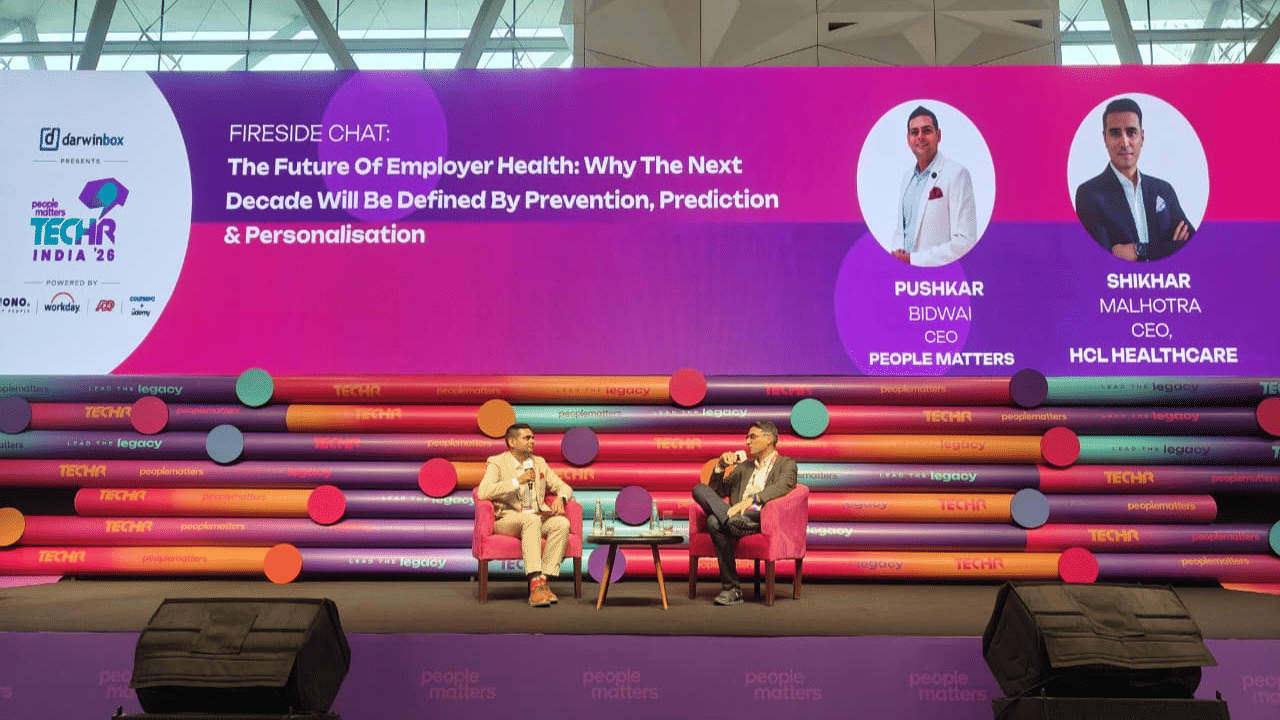
For years, employee healthcare has largely been viewed through the lens of insurance, a benefit employees use only when something goes wrong. But as organisations grapple with rising healthcare costs, chronic diseases and changing employee expectations, that mindset is no longer enough.
Speaking in a fireside chat at People Matters' TechHR India 2026, Shikhar Malhotra, CEO of HCL Healthcare, made a compelling case for reimagining workplace health. In conversation with Pushkar Bidwai, CEO of People Matters, he argued that the next decade of employer healthcare will be shaped by prevention, predictive intelligence and personalised experiences, not simply treatment after illness strikes.
"The biggest opportunity today is to move from reacting to disease to preventing it altogether," Malhotra said.
Healthcare belongs to everyone
One of Malhotra's strongest messages was that workplace health cannot sit within a single function.
"Healthcare is a bit like education," he said. "It doesn't belong to one department or one person. Everyone in an organisation has a lever of influence."
Historically, insurance providers and third-party administrators dominated conversations around employee health. But that model focuses primarily on what happens after employees fall ill.
"I think we're at the beginning of the curve, while insurance is usually at the end of the curve," he explained. "Insurance gives you insights when crisis hits. Prevention happens much earlier."
With digital health platforms, AI and richer workforce data now available, employers have an opportunity to understand employee health long before claims are filed.
Why annual health check-ups are no longer enough
Malhotra compared traditional corporate wellness programmes to cricket's slog overs—an activity squeezed into the final months of an annual calendar simply to tick a compliance box.
"Most organisations conduct annual health check-ups because it's on the calendar. Employees complete them, HR ticks the box and then... what happens next? Nobody really knows."
The real problem, he argued, is that neither employers nor employees have historically had visibility into what those health assessments actually mean or what action should follow.
Today, that is changing. "Organisations that are ahead of the curve have built intelligence layers over their health data. They now understand utilisation, clinical outcomes, disease prevalence and employee engagement."
These insights are also revealing an uncomfortable reality: lifestyle diseases are appearing much earlier than organisations once assumed.
"We used to think prevention should begin after 40. In India, that's already too late. By 40, one in three people may already have full-blown metabolic disease."
For employers, the implication is clear: preventive health programmes need to start much earlier in an employee's career.
Data should empower employees, not monitor them
As organisations collect more health information, concerns around privacy inevitably follow.
Malhotra believes employers have largely matured in their approach. "We are yet to come across a customer that has asked us for an individual's personal health information."
Instead, organisations should focus on aggregated workforce insights while ensuring personal health data remains accessible only to employees and healthcare providers.
"Aggregated data helps organisations understand workforce health. Individual data belongs to the individual."
He stressed that independent healthcare providers play a critical role in maintaining trust because employees are far more willing to participate when they know sensitive information will not flow back to their employer.
"Data integrity and data security are absolutely essential."
Engagement is where wellness programmes succeed, or fail
Technology alone cannot drive healthier behaviours.
One of the biggest reasons wellness initiatives underperform, according to Malhotra, is poor employee engagement.
Simply asking employees to complete health checks rarely changes behaviour.
"If you just send an email saying 'Go for your health check-up,' you should have very low expectations."
Instead, successful organisations combine health services with engagement, rewards and community participation. To mark HCL's 50th anniversary, for example, the company recently launched a company-wide fitness challenge called Moonshot, encouraging employees to collectively walk the equivalent distance to the moon.
Within days, thousands of employees voluntarily joined the initiative. "People love being part of something bigger. They love recognition."
The company also turns routine celebrations into opportunities to reinforce healthy habits, from fitness challenges during Diwali celebrations to recognising employees who make significant improvements to their health.
"We've had employees lose 10, 20 and even 40 kilograms. Sometimes all they really want is recognition."
Personalisation is the missing piece
Despite increasing investment in employee wellbeing, many organisations continue struggling with one fundamental issue: utilisation.
"The biggest challenge isn't the budget," Malhotra observed. "It's getting employees to actually use the programmes available to them."
Personalisation, supported by technology and data, is becoming the answer.
Progressive employers are moving beyond one-size-fits-all wellness offerings and designing interventions based on employee needs, health risks and engagement patterns.
However, Malhotra cautioned against expecting instant results. "Awareness takes time."
The organisations seeing the strongest outcomes are those treating workplace health as a long-term cultural investment rather than a one-year initiative.
"They're patient. They plan for three years, not one." Beyond healthier employees, these companies are also seeing stronger retention, higher engagement and improved employee satisfaction.
"There is significant evidence that employees who actively use healthcare programmes stay longer with their organisations."
Winning boardroom support starts with the CEO
One question many HR leaders continue to face is how to elevate employee health from an HR initiative to a boardroom priority.
Malhotra's answer was refreshingly direct. "Start by creating a health plan for your CEO."
Leadership participation, he argued, sends a powerful message throughout the organisation. "When the CEO, CHRO and COO participate, suddenly everyone is talking about health."
The pandemic fundamentally shifted how boards view employee wellbeing, particularly around mental health. "The best thing that came out of COVID was greater awareness of mental health. The stigma has reduced, and I don't think that's ever going away."
While many boards now recognise wellbeing as a business challenge, Malhotra believes the next step is to see it as a strategic opportunity that strengthens culture, productivity and organisational performance.
From employee benefit to business strategy
Throughout the discussion, one message remained consistent: healthcare should no longer be viewed as a cost centre or insurance benefit.
Instead, organisations should see it as a long-term investment in workforce capability. The future of employer health, Malhotra argued, lies in using technology, predictive analytics and personalised experiences to help employees stay healthier rather than simply helping them recover after illness.
As organisations prepare for the future of work, the companies that succeed may not be those spending the most on healthcare, but those that make prevention part of everyday culture.
"People want to engage. They want to be recognised. If organisations create that environment, the outcomes can be transformational."