








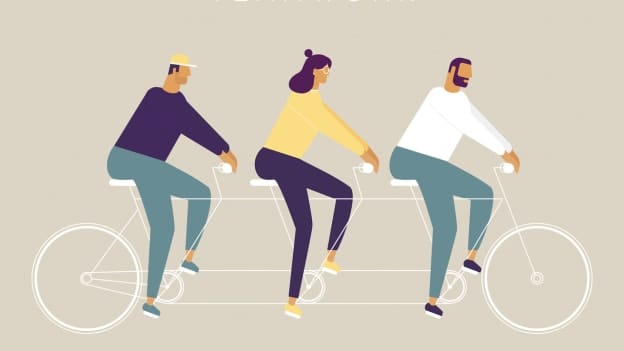
Leadership today is all about leading from the front i.e. taking one’s people along with oneself in the quest to excel at a collective level. Exerting authority and directing “from the top” are fast becoming undesirable. The modern-day workforce stands for the democratization of leadership, by upholding the values of transparency, collaboration, participation and open communication. Today’s leaders must be cognizant of these employee expectations, and lead with a sense of shared accountability. Here’s how.
What is collaborative leadership?
To be an effective collaborative leader, it is important to first understand what constitutes collaborative leadership. Leaders are naturally expected to forge influential relationships and partnerships within and outside the organization. But collaboration essentially boils down to giving others a say in leadership decisions. It demands a style that decentralizes power, and derives from the shared knowledge, skills, expertise, and accountability of others around. It involves moving away from “individualism” to “collectivism”.
Why embrace collaborative leadership?
Employee expectations in the workplace are changing. The earlier work norms of being allocated work with a top-down approach, may no longer work. As more and more millennials with new-generation values enter the workforce and assume leadership roles, their work expectations must be accounted for, to keep them engaged and productive. Which means that leadership is fast stemming values such as from democratization, diversity & inclusion, speed & agility, fairness & trust, team work, innovation and so on.
“Leadership is more about staying true to personal values” - Great Places to Work For All
Millennials are looking for an authentic experience, which does not compel them to differentiate themselves between their “personal” selves and professional selves. They want to bring their own true persona and uniqueness to their work, and this is fast changing the entire organizational ethos. Moreover, by 2020, Millennials are forecast to comprise half of the American workforce, and by 2025, 75 percent of the global workforce.
Clearly, the leadership of the future shall be largely shaped by these new values and culture. Today’s leaders must adapt to the changing leadership ask, or risk falling out with their own people, and failing.
What does it take to be a collaborative leader?
The question is how to change the leadership style as a whole? Traditional leadership has run through organizations since times immemorial, being ingrained in the hierarchical organizational structures, bureaucratic workflows and in peoples’ mindsets. Leaders must make a deliberate effort to realign with certain values:
-
Define a clear purpose: Employees want a clear direction to work towards so that they can be their productive best selves. Defining clear goals at the individual, functional and organizational level is a must. The formulation of these goals must not be developed top-down, it should actively involve employees through visioning exercises.
-
Design open communication lines: Leadership-connect with employees helps build trust. Two-way communication and feedback mechanisms are a must to maintain collaborative leadership. Most importantly, leaders must step down from a position of power and be willing to listen to ideas and suggestions by employees, and implement them.
-
Partner openly: Being an influencer is all about inspiring others, by being authentic. Leaders must partner with people at the grass-root. Technology provides that advantage- virtual one-on-ones, podcast connects, live broadcasted town halls- the opportunities are many, provided leaders show a willingness to build a participative work ethos. Employees no longer want to be “told” what to do, but when they realize that they have the right support and environment, they are often willing to go beyond the call of duty. That’s high performance.
-
Highlight the “human side” of you: With work becoming always-on and seamless, the boundaries between personal and professional personas are blurring. Millennials love to be connected to their “real selves”, and expect their leaders to do so too. Leaders must shed the impersonal mask, and be more forthcoming with what they stand for, how they work, and even how they fail. Authenticity is must-have trait to build trust with the next-generation workforce. Leaders must share more openly about themselves, at the same time make an effort to understand their peoples’ interests, passions, and motivational drivers.
-
Build trust-based relationships: Trust is the hallmark of collaboration. If employees are suspicious and cynical, little collaboration can happen, because employees would refrain from sharing and caring. Leaders must share knowledge, invite participation, and “walk the talk”. They must commit to building a collaborative workplace by creating the right infrastructure, processes and people-processes.
Developing these skills and outlook is not easy, it requires letting go of “command and control”. HR can therefore contribute in rethinking and rebuilding the organizational processes to foster this new mindset.
Role of HR in cultivating collaborative leadership
Moving away from a position of “individual power” to a position of “decentralized power” requires support. HR can play a critical role in driving this change- from building the case for collaborative leadership, to designing and deploying supporting architecture, to urging a cultural shift.
-
Organizational structure: Having to cut through hierarchical layers is the biggest hindrance to collaboration. Redesign the organizational structure for fluidity, speed and agility, by breaking down silos and encouraging cross-functional and cross-levels working.
-
Leadership development programs focussed on collaborative leadership can help leaders “detach” from their power-positions and build collaborative skills. Training, coaching and counselling can help leaders let go of prior habits and working styles.
-
Collaborative processes: Relook at the people processes from the collaboration-mindset. “Does the PMS have a continuous feedback mechanism?”, “Do employees have a voice-outreach to the CXO suite?”, “Do we have an idea-sharing platform, if yes, how are we implementing those employee ideas?”. Ask these questions and more, and design processes and workflows to support collaboration.
-
Culture shift: HR, as the custodian of organizational culture, can play a major part in driving mindset shifts. Educating employees and managers, value-building from the bottom-up, and communicating through open channels will help create sustained change. HR must drive this culture-shift at the CXO level first, and apply across the organization.
Forward-thinking is the key to unlock collaborative value. Organizations must believe in the competitive advantage that collaborative leadership provides. HR and business leaders must themselves work collaboratively to make this happen, and commit to accept and adapt to the future reality.