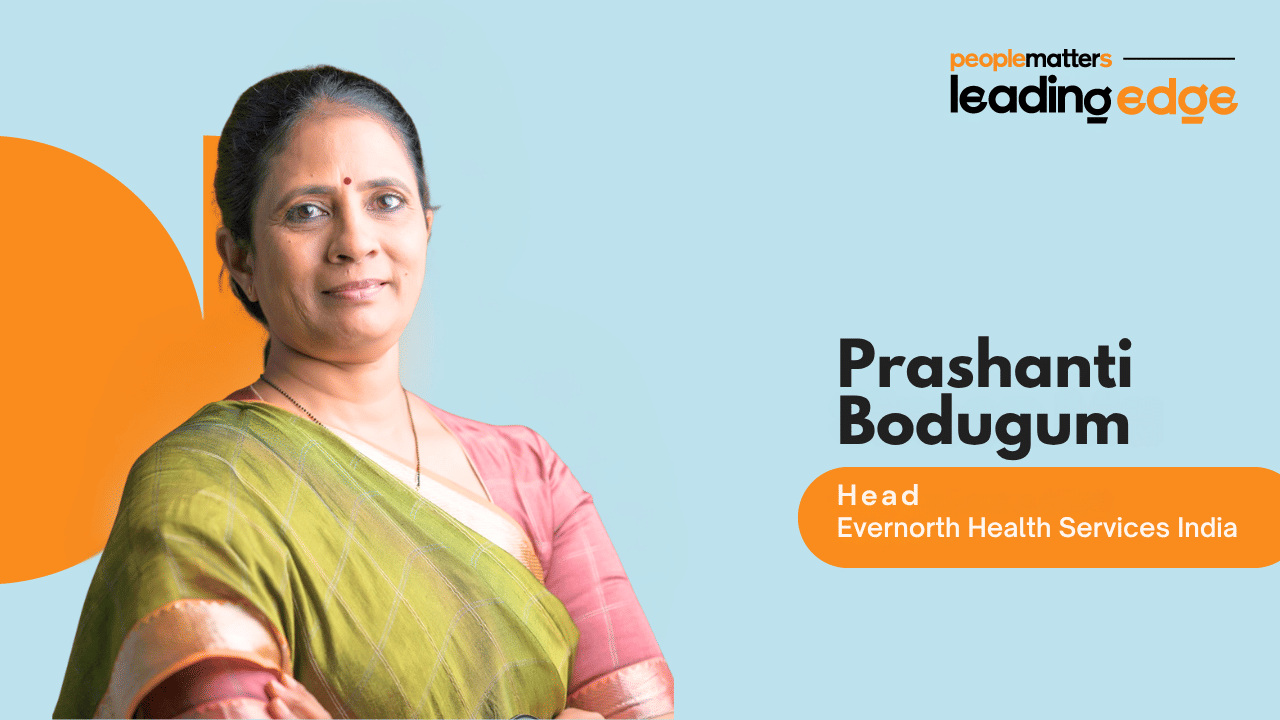
In the clinical, high-stakes world of global healthcare services, there is a tendency to view progress through the cold lens of metrics: claims processed, latency reduced, or "heads" migrated. But sit across from Prashanti Bodugum for an hour, and you quickly realise that she isn’t interested in the arithmetic of the status quo.
Prashanti, the Head of Evernorth Health Services India, is a "disruptor by instinct." Having reached the milestone of three decades in the industry, she possesses the rare vantage point of someone who saw one of the first bricks of India’s GCC (Global Capability Centre) ecosystem being laid and is now architecting its skyscraper phase.
In a wide-ranging conversation for People Matters LeadingEdge, Prashanti peeled back the layers on a leadership philosophy that is as much about psychological safety as it is about systems architecture. At the heart of her vision lies a provocative thesis: in an era where AI can mimic intelligence, the ultimate competitive advantage isn’t the technology you buy—it’s the "Human Edge" you orchestrate.
The evolution of a disruptor
Prashanti's journey is not a linear climb; it is a series of intentional pivots. After starting her career in the US, she was pulled back to India in the early 2000s by the nascent energy of what were then called "captives." Her career spans five behemoths—from the foundational execution prowess of GE and the strategic consulting world of Capgemini to the massive retail-tech engine of Walmart.
"I wish I were smart enough to say this when I started," she reflects with a touch of wit, "but looking back, it has been about moving beyond delivery toward fundamentally transforming outcomes."
When she joined Evernorth—the health services arm of Cigna—she brought this "outcome-first" obsession back to the sector that resonates with her most: Healthcare. To Prashanti, healthcare isn't just another vertical; it is a mission where technology directly translates into human life. This sense of gravity informs her restlessness. "I cannot take a status quo. It makes me restless by design. My question is always: What next, and what else?"
The cultural alchemy of the multi-generational room
The most pressing challenge of 2026 isn't the code; it’s the people writing it. Prashanti is managing a demographic collision: the "tribal knowledge" of Baby Boomers and Gen X meeting the "AI-native" fluency of Gen Z.
"The information world is flat now," she observes. "A Gen Zer has the same information at their fingertips as a veteran. But information isn't insight."
Her solution is a sophisticated model of Reverse Mentoring. In Ptashanti's world, seniority is no longer a shield. While the veterans hold the "why" behind 230 years of healthcare proprietary data, the juniors hold the "how" of the new machine age.
By forcing these two generations to co-create, she is addressing the "frozen layers"—those middle-management tiers that often serve as the graveyard of innovation.
"Culture is not science; it’s art," she says. "You have to be intentional about it. It’s about moving from a culture of control to a culture of trust. In a regulated environment, that shift is terrifying, but it’s the only way to scale."
For Prashanti, culture is both a shield and a catalyst. She sees bringing together distinct generations and backgrounds as an art—requiring intent, structure, and continuous change management. “You need cultural interventions to bridge the gap between US domain expertise and India’s tech talent. The right incentives, recognition of growth mindsets, and clarity of mission make all the difference.”
She credits the HR function, and especially her partnership with the CHRO, as pivotal to this journey. “HR is not a support function, but a strategic co-creator. The best HR leaders are as comfortable talking about business outcomes and technology as they are about people.”
AI: From paper planes to commercial engines
The conversation inevitably turns to the "elephant in the room"—AI anxiety. Prashanti’s take is refreshingly devoid of corporate jargon. She uses a vivid analogy to ground the hype:
"We are currently in the phase between creating a paper plane and building a commercial jet engine. We can see the flight, we understand the physics, but we haven't built the resilient engine that can carry the masses safely yet."
At Evernorth, she isn't chasing "AI scale"; she is chasing AI Equity. She rejects the binary debate of "Human vs Machine." Instead, she focuses on how AI can "mimic" the expertise of retiring domain legends, turning their decades of intuition into "AI Tutors" for the next generation.
"We are density-driven, not scale-driven," she explains. "I don't need a thousand generalists. I need a concentrated group of 'Human-in-the-loop' architects who understand that AI can solve the problem, but only a human can deliver the outcome."
From Support to Strategy: The new era of CHRO collaboration
For Prashanti, the relationship with her Chief Human Resources Officer is not a mere functional partnership—it is a central pillar of leadership, strategy, and cultural evolution at Evernorth Health Services India. Far from the traditional top-down dynamic, Prashanti describes a bond that is grounded in trust, shared ambition, and the courage to challenge each other for the greater good of the organisation.
“When I joined, my message was clear: either we sink, or we rise together,” Prashanti recalls. “That’s the spirit with which I approach our partnership. It’s not about HR simply executing what leadership dictates; it’s about co-creating and co-owning the journey. The CHRO is my thought partner, challenger, and confidante.”
This relationship has transformed from one of information and implementation to one of joint problem-solving and strategic alignment. The CHRO is at the leadership table, influencing not just people policies but the very direction of the business.
“Our daily conversations are about business needs, talent implications, and navigating friction points together. We’re joined at the hip. We debate, we challenge, and we always come back to our shared mission: building a great place to work and grow.”
Prashanti is quick to point out that the CHRO’s role has evolved in response to the changing business landscape. “Today’s CHRO must be business-savvy, tech-fluent, and resilient. They are not just guardians of process—they are architects of culture and drivers of transformation. At Evernorth, our CHRO leads from the front on everything from AI upskilling and performance measurement to fostering a culture of psychological safety.”
Together, they tackle the big questions: How do we build a future-ready workforce? How do we keep engagement and purpose alive amidst rapid change? How do we ensure that every HR initiative is directly tied to business outcomes?
Prashanti’s partnership with her CHRO is marked by mutual respect and a willingness to switch roles—sometimes playing the “good cop, bad cop,” but always with the shared goal of what is best for the people and the business. “It’s collective ownership. Not every decision is easy, but when HR and business are truly aligned, we can move mountains.”
CHRO function is my co-pilot, helping to steer the ship through complexity, disruption, and towards a future where people truly are our greatest asset.”
When asked whether a CHRO can eventually lead a multi-billion-dollar conglomerate, Bodugum doesn't hesitate.
Leadership is an evolution. We used to think tech leaders couldn't drive strategy; now they run the world’s biggest companies. HR is on that same curve.
The ones who speak the language of the business—the ones who understand that talent is the only IP that matters—they are the future CEOs."
Leading with calmness in a volatile world
The pandemic changed Prashanti. It stripped away the "operational efficiency" mask and forced a more "human-centric" leadership style to the surface. She speaks of Psychological Safety not as a buzzword, but as a non-negotiable operating system.
"In a virtual or hybrid world, emotions are contagious. If a leader projects panic, the entire organisation vibrates with that anxiety. One of my non-negotiables is projecting calmness. You have to be the stable point in the storm."
She recounts the "crisis of the day" reality of modern leadership—product shutdowns, shifting regulations, global volatility. In those moments, her "Open Door" policy isn't just a gesture; it’s a release valve. "People need to know they are being taken care of before they can be expected to innovate. You lead with humanity first, and the outcomes follow."
The Future: The GCC as a digital twin
“We’re at an inflection point,” Prashanti asserts. “The role of GCCs is evolving from mere enablers of strategy to true co-architects—sometimes, even setting the agenda for their global enterprises. The ambition is for Indian GCCs to operate as digital twins of headquarters, seamlessly anticipating and influencing core business decisions from thousands of miles away.”
For Prashanti, the future GCC workplace is hybrid and boundaryless—a confluence of deep domain expertise and technological prowess. She envisions teams in India leading innovation, not just execution, and becoming the trusted custodians of intellectual property and business-critical capabilities. “We have the potential to be more than a back office.
The question is: can we become the next hub for headquarters? I believe we can—and, in many ways, we are already on that path.”
But this evolution brings new demands. “The days of cost arbitrage are behind us. The differentiator now is talent density—people who are not just technologists but architects, innovators, and thought leaders.
GCCs must invest in building and nurturing proprietary knowledge, moving from generalist skills to deep specialisation. The future belongs to those who can anticipate what’s next, who can blend technology and business insight to deliver outcomes.
Prashanti is candid about the challenges: talent gaps remain, and not every GCC has made the leap from transactional work to outcome-driven, strategic leadership. But she is equally confident that with a deliberate focus on upskilling, cross-pollination of global best practices, and a culture that prizes innovation, Indian GCCs will emerge as indispensable engines of growth and transformation for the world’s leading organisations.
“India’s GCCs are ready to lead—not just follow. With the right vision, investment, and partnership between business and HR, we are poised to shape the future of global enterprise from right here at home.”
The legacy worth leading
As the conversation draws to a close, Prashanti leaves us with a roadmap for the modern talent leader. It is a three-pronged approach:
Become Domain-Obsessed: You cannot lead what you do not understand. Speak the language of the business.
Anchor to Purpose: In the face of AI disruption, give your people a reason to stay that is bigger than their paycheck.
Be Anti-Fragile: Don’t just survive the disruption; use it to get stronger.
"In 2026," she concludes, "leadership will not be defined by who moved the fastest or who bought the most AI agents. It will be defined by who built wisely. It will be defined by the leaders who managed to keep the 'Human' in the heart of the machine."
For Evernorth India, that legacy is already being written. And with Prashanti at the helm, the "paper plane" of Indian GCCs is looking more and more like a commercial engine ready for take-off.
In this season of LeadingEdge, we are delving deeper into the leadership styles of C-Suite leaders with a significant focus on their ability to empathise with their people, understand the challenges of their workforce, and initiatives to build a people-friendly organisation. We are also decoding the evolving relationships between the C-Suites and the CHROs to drive the company towards a growth trajectory.