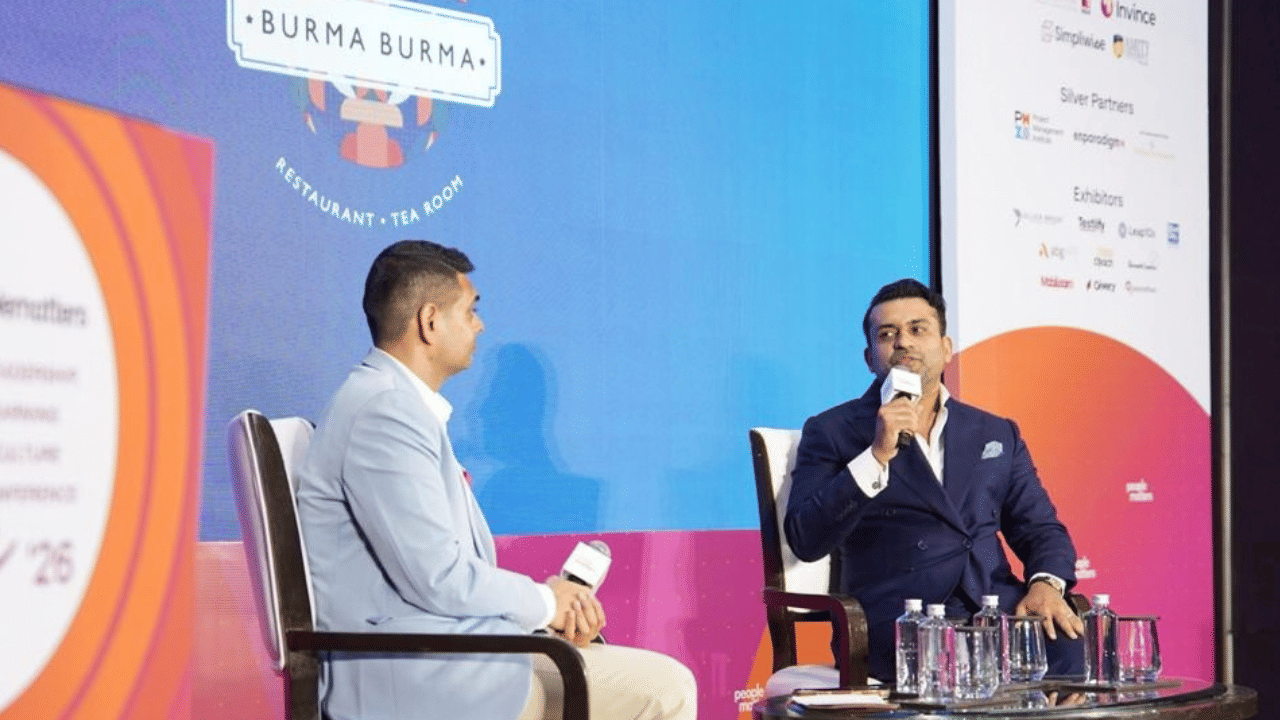
By: Raja Jamalamadaka
For over a century, organizations have relied on a deceptively simple metaphor to define professional success: the career ladder. The premise was elegant. Start at the bottom. Work hard. Climb steadily. Reach the top.
Up meant success. Down meant failure. Lateral movement was viewed as a compromise. Stability, predictability, and progression were tightly linked to vertical advancement.
For more than a hundred years, organizations have been operating under this architectural blueprint. Few concepts have shaped the world of corporate work as profoundly as this one.
Yet in today's volatile business landscape, the career ladder may be one of the most limiting models in talent management. The challenge is not merely that the ladder is outdated. It is that many of our leadership practices, talent frameworks, performance systems, and even our language remain trapped within it.
The invisible power of a language
To understand how deeply the ladder myth is embedded in our collective consciousness, we only need to listen to the everyday language echoing through our corridors and Zoom calls. Our professional lexicon is profoundly wired to believe that verticality is the only metric of human worth.
Consider the phrases we use without a second thought:
- We say someone is "down and out"—never "up and out."
We operate in "top-down" environments.
We dismiss strategic problems as being "above my pay grade."
We push business units to "move up the value chain."
We praise high-performing underdogs for "punching above their weight."
Even outside the workplace, success is associated with elevation. We speak of rising stars, upward mobility, and reaching new heights.
Language shapes perception. Perception shapes behavior. And actions. And hence our rush to climb up the ladder for career growth.
The future of work has broken the “career growth” ladder
Career growth today is increasingly characterized by four distinct qualities.
1. Contextual
Different professionals operate within different life circumstances, aspirations, opportunities, and constraints. Given this contextual difference, one individual may prioritize rapid leadership advancement. Another may seek geographic flexibility. A third may optimize for learning, while the fourth may value family commitments, entrepreneurial experimentation, or social impact. The question is no longer whether a career is progressing according to a universal standard. The question is whether it is progressing according to the individual's evolving context. Comparing career trajectories has become increasingly meaningless. It is like comparing a marathon runner with a mountaineer. Both are moving forward, but toward entirely different but unique goals.
2. Point in time In an era where AI and automation alter job descriptions overnight, a premature promotion into people management can accidentally divorce an employee from the hands-on technical skills they need to remain relevant. Such “vertical” promotions we hand out today can easily become the career bottlenecks of tomorrow.
3. Growth is personal Organizations often define growth through external markers: title, compensation, team size, and organizational influence. While these indicators remain important, they no longer tell the complete story. For professionals, growth could range from impact and freedom to learning, well-being, purpose, creativity, or flexibility. The most successful careers of the future may not be those that maximize external status, but instead maximize alignment between work and internal personal values. 4. Growth is non-linear Many breakthrough moments emerge from detours rather than direct advancement. A lateral move builds critical business understanding. A temporary setback develops resilience. A career pause creates clarity. An unexpected project unlocks a new professional identity. In modern economy, the shortest route forward is not always a straight line, it is a winding path of continuous learning.. The ladder sees these moves as deviations. The kaleidoscope sees them as design choices. Why the career kaleidoscope is the missing piece in the puzzle A Kaleidoscope exhibits several characteristics that are suitable for the current age - 1. Flexibility - Unlike a rigid ladder, a kaleidoscope is flexible. When you turn a kaleidoscope, the pieces don't move "up"- they shift, self-organise, and form an entirely new, beautiful pattern. There is no single pattern, fixed path, universally superior direction or predetermined destination – Flexibility and uniqueness is the lifeblood of a kaleidoscope. This metaphor reflects the reality of contemporary careers far more accurately. 2. Adaptability - The industrial age rewarded predictability. The information age rewarded expertise. The career ladder with its rigidity and predictability was the ultimate currency of success in the industrial and information age. You stayed in your lane, waited for your manager to retire or move on, and stepped into their shoes. The AI era that we live in rewards adaptability. The career kaleidoscope is ideal for this age because strategic adaptability is its currency. 3. Performance vs Potential: When an organisation treats careers like a ladder, it accidentally triggers the Peter Principle—promoting people to their level of incompetence simply because "up" is the only recognized direction of reward. When we shift to a kaleidoscope mindset, we unlock hidden potential. We allow people to move where their passion, current life stage, and evolving skill sets intersect with the company's real-time needs. Here is a comparison of the two modelsDimension The Traditional Career Ladder (20th Century The Modern Career Core Philosophy Linear Progression: Growth only moves vertically. Step-backs are failures; lateral moves are compromises Multidirectional Shifting: Growth is fluid and self-organizing. Success is defined by alignment and enrichment. Ultimate Currency Rigidity & Compliance: Staying in your lane, waiting your turn, and mastering a fixed job description. Strategic Adaptability: Navigating change, rapidly acquiring new skills, and adjusting to context. Organisational Risk The Peter Principle: Employees are promoted vertically until they reach a level of incompetence. Systemic Friction: Rigid legacy HR systems struggle to accommodate non-linear talent movements. Compensation Focus Headcount & Hierarchy: Pay raises are strictly tied to climbing the organizational chart and managing larger teams. Broadbanding & Skills: Pay is tied to market value of skills, cross-functional agility, and project impact. Managerial Goal Pipeline Management: Pushing employees up a predefined track to fill vacancies above them. Labyrinth Navigation: Coaching employees to configure their roles around changing life stages and market realities. Employee Motivator Status & Predictability: Chasing the next title, a bigger office, and corporate stability. Autonomy & Portfolio: Designing a resilient, personalized collection of experiences and technical mastery.
How to operationalise the kaleidoscope
HR leaders increasingly need frameworks that accommodate diverse definitions of success rather than forcing everyone into a single hierarchy. To bridge this gap, HR must actively re-engineer talent infrastructure.
Rebuild performance and compensation frameworks
Historically, significant compensation increases have been tied exclusively to vertical promotions and headcount management. HR must decouple compensation from hierarchy alone. We need robust systems that reward deep skill acquisition, cross-functional agility, and business impact, making lateral or diagonal moves financially viable and attractive for top talent.
Train managers to have "labyrinth conversations"
When an employee tells their manager they want to step back from a leadership track to focus on execution, the typical managerial response is panic or disappointment. We must train our leaders to facilitate non-linear career discussions. Managers should ask: "What configuration of your skills and life needs do we need to design next?" rather than "Where do you want to be promoted next?"
Normalise the "boomerang" and the step-back
Create internal pathways that allow individuals to gracefully step out of people-management roles back into individual contributor tracks without stigma or a punitive drop in psychological status. Celebrate these moves publicly as examples of strategic agility, transforming them from perceived failures into celebrated transformational pivots.
Not a zero sum game
HR leaders should recognize that introduction of kaleidoscopes doesn’t automatically mean elimination of the ladder - instead, ladders and kaleidoscopes need to co-exist for the foreseeable future to allow staff to choose the right mix for paths for a rich and fulfilling career.
From climbing to designing
The ultimate question facing HR leaders today is no longer how high we can help our people climb. The real question is how nimbly, safely, and creatively can we help them navigate the turns.
As architects of the workplace, we can hand our employees the kaleidoscope and give them autonomy to design a career that is resilient, dynamic, and profoundly human.
About the Author: Raja Jamalamadaka is a Harvard educated neuroscience researcher, mental wellness expert and an industry keynote speaker/writer specializing in mental wellness, professional and personal leadership, and peak performance.