








Every organisation says it wants agility. Far fewer have designed a culture in which people, power and opportunity can actually move.
For decades, culture was built to produce consistency: shared values, familiar behaviours, stable teams and predictable career paths. Those qualities still matter, but the operating environment around them has changed. AI is redistributing tasks, business models are generating new capability demands, and skills are becoming more valuable and more perishable at the same time.
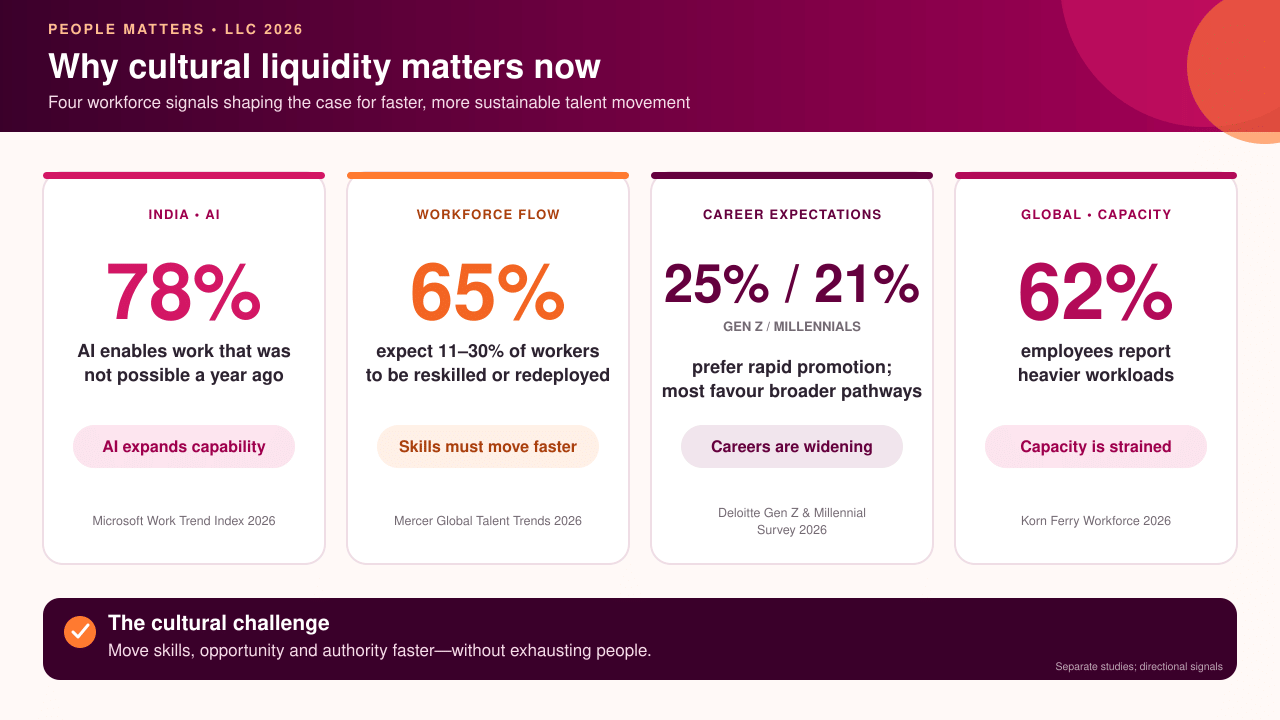
Mercer’s Global Talent Trends 2026 shows the scale of the transition ahead. While 98% of executives expect organisational design changes over the next two years, 65% anticipate that between 11% and 30% of their workforce will need to be reskilled or redeployed because of AI.
The organisational challenge is therefore moving beyond skills acquisition. Businesses must be able to redirect capability towards changing priorities without repeatedly losing talent, institutional knowledge or employee trust.
This is the case for cultural liquidity: the ability of an organisation to move skills, knowledge, authority and opportunity towards emerging value while keeping purpose, accountability and belonging intact.
It does not mean creating a culture in permanent flux. It means building one that can absorb continuous change without creating continuous disruption.
The next transformation problem is organisational absorption
India’s workforce is showing considerable appetite for AI-enabled work. A Microsoft’s 2026 Work Trend Index found that 32% of Indian AI users employ agents for multi-step workflows, twice the global average. Seventy-eight per cent say AI is enabling work that was not possible a year ago, while 87% continue to see themselves as responsible for the thinking behind the output.
These findings point to a workforce prepared to experiment, exercise judgement and redesign work. Yet individual readiness does not automatically create organisational adaptability.
Employees may learn to work with AI while remaining restricted by old job descriptions. Teams may identify a better process but lack the decision rights to change it. Managers may be asked to redeploy talent while continuing to be evaluated on the performance of their immediate teams.
The next transformation bottleneck will therefore be organisational absorption: whether systems, incentives and cultural norms can convert new capability into different ways of working.
Specific technologies will continue to change. This operating question will endure.
A skills map cannot move a person
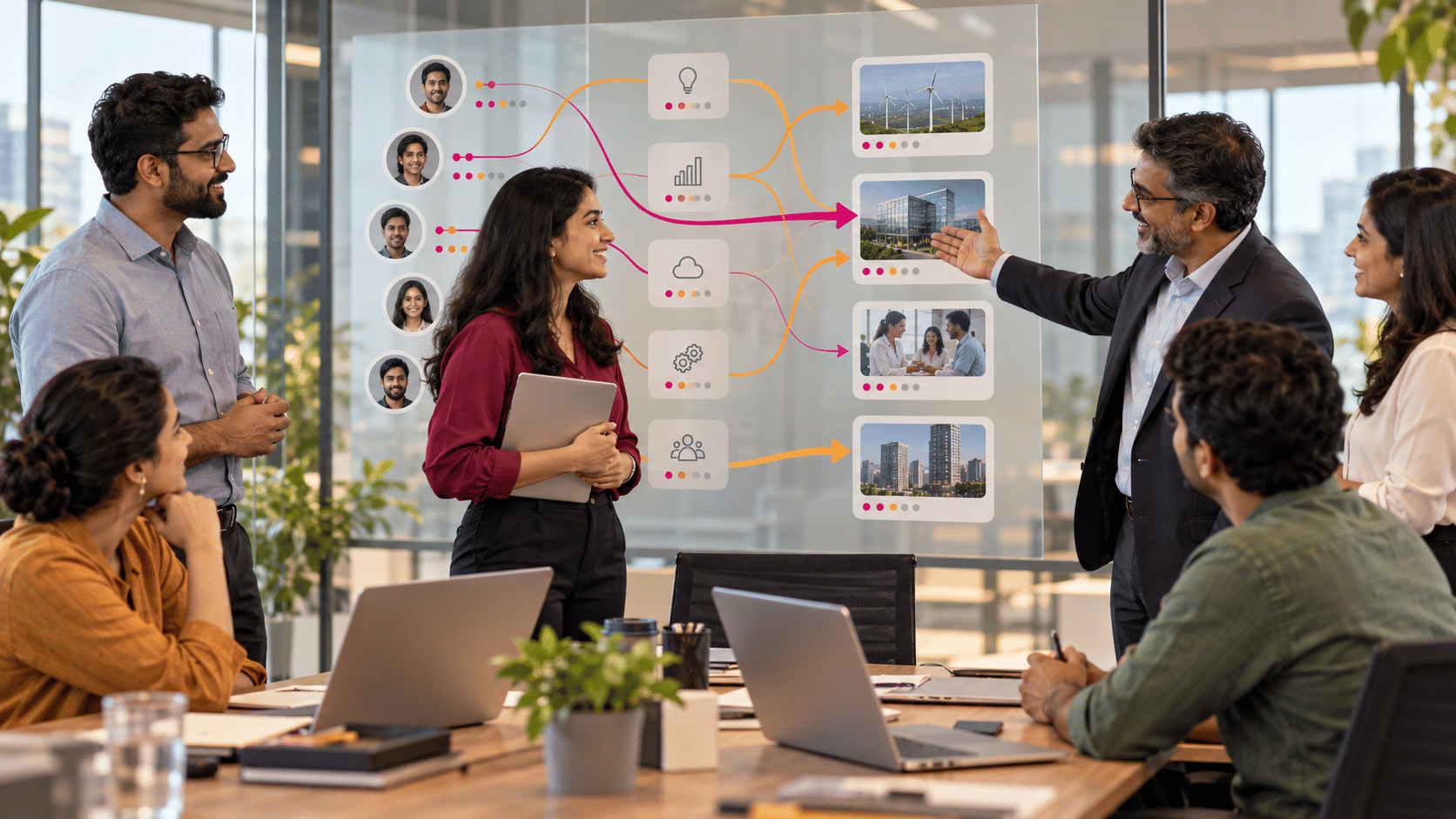 Skills intelligence is giving organisations a clearer view of the capabilities they possess, the gaps they face and the talent that could be deployed differently. But visibility should not be mistaken for movement.
A talent platform can identify an employee with adjacent capabilities, but it cannot persuade a manager to release a high performer. An algorithm can recommend a person for an internal opportunity, but it cannot remove the reputational risk that employee may associate with entering an unfamiliar role.
As a recent People Matters conversation on skills intelligence highlighted, mapping capabilities is frequently easier than changing the behaviours that shape hiring, promotion and workforce deployment. Skills-based models ask leaders to look beyond jobs and titles when making talent decisions.
Important Read: Skills intelligence moves from the HR dashboard to the boardroom
This is where cultural liquidity becomes decisive.
If managers gain status by accumulating talent, they will resist mobility. If career progression depends on remaining visible to one leader, employees will hesitate to move. If internal opportunities circulate through informal networks, skills intelligence may make capability visible without making opportunity equitable.
Data can reveal where talent could create value. Culture determines whether it is permitted to go there.
India is beginning to test redeployment at scale
The movement from AI productivity to workforce reallocation is already becoming visible in India.
Wipro recently said that its AI initiatives had freed capacity equivalent to approximately 20,000 employees, with people redeployed into other roles. The company has also trained more than 100,000 employees in advanced AI capabilities as it develops a human-AI operating model, as reported by Reuters recently.
The significance lies beyond the number. Productivity gains create a second-order leadership question: what happens to the capacity technology releases?
Organisations can treat it primarily as a cost opportunity, or they can redirect people towards emerging work, customer problems, innovation and capabilities that remain scarce. The latter requires visibility into skills, credible reskilling pathways and a culture in which redeployment is experienced as progression rather than displacement under a different name.
As more Indian organisations move from AI pilots to operating-model redesign, this distinction will become increasingly important. Cultural liquidity will be tested by whether employees can see a future for themselves inside the transformation.
Reskilling asks people to trade status for possibility
Reskilling is frequently framed as a content and access problem: identify the gap, build the programme, enrol employees and measure completion.
The deeper challenge is identity.
An experienced professional asked to develop an unfamiliar capability must temporarily surrender certainty, expertise and status. They may need to ask basic questions, make visible mistakes and learn alongside colleagues with less tenure but greater technical familiarity.
That transition carries a psychological cost. A culture that celebrates expertise but penalises beginnerhood will struggle to create continuous learners, regardless of how much content its learning platform contains.
Culturally liquid organisations make reinvention professionally credible. Leaders model learning rather than simply sponsor it. Employees receive assignments where new capabilities can be applied. Early mistakes made during responsible experimentation are treated as learning signals, not permanent judgements about competence.
Learning becomes valuable when it changes the work an employee can access. Without that connection, reskilling risks producing more qualified people who still cannot move.
Gen Z is challenging one-dimensional progress
 Discussion about Gen Z at work often becomes trapped in stereotypes about loyalty, ambition and flexibility. A more valuable interpretation is that younger employees are exposing the limits of career systems designed for a more stable organisation.
According to a Deloitte’s 2026 Gen Z and Millennial Survey, only 25% of Gen Z respondents and 21% of millennials prefer fast career progression through rapid promotions. Most favour gradual development or are willing to make lateral moves that build experience for longer-term success. Only 6% identify attaining a leadership position as their primary career goal.
This is not an absence of ambition. It is a broader definition of progress - one that includes stability, wellbeing, capability and varied experience alongside hierarchy.
For a multigenerational workforce, that shift creates an opportunity. Experienced employees bring context, judgement and institutional memory; younger colleagues often bring emerging technical fluency and fewer attachments to established processes. A liquid culture enables those strengths to circulate through mentoring, reverse mentoring, project assignments and cross-functional work.
The goal should not be to design culture around one generation. It should be to create a system in which different forms of expertise can move towards the problem that needs them.
Fluid cultures need stronger anchors
Cultural liquidity should not be confused with cultural vagueness.
When everything appears negotiable, employees experience uncertainty rather than empowerment. Movement becomes sustainable only when people understand what remains consistent as work changes.
Purpose, ethical boundaries, respect, customer commitments and accountability for decisions should form the stable core. Roles, team structures, decision rights, learning pathways and career routes can become the adaptable edges.
This combination allows people to move without losing their organisational bearings. It also prevents agility from becoming a justification for endless restructuring, unclear ownership or change without direction.
The most adaptable cultures will not abandon stability. They will become more deliberate about where stability belongs.
Speed without capacity creates cultural debt
There is a human limit to how much movement an organisation can absorb.
As per a Korn Ferry’s global Workforce 2026 study, 62% of surveyed employees had experienced significantly heavier workloads over the previous two years, while 45% said they were too busy to produce meaningful results that contribute to growth. More than half of AI-weary employees surveyed said the technology had increased their workload.
The research is global rather than India-specific, but its warning is relevant to an Indian ecosystem accelerating AI deployment, capability-building and operating-model change simultaneously.
Employees cannot continually learn, move, experiment and deliver more if every new expectation is added to an already full role. Managers cannot enable talent mobility if they lack the capacity to coach, reorganise work or absorb short-term performance gaps when people move.
Speed built on overload eventually creates cultural debt: exhaustion, scepticism and resistance that future transformations must repay.
Cultural liquidity therefore requires protected learning time, space for experimentation, thoughtful workload redesign and the discipline to stop work that has lost its value. Human sustainability is not a counterweight to workforce velocity. It is what makes repeated movement possible.
Measure flow, not cultural intent
Engagement scores and values surveys can indicate how employees feel about the organisation, but they reveal little about whether culture permits movement.
Leaders should also examine how long it takes to deploy talent into priority work, how many employees apply newly acquired skills, whether lateral moves lead to stronger careers and which managers consistently develop people who succeed elsewhere in the enterprise.
They should ask whether internal opportunities reach employees beyond the most visible networks, whether redeployment is distributed fairly and whether people can challenge an AI-supported recommendation without damaging their standing.
These are not simply talent metrics. They show whether the organisation can convert capability into performance.
Skills Intelligence 2.0 can reveal what an organisation is capable of. Strategic orchestration can determine where that capability should be directed. Cultural liquidity decides whether people, decisions and opportunities can actually move.
The organisations best prepared for continued disruption will not necessarily be those with the largest skills databases or the greatest number of AI pilots. They will be those whose people can move towards new value without first having to move out of the organisation.
This question sits at the heart of People Matters Leadership, Learning & Culture Conference 2026, taking place on 8 October at Grand Hyatt, Mumbai. As leaders examine workforce liquidity, Skills Intelligence 2.0 and strategic orchestration, the cultural conversation must become equally practical: what is preventing talent, knowledge and decisions from moving at the speed the business now requires?
For leaders ready to examine those barriers, and the systems required to remove them LLC 2026 is the conversation to join.
The next transformation problem is organisational absorption
India’s workforce is showing considerable appetite for AI-enabled work. A Microsoft’s 2026 Work Trend Index found that 32% of Indian AI users employ agents for multi-step workflows, twice the global average. Seventy-eight per cent say AI is enabling work that was not possible a year ago, while 87% continue to see themselves as responsible for the thinking behind the output.
These findings point to a workforce prepared to experiment, exercise judgement and redesign work. Yet individual readiness does not automatically create organisational adaptability.
Employees may learn to work with AI while remaining restricted by old job descriptions. Teams may identify a better process but lack the decision rights to change it. Managers may be asked to redeploy talent while continuing to be evaluated on the performance of their immediate teams.
The next transformation bottleneck will therefore be organisational absorption: whether systems, incentives and cultural norms can convert new capability into different ways of working.
Specific technologies will continue to change. This operating question will endure.
A skills map cannot move a person
A talent platform can identify an employee with adjacent capabilities, but it cannot persuade a manager to release a high performer. An algorithm can recommend a person for an internal opportunity, but it cannot remove the reputational risk that employee may associate with entering an unfamiliar role.
As a recent People Matters conversation on skills intelligence highlighted, mapping capabilities is frequently easier than changing the behaviours that shape hiring, promotion and workforce deployment. Skills-based models ask leaders to look beyond jobs and titles when making talent decisions.
Important Read: Skills intelligence moves from the HR dashboard to the boardroom
This is where cultural liquidity becomes decisive.
If managers gain status by accumulating talent, they will resist mobility. If career progression depends on remaining visible to one leader, employees will hesitate to move. If internal opportunities circulate through informal networks, skills intelligence may make capability visible without making opportunity equitable.
Data can reveal where talent could create value. Culture determines whether it is permitted to go there.
India is beginning to test redeployment at scale
The movement from AI productivity to workforce reallocation is already becoming visible in India.
Wipro recently said that its AI initiatives had freed capacity equivalent to approximately 20,000 employees, with people redeployed into other roles. The company has also trained more than 100,000 employees in advanced AI capabilities as it develops a human-AI operating model, as reported by Reuters recently.
The significance lies beyond the number. Productivity gains create a second-order leadership question: what happens to the capacity technology releases?
Organisations can treat it primarily as a cost opportunity, or they can redirect people towards emerging work, customer problems, innovation and capabilities that remain scarce. The latter requires visibility into skills, credible reskilling pathways and a culture in which redeployment is experienced as progression rather than displacement under a different name.
As more Indian organisations move from AI pilots to operating-model redesign, this distinction will become increasingly important. Cultural liquidity will be tested by whether employees can see a future for themselves inside the transformation.
Reskilling asks people to trade status for possibility
Reskilling is frequently framed as a content and access problem: identify the gap, build the programme, enrol employees and measure completion.
The deeper challenge is identity.
An experienced professional asked to develop an unfamiliar capability must temporarily surrender certainty, expertise and status. They may need to ask basic questions, make visible mistakes and learn alongside colleagues with less tenure but greater technical familiarity.
That transition carries a psychological cost. A culture that celebrates expertise but penalises beginnerhood will struggle to create continuous learners, regardless of how much content its learning platform contains.
Culturally liquid organisations make reinvention professionally credible. Leaders model learning rather than simply sponsor it. Employees receive assignments where new capabilities can be applied. Early mistakes made during responsible experimentation are treated as learning signals, not permanent judgements about competence.
Learning becomes valuable when it changes the work an employee can access. Without that connection, reskilling risks producing more qualified people who still cannot move.
Gen Z is challenging one-dimensional progress
According to a Deloitte’s 2026 Gen Z and Millennial Survey, only 25% of Gen Z respondents and 21% of millennials prefer fast career progression through rapid promotions. Most favour gradual development or are willing to make lateral moves that build experience for longer-term success. Only 6% identify attaining a leadership position as their primary career goal.
This is not an absence of ambition. It is a broader definition of progress - one that includes stability, wellbeing, capability and varied experience alongside hierarchy.
For a multigenerational workforce, that shift creates an opportunity. Experienced employees bring context, judgement and institutional memory; younger colleagues often bring emerging technical fluency and fewer attachments to established processes. A liquid culture enables those strengths to circulate through mentoring, reverse mentoring, project assignments and cross-functional work.
The goal should not be to design culture around one generation. It should be to create a system in which different forms of expertise can move towards the problem that needs them.
Fluid cultures need stronger anchors
Cultural liquidity should not be confused with cultural vagueness.
When everything appears negotiable, employees experience uncertainty rather than empowerment. Movement becomes sustainable only when people understand what remains consistent as work changes.
Purpose, ethical boundaries, respect, customer commitments and accountability for decisions should form the stable core. Roles, team structures, decision rights, learning pathways and career routes can become the adaptable edges.
This combination allows people to move without losing their organisational bearings. It also prevents agility from becoming a justification for endless restructuring, unclear ownership or change without direction.
The most adaptable cultures will not abandon stability. They will become more deliberate about where stability belongs.
Speed without capacity creates cultural debt
There is a human limit to how much movement an organisation can absorb.
As per a Korn Ferry’s global Workforce 2026 study, 62% of surveyed employees had experienced significantly heavier workloads over the previous two years, while 45% said they were too busy to produce meaningful results that contribute to growth. More than half of AI-weary employees surveyed said the technology had increased their workload.
The research is global rather than India-specific, but its warning is relevant to an Indian ecosystem accelerating AI deployment, capability-building and operating-model change simultaneously.
Employees cannot continually learn, move, experiment and deliver more if every new expectation is added to an already full role. Managers cannot enable talent mobility if they lack the capacity to coach, reorganise work or absorb short-term performance gaps when people move.
Speed built on overload eventually creates cultural debt: exhaustion, scepticism and resistance that future transformations must repay.
Cultural liquidity therefore requires protected learning time, space for experimentation, thoughtful workload redesign and the discipline to stop work that has lost its value. Human sustainability is not a counterweight to workforce velocity. It is what makes repeated movement possible.
Measure flow, not cultural intent
Engagement scores and values surveys can indicate how employees feel about the organisation, but they reveal little about whether culture permits movement.
Leaders should also examine how long it takes to deploy talent into priority work, how many employees apply newly acquired skills, whether lateral moves lead to stronger careers and which managers consistently develop people who succeed elsewhere in the enterprise.
They should ask whether internal opportunities reach employees beyond the most visible networks, whether redeployment is distributed fairly and whether people can challenge an AI-supported recommendation without damaging their standing.
These are not simply talent metrics. They show whether the organisation can convert capability into performance.
Skills Intelligence 2.0 can reveal what an organisation is capable of. Strategic orchestration can determine where that capability should be directed. Cultural liquidity decides whether people, decisions and opportunities can actually move.
The organisations best prepared for continued disruption will not necessarily be those with the largest skills databases or the greatest number of AI pilots. They will be those whose people can move towards new value without first having to move out of the organisation.
This question sits at the heart of People Matters Leadership, Learning & Culture Conference 2026, taking place on 8 October at Grand Hyatt, Mumbai. As leaders examine workforce liquidity, Skills Intelligence 2.0 and strategic orchestration, the cultural conversation must become equally practical: what is preventing talent, knowledge and decisions from moving at the speed the business now requires?
For leaders ready to examine those barriers, and the systems required to remove them LLC 2026 is the conversation to join.