








While we have been addressing several issues from physical safety, resuming work from office, lockdown to economic relief packages, we are either being ignorant or have missed out on the next big crisis knocking our door - a global psychological pandemic. How is that worse than COVID? Social distancing and quarantine will not be enough to contain it, rather that might become, or in fact has already become a trigger to the biggest psychological threat to the world.
Before we begin addressing mental health in this story, let’s get some facts in place.
Global research reports indicate some of the biggest COVID related consequences, beyond health related consequences, as below:
- Panic
- Mass unemployment
- Poverty and homelessness
- Social distancing induced isolation
The mental health consequences of above?
- Surge in suicide risk: Given the number of suicides owing to COVID-19 and the lockdown so far, experts argue that lockdown will cause more deaths than COVID-19 itself amid recession
- Enhanced anxiety and depression
- Post-Traumatic Stress Disorder (PTSD): A medical condition that delays psychological recovery from any trauma or terrifying experience. Quarantine and fear of contracting COVID-19 is already instilling a profound and lasting fear of shared spaces including hotel lobbies, restaurants, theatres, flights, trains, and so on
- Xenophobia: Prejudice against people of specific countries. With China being the epicenter of COVID-19, the country is already being held responsible by several global leaders for the massive outbreak and inadequate measures to contain it, with multiple conspiracy theories doing the rounds
Is this the first time we are experiencing quarantine?
As one big world? Yes.
In the capacity of individual nations? No.
Be it the SARS outbreak back in 2003 leading to a citywide quarantine across China and Canada or the 2014 Ebola outbreak that led to several Western Africa countries having to quarantine themselves, we are not new to the concept. While it might not have been possible to estimate the extent of the coronavirus pandemic beforehand, we are nearly four or five months into it, and yet have not emphasized the psychological threats it carries with itself. Quarantine is critical to contain further spread of COVID-19, however, are we prepared for the apparent psychological costs? Let’s find out!
Lives lost on account of fear
Research, historic and recent, has shown that the consequential impact of isolation, arising out of the need for quarantine bears a distressing outcome for mankind. Here are some incidents that have been reported over the last two months, owing to COVID-19 and how it shook the world:
- Emily Owen, 19 year old, female, Britain: The youngest reported suicide victim amid COVID-19. The young girl took this drastic step triggered by the fear of an anticipated prolonged isolation.
- K Balakrishna, 50 year old, male, Indian: Reportedly the first suicide victim of COVID-19. After consuming unfiltered and limitless content on COVID-19, Balakrishna fell prey to the human tendency of feeling scared. In the fear of feeling that he had contracted coronavirus and was a threat to his family, he took his own life.
- Zahidul Islam, 36 year old, male, Bangladesh: The first COVID-19 related suicide in Bangladesh. Zahidul on return from his travel from Dhaka, reached his hometown with fever, cold symptoms and weight loss. Based on the information they came across, Zahidul and the villagers feared he had contracted COVID-19, leading to avoidance by people of his village (on the lines of Xenophobia), without confirming if he in fact was positive or not. The circumstances led to Zahidul taking his life. The autopsy results found that he did not have COVID-19.
- Daniela Trezzi, 34-year-old, female, Italy: A nurse at the San Gerardo Hospital in Italy, feeling deeply traumatized, suffering from compassion fatigue, emotional burnout, hopelessness, and the fear of contracting and spreading the disease to others, Daniela gave up her life.
These are only a few of the reported cases so far. What did they have in common? They lived in a time of a pandemic, and were overwhelmed by how they could be a threat to others, accompanied by a sentiment of hopelessness. Does that sound familiar?
According to media reports, India alone has recorded 338 suicides during the lockdown period.
Major causes for these suicides were found to be:
- Feeling of loneliness
- Fear of testing positive for COVID-19
- Deaths triggered by withdrawal symptoms - alcohol, drugs, etc
- Starvation
- Financial distress
Understanding who is predisposed to taking extreme decisions
The physical health risk that COVID-19 has brought upon is one extreme. You notice symptoms, you get yourself tested, you find out if you need treatment or not, so on and so forth. It can happen to anyone, literally anyone, you are only safe as long as you take precautions.
Now mental health. Who is essentially at risk?
According to a 2019 WHO report, “One in four people in the world will be affected by mental or neurological disorders at some point in their lives. Around 450 million people currently suffer from such conditions, placing mental disorders among the leading causes of ill-health and disability worldwide.”
Taking into account WHO numbers, experts are of the opinion that the most vulnerable in the current times are those who have existing mental health issues - depression, anxiety, suicidal tendencies, addiction, insomnia, and anger issues, to name a few. The people in this segment often have low self-esteem, can be easily triggered by any unpleasant comment/ information, and this threat increases exponentially under isolation.
With restricted movement, their routine which they had been working on to get better, which could involve a walk in the park, visiting psychiatrists/ therapists, attending meetings with support groups, playing a sport to get fit both physically and mentally, and more, that routine to improve their mental health has been distorted, leaving them to depend solely on technology to stay connected with the outside world, the same technology where in the middle of a video call with a family member or friend, there is a news alert on COVID cases, or any other disturbing news, sending their minds back into a shell that only keeps shrinking and drawing out all hope for a better tomorrow, triggering negative, and often self-destructive thoughts.
While the danger is higher for those with an existing mental health issue, it also poses a threat for the remaining segment of the population. For instance, for families with younger children or older parents and a working couple, the stress to manage work and home, and guilt of not being able to be there 100% for family members makes their situation worse. A majority of this segment of the workforce relied on caregivers, day care providers, creches, and now have to not only continue to work, but work with the sense to be omnipresent. For nuclear families with/ without children, reports have experienced a spike in cases of domestic violence, which could be triggered by increase in alcohol consumption, substance abuse, or really just the fact that there is nowhere to go, causing increased irritability for those who suffer grave inability to rationalize thoughts, and therefore become a threat to people around.
Another at-risk segment is students. With the current timeline being one where a large number of students step into the corporate world to begin their careers, or are amid their internships, the ongoing pandemic has led to a majority of organizations having to pull back job offers and decline internship opportunities. A number of organizations, however, were able to honour their offers. This has brought about an imbalance and fear in the minds of the younger workforce with their careers being at a crossroads, with no immediate solution.
The anxiety brought on by the fear of being left behind, the competitive behavior that makes them question their abilities and fate with respect to job prospects, all these factors add-on to the stress for the younger population, especially for those who are living all by themselves.
An unfortunate experience for many amid the crisis has been losing their loved ones and not being able to travel to be present with family for the last riots. Being paralyzed by the circumstances and unable to be present physically to help each other through such difficult times also has a deep and lasting psychological impact on people.
Contribution of workplace related factors
According to a 2016 Myers Briggs survey, 31% of employees were expected to be responsive to work emails outside working hours, both by employers as well as clients. On conditions of anonymity, a significant number of employees admit this is the reality even in the present day, despite the reinforced need to draw boundaries between work and personal time.
Head of Thought Leadership at The Myers-Briggs Company, John Hackston, recently said in an interview, “In the current climate, the lines between work and leisure are increasingly blurred, and this, combined with the feelings of isolation that are caused by the limited interaction that comes with social distancing, can lead to excessively elevated levels of stress.”
“Perhaps the most important advice, however, is for leaders to recognize that remote working will affect each member of staff differently, including themselves. It is therefore crucial that managers recognize their own styles of working as to not impose their preferred work patterns onto employees. In turn, if employees understand how they work to the best of their ability, they are better equipped to cope with remote working. By understanding what strategies work for them, how they can best switch off, avoid information overload, set boundaries and find a form of work-life balance that suits them, they can reduce their stress levels, which will in turn help to combat the rise in stress during this difficult time.” added Hackston.
John Gaunt, Chief Human Resources Officer, Synechron shared with People Matters, “For employees working from home, multi-tasking would mean caring for elder parents with health conditions, looking after a toddler, or even domestic chores along with the usual office duties.
"Employers, thus, need to watch out for several signs that employees may show such as increased anger or irritability, lack of motivation, procrastination, persistent sadness, excessive worrying or anxiety, poor sleep patterns, lack of creativity or innovation, negative or pessimistic thoughts, increase in substance use/abuse or even reckless behavior,” shares Gaunt.
He further added that at Synechron, they are listening to employees always. “In fact a lot of HR policies are drafted taking into consideration our direct employee feedback to the Management. We recently launched and successfully completed a global survey that captured employee opinion and feedback related to their work from home experience and the support provided by Synechron to its employees during the ongoing Covid-19 crisis. Majority of our workforce which participated in this survey, has helped us understand the pulse of their mindset and what are the immediate action items for us to support them further.”
What can organizations do?
Before we get down to what you can do as an organization, here is an interesting note to go through. This note was circulated on Twitter by an employee of the Canadian Federal Government:
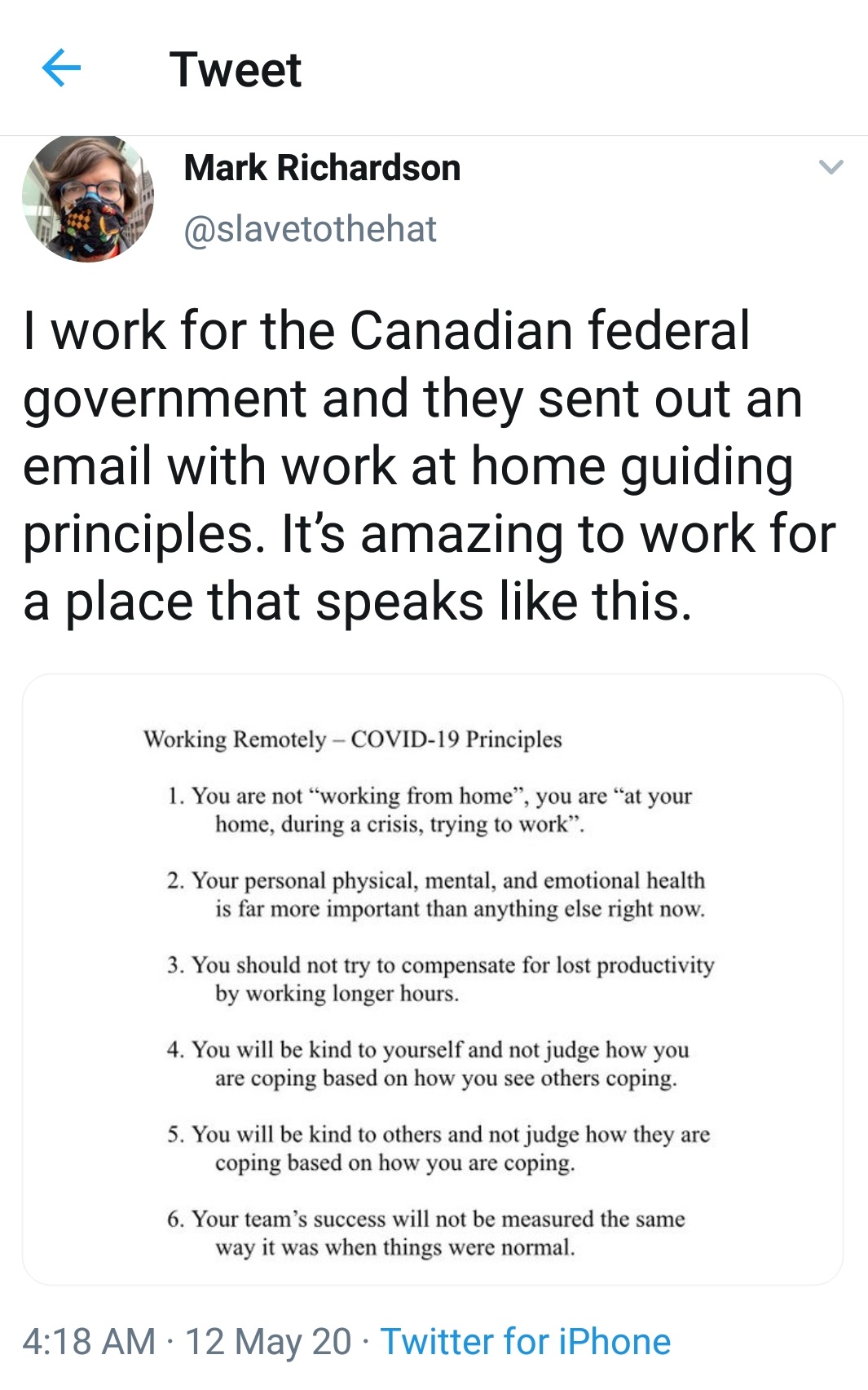
With that in mind, here are some additional action steps for organizations to protect the mental wellbeing of their people:
- Educate: Lack of awareness is the biggest contributor to the uprising of widespread mental illness and its growth. It is crucial to emphasize and caution the workforce about the rising threat to mental health that has been exponentially magnified by COVID-19 as well as the measures needed to sustain life and business post its advent into the global space. Educating the workforce and helping them understand the psychological impact of the trauma induced by the current circumstances, recognizing symptoms, encouraging conversations, engaging in healthy habits to stay mentally and physically fit and maintaining consistent communication is critical to ensure mental wellness of the community. Organizations can also issue a handbook for coping mechanisms to assist those who are struggling.
Otis India’s President Sebi Joseph in conversation with People Matters shared, “We have had an employee wellbeing program for a number of years which we revived again once the lockdown was announced. This program focuses on the mental wellness of employees and is also extended to their families. We recognize that family support and participation is crucial to make many initiatives stick, including our on-the-job safety programs. The remote wellness program aims to help employees navigate through the new normal which includes elements like the feeling of working in isolation or working remotely, lack of external stimuli, ability to stay motivated, being able to stay emotionally connected while social distancing, all of which are arising out of the remote working arrangements or working in isolation.”
He further added that based on a virtual online platform, the program provides employees and their families the ability to connect with professional psychological counsellors through phone counselling, chat, email or face-to-face video counselling as required, while also providing stress control programs for resilience building, tranquil mindfulness programs, holistic wellbeing and online assessment for stress and coping skills, and can be accessed online or via a mobile phone app too.”
- Virtual ERG’s: The prolonged social distancing and quarantine life augments the need for virtual employee resource groups to maintain the continuity of support groups and allyship.Virtual ERG's are an absolutely critical element to keep a check on rising mental and emotional outbreaks. Identify who is alone and have regular check-ins and understand how they are doing, what challenges are they facing. Aptly said by Moody’s D&I Lead DK Bartley in a recent interview, ERGs are a way to rise to the occasion.
- 24*7 helpline: Organizations need to partner with NGOs, counsellors, therapists and psychiatrists to ensure availability of a 24*7 helpline, for employees, and extending it to their family members as well, to help manage any sudden emotional, behavioural or mental breakdown. Quarantine and remote working has shaken up everyone’s routine all over the world, and while it is important to have a routine, elements of the reality today make it challenging. Work timings feel stretched, domestic needs need to be taken care of, you have to be there for the family, cook, connect with colleagues and everything within 24hours. Humans had really no other choice but to adapt to this lifestyle, which has taken a toll on their health, including sleeping pattern. In those 24hours, they also are at a battle with self-destructive thoughts, depression, anxiety, isolation, and other concerns with no possible parked time to deal with them. By providing assistance through calls (telephonic/ video), leaders can do their bit to ensure their employees have someone to speak with and share their feelings.
In conversation with People Matters, Pallavi Tyagi, EVP & CHRO India at Capgemini said, "To provide emotional support to our employees, we have launched a series of wellness initiatives. We have arranged counselling service for our employees through our empaneled counselling service provider. We are regularly conducting webinars in association with our external partner on pertinent topics like dealing with anxiety and stress and have also started a guided meditation series in association with our wellness partner which includes light pre-exercise, meditation and post-exercise. We have been regularly sharing best practices of maintaining health and hygiene during these challenging times."
In its series of initiatives, Capgemini has launched three very different programmes. Discussing the initiatives, Pallavi shares, "We have launched ‘Capgemini Bigg Boss challenge’ where employees along with their family or friends can take up exciting series of tasks and participate in contests, focused on mental relaxation. Nearly 46,000 employees have been engaged through this Pan India level program. We have also started 21 Day Habit Challenge, a virtual program designed to engage with employees on activities other than day-to-day work and to keep employee spirits up during this time. Through this program each individual participant cultivates a positive habit in a span of 21 days. This program aids in developing a positive mind-set and translates it into constructive utilization of time and energy in this pandemic crisis. The program started on April 2nd and so far, we have seen engagement with nearly 15,000 employees. We have also started a podcast series called Candid Connect, where leaders talk to employees on a range of topics like passion and motivation, experience of remote working, things our leaders do at home, stories of people who have shaped their careers and new skills developed."
- Tap into emotional intelligence: Another actionable measure at this point is training leaders and the workforce in emotional intelligence (EI). EI is not just a critical skill for leaders, but quite close to being a life skill that one must build on. The number of people who are currently facing a mental illness is quite significant, which makes it even more crucial to be trained in being emotionally intelligent to make the community a safe space for one and all, curbing the casual remarks and comments one often passes. Marjet Andriesse, Managing Director of Telstra, APAC, shares with People Matters, “Organizations need to foster a mindset of togetherness and cohesiveness, in order to keep teams feeling close and connected. We should build a system for people to look out for one another.”
Marjet further adds that work flexibility means different things to different people, so remote work arrangements need to be tailored to the individual. "Our leaders are proactively and regularly talking to their teams, to understand their needs and adjust accordingly."
"We have also launched a series of webinars, to share with our team members, about how to connect and look after their health and wellbeing when working from home. We also share tips on managing emotions at home, impart knowledge on how to implement self-care, and help parents learn ways to keep their children happy. Several virtual workouts have also been arranged for people to stay active and connected. I believe it’s the “Kampong spirit” that we need to emerge stronger from these challenging times,” she added.
- Respect personal time: Organizations today in their intent to stay connected with employees, feel an increased need to engage employees in activities to maintain a strong bond. While the intent is justified, it is important here to realize that the priority is about ensuring employees are doing well, and sometimes it might be a good idea to give that time back to employees rather than enforcing a fun/party hour. The need is to have meaningful conversations and find opportunities to destress, and any such initiatives from the organization’s side must be made voluntary. Employees suffering from a mental illness or feeling low might find it overwhelming to be asked “why so quiet” or “why don’t you share something”. As an organization all you can do is provide a platform and encourage meaningful associations with colleagues, while also respecting that for some employees, engagement might trigger greater anxiety and restlessness than help them stay in touch with colleagues. Some might want to spend that time with family instead or get done with house chores, or simply have some quiet time.
- Internship opportunities for students: This is one area which can benefit not only the passive workforce but also the organization. Identify roles and projects which can leverage the help of students. The finance part is the question here. While organizations are struggling to keep existing employees on the payroll how do they bear additional costs? For this, organizations will need to partner with educational institutions and identify an approach. If not a stipend, can they consider gaining credits for work experience? Any benefits package that can be extended to the interns if not a monetary compensation for their contribution? By engaging with the younger workforce, organizations can benefit from the extra pair of hands at work, and students can benefit from the work experience. This keeps them from feeling dejected and hopeless about their future prospects.
How can you help yourself?
If you have been dealing with any form of a mental health illness, please prioritize your health, now more than ever. You have been working on yourself to be better and it gets exhausting, but now is not the time to give up, it's time to prioritize and protect yourself. Here are some suggestions for you to get started with:
- Keep emergency contact numbers handy: As an individual suffering from a mental health issue, you are aware that a breakdown or an episode can be triggered but absolutely anything, which is why you need to be proactive and keep emergency numbers including helplines, contact numbers of family members, friends, support groups on your speed dial/ post-its, and ensure you reach out to them once you begin to notice signs of a possible outbreak or if you have recurring feelings of loneliness or a low mood. If you have been consulting a therapist, ensure you schedule regular check-ins to keep a track of your mental health and seek advice on how to keep going despite all odds.
You might not always be able to step out but that does not mean you cannot connect with the outside world.
Here’s a verified list of global helpline numbers to reach out to if you have been experiencing suicidal thoughts, increased anxiety and panic, have been feeling depressed or feel the need to seek help.
- Reach out for help: The ongoing crisis is not only a threat to the mental health of those predisposed to mental illness, but for anyone and everyone experiencing any similar symptoms. Given the uncertainty surrounding the end of COVID-19 or the lockdown and imposed distancing restrictions, one must not delay seeking help if they feel the need. With the availability of video conferencing tools, individuals can sign up on a host of apps to seek video consultation from certified therapists. The stigma or fear of judgement keeps people from making use of employer implemented EAPs. For those of you who fear that, ensure to not let that keep you from seeking help and browse through the fitness apps that offer such services.
- Limit your COVID-19 related information consumption: There are no two ways about the impact of negative news on the human mind, it is bound to trigger certain brain cells and compel one to feel depressed, sad, disappointed and even disturbed. While information is absolutely important to stay informed and alert on the latest updates surrounding the guidelines and precautions, in the current era there is no limit to the number of places offering you such information, however, their credibility might be questionable. Which is why proactively you need to not only identify reliable sources of information, such as the World Health organization and local credible authorities, but also narrow down a limit to investing time in reading or listening to it. Avoid over-burdening yourself with meaningless noise and misinformation that brings you down.
- Dedicated community time: Routines are difficult to build and maintain, however, here is one routine which is not about you liking it, but more about you needing it.
The feeling of isolation and loneliness is not new to you. You have been struggling with it from as long as you know that you are in fact facing certain mental health concerns, probably even before that. Today, the entire world is feeling how you have been feeling.
Here is an opportunity for you to not only look out for yourself, but also be there for your loved ones, check-in on them, make video calls/ voice calls, share how you are feeling, ask them how are they doing, discuss a movie, plan a Netflix party, play online games, in short stay connected with your community. The stigma still exists right? Despite all the measures to eradicate it. Here’s your chance to be an advocate for mental health, and reach out to those who might feel better just after a call with you. And for your health, make sure you factor in a dedicated time slot everyday, and make it a routine to talk to your family, friends, acquaintances, support group and anyone who you feel could use a call.
- Draw a boundary between work and personal time: The overwhelming amount of additional work that exists today is only partially because of excess work, the remaining part of it is because your work and personal lives have collided, and you weren’t given a heads up before that happened. That constant feeling of not being able to deliver, too much work, not enough time, irritability in morning huddles, the restlessness in attending video calls while also preparing meals for the family, no one could have prepared you for this. Not your mother, not your college, and definitely not your boss. Which is why you need to pause and figure out what all daily activities need your dedicated time and focus, and list them down.
Breakdown work and personal activities into time slots and then go about accomplishing those tasks one after the other, in a manner that works best for you and that aligns with your requirements at the personal as well as professional front.
We weren’t prepared for COVID-19, but are trying to protect ourselves to the extent possible by following protocol. The mental and emotional impact of isolation and quarantine life has already begun to make its way through the global population with extreme, moderate and low level responses. Before it's too late, let’s take corrective action in time and not let this become another pandemic the world was not prepared for.