








The Global Capability Centre (GCC) landscape is undergoing a seismic shift. What was once a cost-saving model for multinational corporations has evolved into a powerhouse of innovation, digital transformation, and business-critical functions. Today, GCCs are not just delivery hubs—they are strategic enablers driving enterprise-wide transformation.
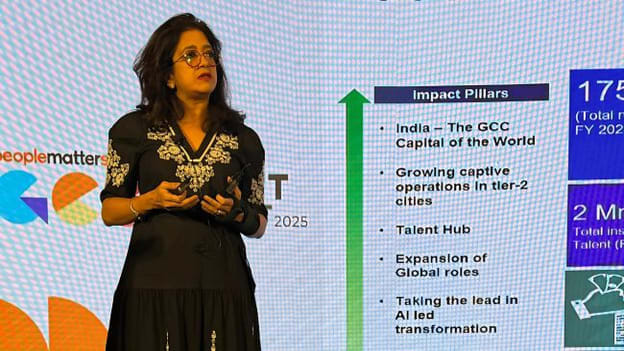
With a new GCC emerging every 10 days, the sector is reshaping the global business landscape at an unprecedented pace. "GCCs aren’t just expanding; they’re making headlines daily, redefining the future of work and innovation," remarked Shalini Pillay, Partner & India Leader - GCC, KPMG, at the People Matters' GCC Talent Summit in Bengaluru. She emphasised that this is more than just scaling up—it's a defining moment. To sustain and accelerate their exponential trajectory, GCCs need bold, forward-thinking talent strategies or risk stagnation in a hyper-competitive global market.
The Evolution of GCCs: From Delivery Centers to Business Solution Hubs
"Gone are the days when GCCs were merely execution centres. Organisations now view them as strategic partners—leading business transformation, leveraging digital capabilities, and delivering tangible value," Pillay stated. She underscored that the question is no longer whether organisations should invest in GCCs, but how they can maximise their potential.
GCCs have transformed from traditional operational centres to high-impact business solution hubs. "There was a time when searching for 'GCC' gave you an entirely different acronym. Today, these centres are evolving into true Business Solution Centres, solving real business problems through a hybrid model of in-house expertise and ecosystem partnerships," she explained.
The role of parent organisations is pivotal in shaping a GCC’s strategic direction. "If a parent company sees its GCC as merely a cost-saving delivery centre, that’s all it will ever be. But if the vision is to harness Gen AI and advanced digital capabilities to transform core processes, the GCC can become a true powerhouse of innovation," Pillay asserted.
The Talent Imperative: Managing Risk and Unlocking Potential
Talent is both the biggest enabler and the most significant risk for GCCs today. A recent survey conducted by KPMG across GCCs of various sizes (ranging from 500 to 50,000 employees) revealed that talent risk is the number one challenge leaders are grappling with. "With a new GCC emerging every 10 days, the question is: Is India’s talent advantage sustainable?"
Pillay pointed out that while India holds an unparalleled edge in digital talent, the focus must shift from mere availability to capability and quality. "Pushing large graduate numbers is no longer impressive. What matters is the depth of expertise and readiness of talent to step into high-value roles."
To bridge the gap, GCCs are increasingly investing in talent accelerator programs and collaborating with academic institutions to shape a curriculum aligned with industry needs. "The organisations that proactively define their talent strategy for the next three years will gain a competitive edge. How many have conducted a structured exercise to map their future talent requirements?" she inquired from the audience. Only a handful raised their hands, underscoring a critical gap in workforce planning.
Future-Ready Workforce: Rethinking Talent Acquisition and Retention
Attracting and retaining talent has become an escalating challenge as GCCs compete for the same talent pools. "The next GCC might set up shop right next to yours. How strong is your employee value proposition compared to theirs?" Pillay questioned. She emphasised that a powerful strategic narrative is essential to retaining top talent.
"If you cannot show employees a clear career trajectory and a dynamic work environment, they will move on. GCCs must evolve their leadership pipelines—succession planning is still a weak spot, and many struggle to fill senior roles internally."
The conversation around workforce models has shifted from rigid structures to outcome-based performance measurement. "Whether it's 90 hours or 20 hours a week, the focus should be on outcomes, not clocked hours. Organisations need to rethink workforce models to stay relevant," emphasised Pillay.
Addressing the Talent Challenge: A Multi-Model Approach
To thrive in this evolving ecosystem, GCC leaders must rethink their talent strategies and adopt a forward-looking approach. They must assess their long-term business objectives and work backward to define the talent capabilities required. A structured skills mapping exercise—aligned with the organisation’s technology roadmap—can help bridge current gaps. Additionally, a multi-model workforce approach is necessary: hiring strategically for core competencies, borrowing talent for short term specialised skills, co-creating talent pipelines through partnerships with academic institutions, and leveraging ecosystem collaborations to access niche expertise. Strengthening leadership development is also crucial, with reports indicating that 30,000 GCC leadership roles will emerge by 2030, organisations must proactively develop internal talent. “A GCC without a strong leadership pipeline is at risk of stagnation,” warns Pillay.
Embedding Innovation and Strengthening Global Influence
GCCs are no longer just adapting global strategies—they are shaping them. "Gone are the days when we tried to replicate global culture seamlessly. Today, we are embedding India’s innovation mindset back into the global organisation," Pillay noted. With many GCCs housing 60-70% of their organisation’s workforce, their influence on global business strategies is growing.
The discussion also touched upon digital maturity, cybersecurity, and risk management, which remain critical areas as GCCs scale their impact. "With every new technology adoption, there’s a fresh risk emerging. How prepared are we to handle it? Risk management and resilience must be at the core of GCC operations."
The Future of GCCs: A Call to Action for Talent Leaders
The next five years will define the trajectory of GCCs as they continue their shift toward innovation, digital leadership, and business transformation. Talent leaders are at the helm of this change. The ability to attract, develop, and retain top talent will determine whether GCCs merely sustain or truly excel.
“GCCs must evolve beyond efficiency-driven operations. The organisations that invest in talent as a strategic differentiator will be the ones leading exponential growth in the years to come,” Pillay summarised.
The journey ahead is one of reinvention. It is now up to GCC leaders to reimagine workforce strategies, embrace new operating models, and build the talent capabilities that will shape the future of global enterprises.
People Matters hosted the GCC Talent Summit 2025 on the theme “The Talent Code: Maximising Growth for GCCs” at the Leela Palace Bengaluru on February 25.